All Multilingual Name Generators & Arabic Tools — Free, No Install
Everything you need to write, learn, and explore Arabic, Japanese, English, Spanish, African, Russian, and more — all in your browser. Discover authentic baby names, cultural surnames, and unique international names from 1,000+ verified entries. No account, no download, no installation — just open and use.
Arabic Keyboard
Type in Arabic script directly in your browser. No installation or special keyboard layout required. Copy your text anywhere — emails, documents, social media.
Open toolClavier Arabe
Écrivez en arabe directement dans votre navigateur sans aucune installation. Interface en français, compatible AZERTY. Idéal pour les locuteurs francophones.
Ouvrir l’outilClavier Arabe (English)
The Clavier Arabe tool with a full English-language interface. Perfect if you prefer the layout but want English instructions and labels.
Open toolArabic Name Generator
Discover 200+ authentic Arabic names with meanings, Arabic script, and regional origins. Filter by gender, Quranic, Moroccan, Gulf, or Persian tradition. Save and share your favorites.
Generate namesChinese Keyboard
Type Chinese characters directly in your browser without installing a Chinese input method. Works on all devices — desktop, tablet, and mobile.
Open toolEnglish Name Generator
Generate authentic English names with meanings, origins, pronunciation, and male or female filters. Explore classic British, modern American, medieval, royal, and unique English names instantly.
Generate namesJapanese Name Generator
Generate beautiful Japanese names with Kanji writing, meanings, pronunciation, and anime-inspired styles. Explore traditional, modern, samurai, and unique Japanese names instantly.
Generate namesLatina Name Generator
Discover elegant Latina names with meanings, origins, pronunciation, and cultural roots. Generate modern, traditional, rare, and beautiful Hispanic girl and boy names instantly.
Generate namesSpanish Name Generator
Generate authentic Spanish names with meanings, pronunciation, and regional origins from Spain and Latin America. Explore classic, royal, modern, and rare Spanish names.
Generate namesAfrican Name Generator
Generate powerful African names with meanings, tribal origins, pronunciation, and cultural significance. Explore Swahili, Yoruba, Zulu, Akan, Ethiopian, and unique African names.
Generate namesRussian Name Generator
Generate authentic Russian names in Cyrillic with meanings, pronunciation, and historical origins. Explore classic Slavic, royal, rare, and modern Russian names instantly.
Generate namesFree Arabic Language Tools — No Install Required
TheArabicKeyboard.com offers a growing collection of free browser-based tools for anyone working with the Arabic language and other scripts. Whether you need to type a message in Arabic, find a meaningful baby name, or write in Chinese characters, every tool on this page runs instantly in your browser — no software to install, no account to create.
All tools are designed to work on mobile, tablet, and desktop, making them accessible anywhere in the world.
About Our Arabic Keyboard Tools
Our flagship tool is the online Arabic keyboard, which lets you type in Arabic script using a standard QWERTY or on-screen keyboard. For French-speaking users — particularly those in Morocco, Algeria, Tunisia, and France — the clavier arabe offers the same functionality with a French-language interface optimized for AZERTY layouts.
Arabic is written right-to-left (RTL) and uses a unique script with 28 letters that change shape depending on their position in a word. Our keyboard tools handle all of this automatically, so you can focus on writing.
About the Arabic Name Generator
The Arabic name generator is one of the most comprehensive free tools of its kind, featuring over 200 authentic Arabic names verified against established Arabic naming traditions. Each name includes the Arabic script, romanized spelling, full meaning, and regional origin (Quranic, Classical, Modern, Moroccan, Gulf, Persian, or Rare). You can filter by gender and meaning theme, save favorites, and share your list directly.
Once you find a name you love, use our Arabic keyboard to write it correctly in Arabic script.
How to choose between free online tools for Arabic
There are hundreds of free online tools for Arabic and most of them do the same three things badly. Four questions separate the free online tools worth a bookmark from the rest, and none of them is about how the page looks.
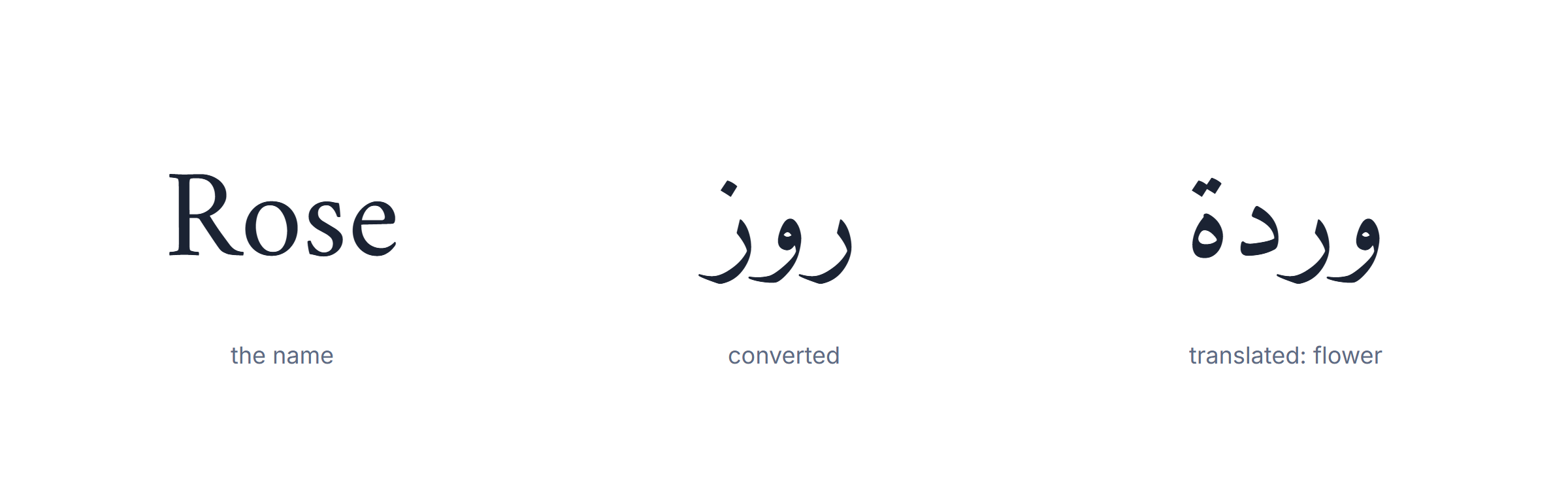
1. Does it convert, or does it translate? This is the distinction that wastes the most time. A keyboard and a transliteration converter change the script: salam becomes سلام, still the same word. A translator changes the language. Free online tools that blur the two produce وردة — the flower — when you asked for the name Rose.
2. Does it run in your browser or on their server? You cannot tell by looking, and it decides where your text goes. The test takes ten seconds: load the page, switch off your Wi-Fi, keep typing. Free online tools that keep working never sent anything anywhere.
3. Does it need an account? A keyboard needs no sign-in. Any tool asking for an email before it will convert a word is collecting the email, not providing the tool. It is the fastest way to sort free online tools from lead magnets.
4. Does it tell you what it cannot do? Arabic has genuine ambiguities — emphatic consonants, hamza placement, unwritten short vowels — that no converter resolves perfectly. Free online tools that claim otherwise have not measured themselves. Honest free online tools name their limits on the page.
Everything on this page answers those four the same way: conversion not translation, in your browser, no account, and each page states its own limits. That is the standard we hold these free online tools to, and it is the standard worth applying to anyone else’s.
Which of these free online tools keep working offline
A surprising amount of what people call an online tool is really a lookup table shipped to your browser. Once the page has loaded, these free online tools need nothing further — and that has two consequences worth knowing.
Your text never leaves the device. A keyboard layout is a mapping from key to character. A transliteration scheme is a mapping from letter to letter. Neither needs a server, so these free online tools do not use one: nothing is transmitted and nothing is stored.
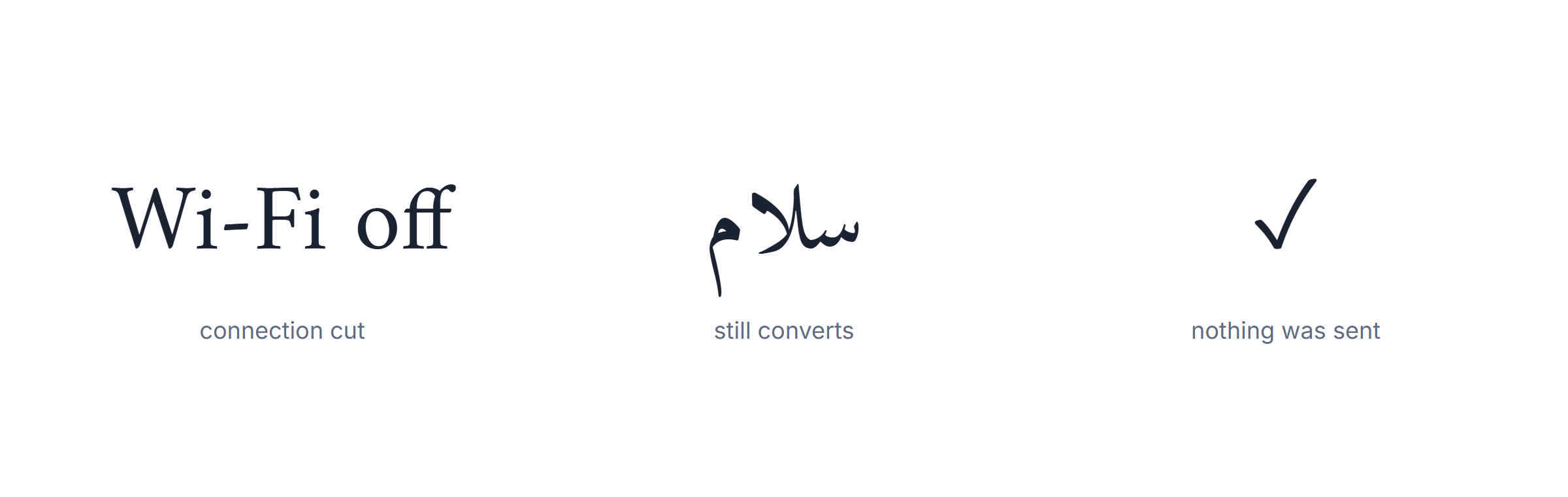
They survive a dropped connection. On a train, on hotel Wi-Fi, on a phone with no data left — load the page once and the keyboard, the harakat and the transliteration all keep working. Only the parts that genuinely need the network stop: fetching a new page, and the network voices some browsers use for reading text aloud. Everything else in these free online tools is already on your device.
What does need a connection. Anything that consults something outside your machine — a translator, a search, an online dictionary. If a tool claims to do those offline, it is caching results rather than computing them, and free online tools that hide the difference are worth less trust.
A practical habit for travel: open the pages you expect to need before you lose signal and leave the tabs open. It costs nothing and it turns a set of free online tools into something you can rely on where there is no coverage at all.
The one caveat is the same everywhere: once you copy text out, it lives in your clipboard and then in whatever app you paste it into, and that app decides what happens next. Free online tools can guarantee their own behaviour, never the destination’s.
What to use for which job
The most common question about this page is simply which of the free online tools above fits the task in front of you. Here is the short answer, by job.
You know the sound but not the letters. Use the phonetic keyboard or the transliteration converter: type salam, get سلام. This is the fastest route for anyone who speaks some Arabic and cannot yet find the letters, and it is the entry point most people want from free online tools.
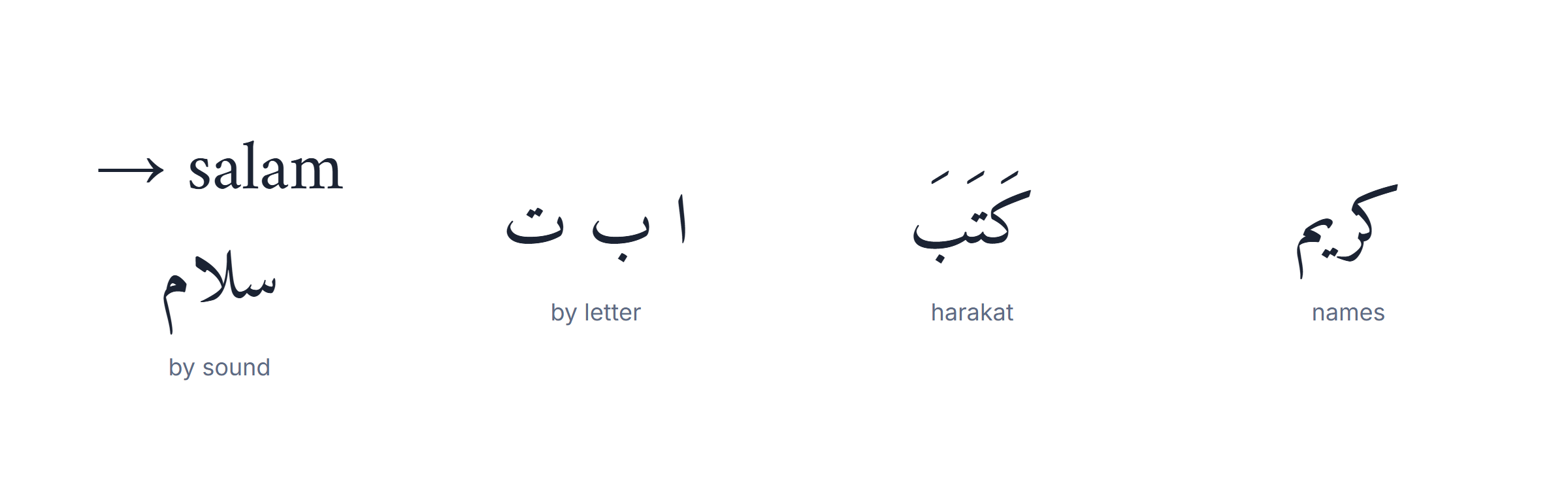
You know the letters and want speed. Use the Arabic keyboard directly. Learning the standard layout takes about three weeks of short sessions and then works on every device you will ever touch, which is more than most free online tools can promise.
You need a name written correctly. Use the dedicated name page rather than any general converter, and have the result checked. A name has no single correct spelling, and for an official document the spelling that already exists is the one that counts — no amount of free online tools changes that.
You need vowel marks. Use the harakat keyboard — but only for text meant to be read aloud or learned from. Anything meant to be found by a search should be written without them. Free online tools cannot make that judgement for you.
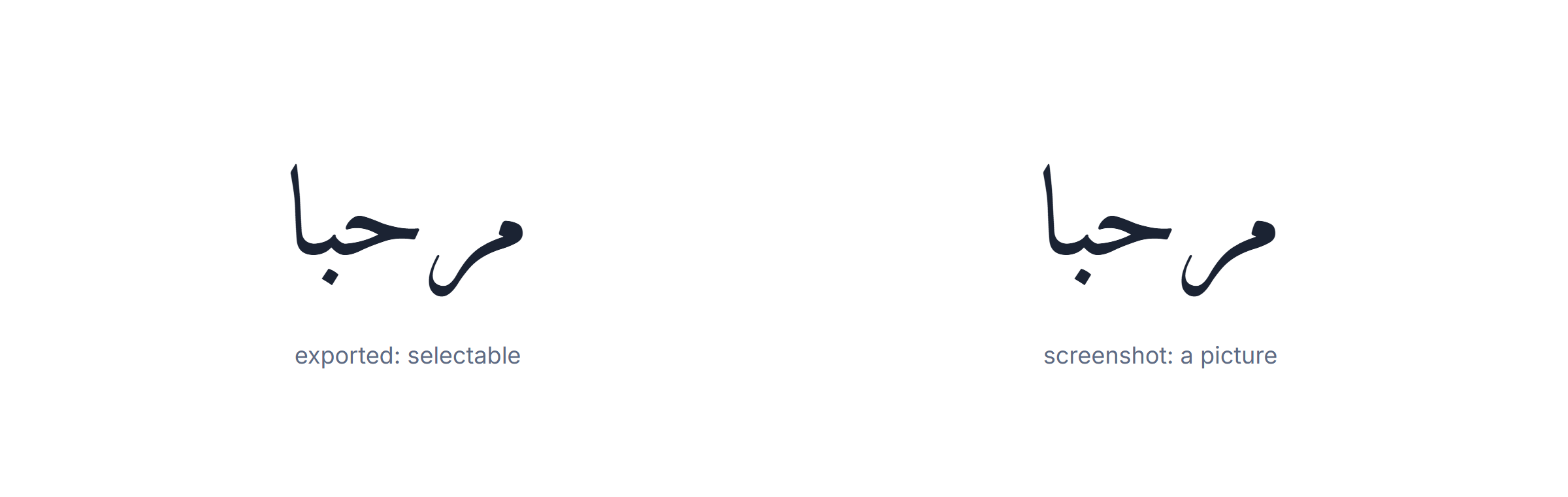
You need Arabic in a design. Use the calligraphy generator, and export rather than screenshot, so the letters stay joined. This is the one place where free online tools differ most: a screenshot of Arabic is a picture that no search engine and no screen reader can read.
You need to check something someone else wrote. Paste it back into the keyboard box. If it reads correctly there, the text is stored correctly and only the other program is displaying it wrongly — the single most useful diagnostic these free online tools offer, and the one nobody thinks to use.
All of these free online tools are free in the plain sense: no account, no trial, no export limit, nothing to install. What they are not is a substitute for someone who reads Arabic, and for anything permanent — a document, an engraving, a tattoo — that second pair of eyes is the step worth not skipping.
One last piece of advice about collecting free online tools at all: two bookmarks you actually use beat twenty you meant to try. Pick the keyboard and the one converter that matches how you think — by sound or by letter — and ignore the rest until something you cannot do makes you look for them.
And if you are here because a page you were sent looked broken, start with the font. Nine times out of ten the Arabic was fine and the destination could not draw it, which is not something any of these free online tools can fix from their side.
Frequently Asked Questions
Are all tools on TheArabicKeyboard.com free?
Yes — every tool is completely free to use with no registration, no download, and no installation required. All tools run directly in your browser on any device.
Can I use the Arabic keyboard on mobile?
Yes. All tools are fully responsive and tested on iOS and Android. The Arabic keyboard and clavier arabe are optimized for touch input on smartphones and tablets.
What is the difference between the Arabic keyboard and the Clavier Arabe?
Both tools let you type in Arabic script, but the Clavier Arabe is designed for French-speaking users with a fully French-language interface. The Arabic keyboard uses English labels and is ideal for English-speaking users.
Do I need to install anything to use these Arabic tools?
No. Everything runs in your browser. There is nothing to install, no app to download, and no account to create. Simply click any tool above and start using it immediately.
World-Class Name Generators — Authentic, Cultural & Multilingual
Beyond Arabic, TheArabicKeyboard.com has expanded into a full suite of internationally respected name generators covering the most widely spoken and culturally significant languages in the world. Whether you are searching for a meaningful baby name, a compelling character name for fiction or fantasy, or an authentic surname for a business or creative project, each generator draws from verified cultural naming traditions.
English Names — Classic, Royal, and Uniquely British or American
The English name generator covers the full breadth of English-language naming culture — from Old English Anglo-Saxon names like Aethelred and Wulfric to timeless Victorian classics like Edmund and Florence, and contemporary favourites popular in the United Kingdom and the United States. Royal English names carry centuries of heritage; unique modern English names reflect evolving cultural identity. Each name comes with its etymology, meaning, and regional usage to help you make an informed choice for a baby, character, or brand.
Japanese Names — Kanji, Anime, Samurai, and Traditional
The Japanese name generator is designed for anyone fascinated by Japanese culture, language, or storytelling. Japanese names are deeply symbolic: each Kanji character carries its own meaning, and a single name can have dozens of possible written forms. The generator displays each name in authentic Kanji script alongside its romaji (romanized) spelling and phonetic pronunciation — ideal for writers, game designers, anime fans, and parents seeking a name rooted in Japanese tradition. Both masculine and feminine Japanese names are included, spanning classical samurai surnames, elegant female names, and popular modern names used in contemporary Japan.
Spanish and Latina Names — Passionate, Traditional, and Royal
Spanish is one of the most widely spoken languages in the world, and its naming traditions are as rich and varied as the cultures that speak it — spanning Spain, Mexico, Colombia, Argentina, Cuba, and beyond. The Spanish name generator covers names from the Iberian Peninsula’s royal court traditions to the vibrant naming customs of Latin America. The Latina name generator focuses specifically on Hispanic female names with strong cultural roots — from classic names like Isabella and Valentina to rare gems like Xiomara and Soledad. Both generators include meanings, pronunciation, and regional origin for every name.
African Names — Swahili, Yoruba, Zulu, and Beyond
Africa is a continent of extraordinary linguistic diversity, home to over 2,000 distinct languages and naming traditions. The African name generator honours this richness by drawing from multiple established traditions: Swahili names from East Africa carry meanings tied to virtue and nature; Yoruba names from Nigeria encode profound philosophical and spiritual messages; Zulu names from South Africa reflect family heritage and circumstance of birth; Akan names from Ghana are often tied to the day of the week a child is born. Ethiopian names, rooted in Amharic and Tigrinya, add further depth. Every name includes its tribal origin, meaning, and pronunciation guide.
Russian Names — Cyrillic, Slavic, and Historically Rich
Russian names carry the weight of a thousand years of Slavic, Byzantine, and imperial history. The Russian name generator presents each name in its authentic Cyrillic script alongside its romanized form and meaning. From classic Slavic names like Miroslav and Svetlana to imperial names from the Romanov era and rare pre-revolutionary gems, the generator covers the full spectrum of Russian naming culture. Male and female Russian names are equally represented, along with traditional diminutives (pet names) commonly used in Russian family life.
More Frequently Asked Questions
Are these name generators culturally accurate?
Yes. Each generator is built using verified names from authentic cultural traditions. Arabic names are cross-referenced with Quranic and classical Arabic sources. Japanese names include correct Kanji. African names are sourced from Swahili, Yoruba, Zulu, and Akan traditions. Spanish and Latina names reflect real customs from Spain and Latin America. Russian names include Cyrillic script and historical Slavic origins.
Can I generate male and female names?
Yes. All name generators include gender filters so you can generate male names, female names, or both. This applies to the Arabic, English, Japanese, Spanish, Latina, African, and Russian name generators.
Do the generators include name meanings?
Yes. Every name generator includes the full meaning of each name, along with its cultural origin, pronunciation guide, and native script where applicable — Arabic script, Japanese Kanji, and Russian Cyrillic. Meanings are displayed directly on the page without any extra click required.
Are Japanese names shown in Kanji?
Yes. The Japanese name generator displays each name in Kanji characters along with the romanized spelling (romaji), meaning, and pronunciation. Both traditional and modern Japanese names are included, covering samurai surnames, anime-inspired names, and classic feminine and masculine forms.
Can I use generated names for babies, games, or businesses?
Absolutely. The name generators are built to be versatile. Use them for baby naming, fantasy or RPG character names, creative writing, game characters, business branding, screen names, and more. Each name includes its meaning and cultural context to help you choose with confidence.
Are African tribal names included?
Yes. The African name generator includes names from Swahili (East Africa), Yoruba (Nigeria), Zulu (South Africa), Akan (Ghana), and Ethiopian traditions. Each name includes its tribal or regional origin and full meaning.
Keyboard guides
Not about Arabic — about the keyboard itself.