Arabic Dialects: The 5 Main Groups and How Different They Really Are
There is no single spoken Arabic. There is a written standard almost nobody speaks at home, and a family of Arabic dialects that differ roughly as much as the Romance languages do. This is what actually separates them.
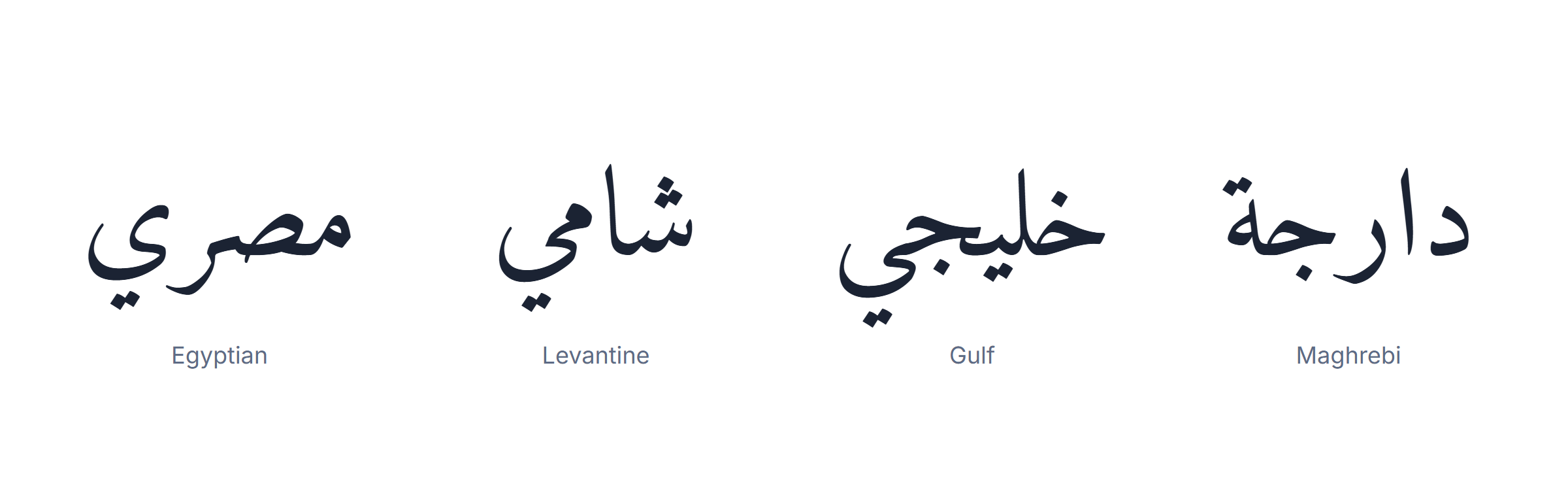
The written standard nobody speaks
The two layers in one line each
- Fuṣḥā — written, formal, taught at school, nobody’s mother tongue.
- The Arabic dialects — spoken, learned first, almost everything online.
The first thing to understand about Arabic dialects is that the language you would learn from a textbook is not the language anyone uses at home. Arabic lives in two layers at once, and linguists call the arrangement diglossia.
Modern Standard Arabic — fuṣḥā — is the written and formal layer. It is the language of newspapers, novels, contracts, the news broadcast and the classroom. It is nobody’s mother tongue. Children learn it at school the way an Italian child learns Latin, except that they also read and hear it constantly.
The Arabic dialects are the spoken layer. They are what a child actually learns first, what people argue and joke in, and what almost everything on social media is written in. They have their own grammar, their own vocabulary and their own sound systems, and none of them is a “corrupted” version of the standard — they are the living descendants of the same ancestor.
The practical consequence catches every learner off guard: you can complete two years of Standard Arabic, land in Cairo, and not follow a conversation between two taxi drivers. That is not a failure of your study. It is the structure of the language.
The five main Arabic dialects
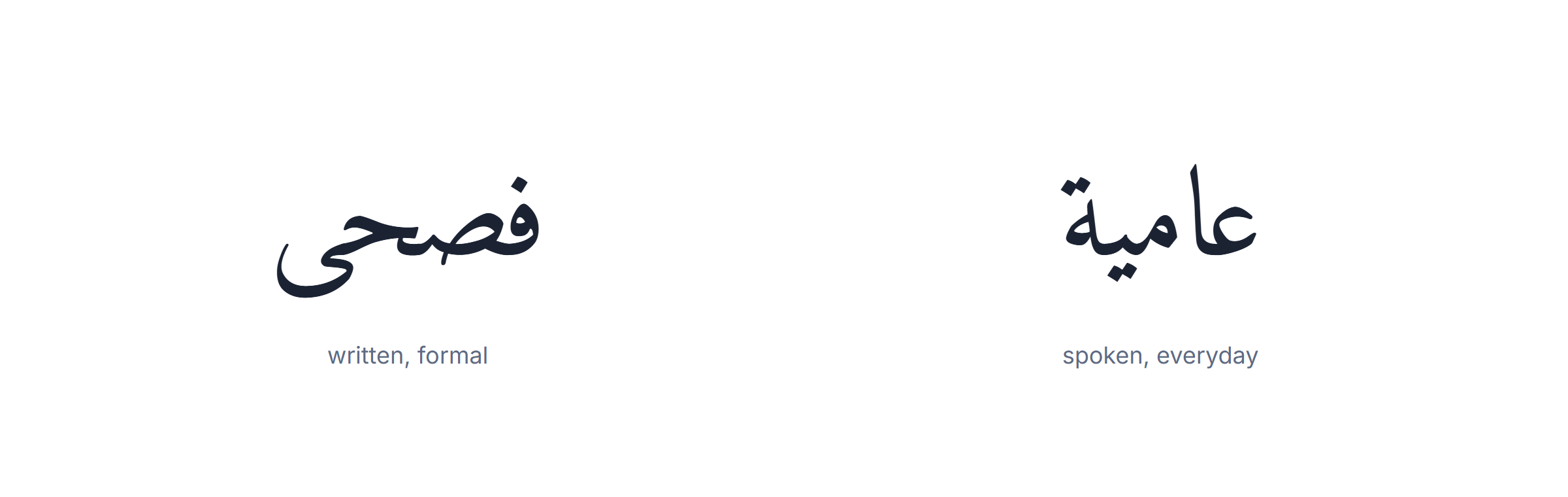
The borders between Arabic dialects are gradients, not lines — speech changes gradually from one town to the next, and the labels below are convenient groupings rather than fixed categories. With that caveat, five groups cover most speakers.
| Group | Where | Rough speakers | Reputation |
|---|---|---|---|
| Egyptian | Egypt | ~100 million | The most widely understood |
| Levantine | Syria, Lebanon, Jordan, Palestine | ~40 million | Soft, widely liked |
| Gulf | Saudi Arabia, UAE, Kuwait, Qatar, Bahrain, Oman | ~35 million | The most conservative |
| Maghrebi | Morocco, Algeria, Tunisia, Libya | ~90 million | The hardest for outsiders |
| Iraqi | Iraq, parts of Syria and Iran | ~30 million | Between Gulf and Levantine |
Three more Arabic dialects do not fit the five neatly: Sudanese, which sits between Egyptian and the Gulf; Yemeni, which is highly conservative and internally very varied; and Hassaniya, spoken in Mauritania and Western Sahara, which is far enough from everything else that even other Maghrebis struggle with it.
Egyptian — the one everyone understands
Egyptian Arabic has an advantage no other of the Arabic dialects has: for most of the twentieth century, Arabic cinema, music and television were made in Cairo. A Moroccan, an Iraqi and a Kuwaiti all grew up hearing it. That single fact makes it the closest thing the Arab world has to a shared spoken language.
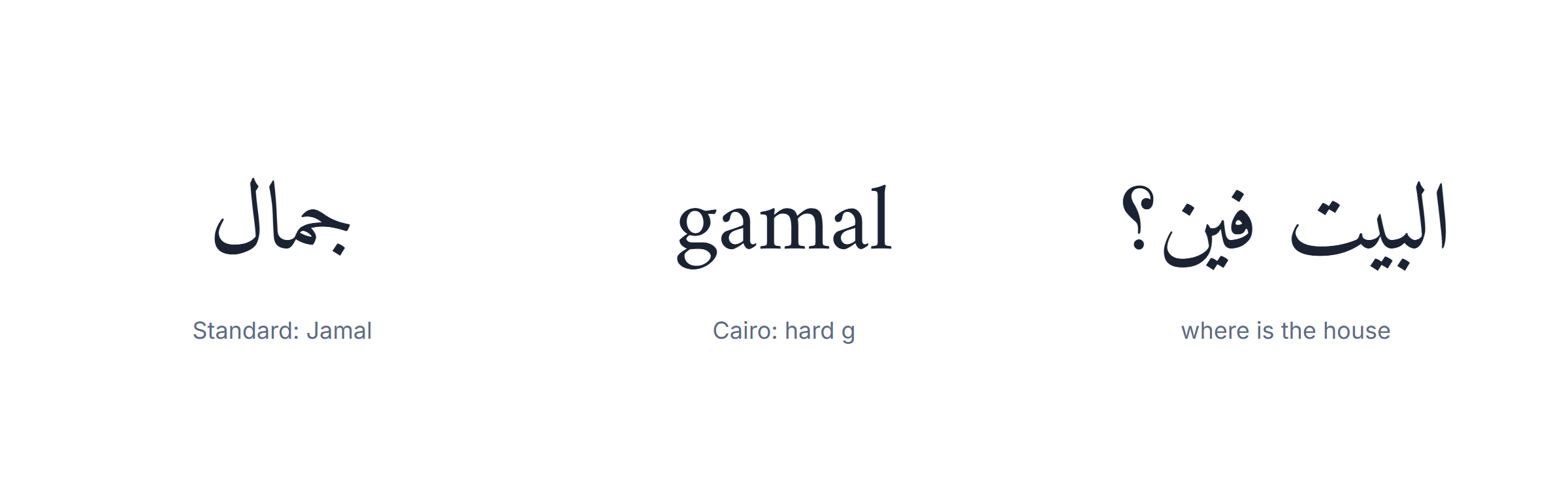
Its most famous marker is a single letter. ج (jīm), pronounced roughly like the j in “jam” almost everywhere else, is a hard g in Cairo. Gamal, not Jamal. Once you hear it you can identify an Egyptian speaker in one word.
Two more markers are easy to spot. ق (qāf), a deep k made at the back of the throat in Standard Arabic, is usually a glottal stop — the catch in the middle of “uh-oh”. And question words move to the end of the sentence: where Standard Arabic asks ayna al-bayt, Egyptian asks al-bēt fēn — “the house where”.
What marks Egyptian out among the Arabic dialects
- Jīm as a hard g — Gamal, not Jamal. The single fastest tell.
- Qāf as a glottal stop — the catch in the middle of “uh-oh”.
- Question words at the end — al-bēt fēn, “the house where”.
- Negation wrapped around the verb — ma- before and -sh after.
- Present tense with bi- — bayktib, “he writes”, where Standard Arabic has no such prefix.
Where it is spoken
Egypt, roughly 100 million native speakers, with Cairene as the prestige form. Upper Egyptian (Ṣaʿīdī) differs enough to be recognised instantly and is not what learners are taught.
Why start here
For a learner, Egyptian is the most practical of the Arabic dialects to start with, by a wide margin. There is more material, more media, more music and more people to practise with than for any other variety, and being understood outside Egypt is close to guaranteed.
Levantine — the middle ground
Of the Arabic dialects, Levantine covers Syria, Lebanon, Jordan and Palestine, and while a Damascene and a Beiruti will tell you at length how different they sound, the group holds together well for an outsider.
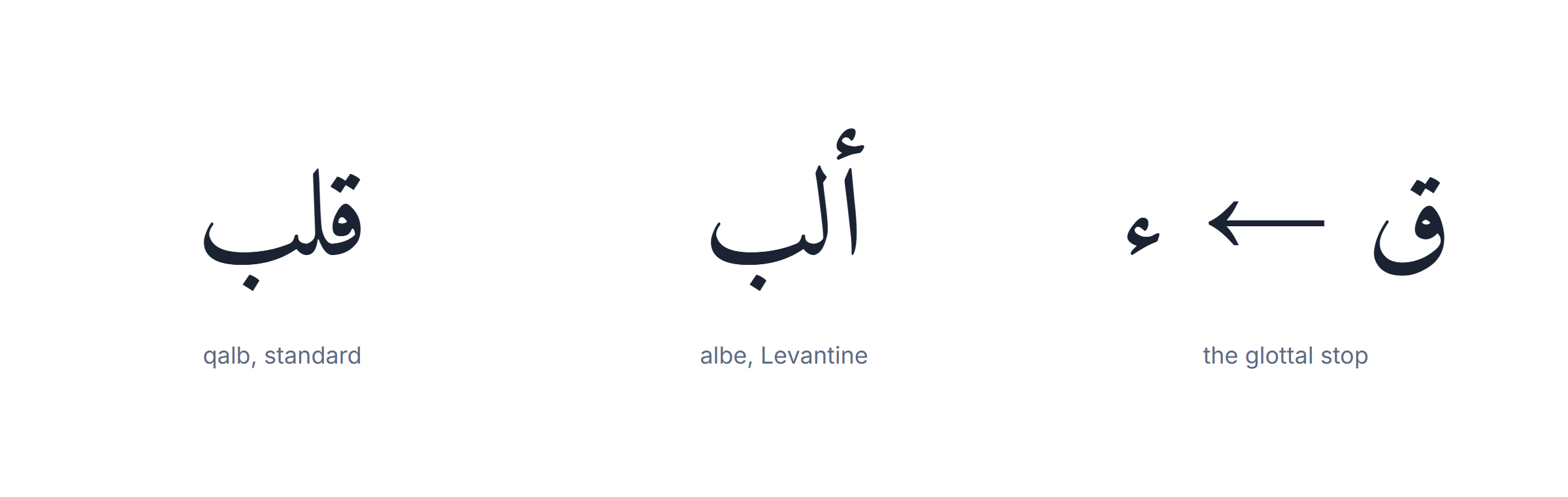
Its signature is what happens to ق. In most urban Levantine speech it becomes a glottal stop, so qalb (heart) is heard as albe. Rural and Bedouin speech often keeps it, and Druze speech keeps it distinctly — which is why the same letter functions as a social marker as much as a regional one.
What marks Levantine out among the Arabic dialects
- Qāf as a glottal stop in the cities — albe for qalb, heart.
- Rural and Druze speech keeps the qāf, so one consonant signals community as well as region.
- Imāla — long ā tilting toward ē, the sound people mean by “the Lebanese accent”.
- Turkish and French loanwords — ʾōḍa (room), asansēr (lift).
Its internal spread
Damascus, Beirut, Amman and Jerusalem are all Levantine and all distinguishable to a local ear. For a learner the group holds together well; for a Syrian and a Lebanese it does not, and they will tell you so at length.
Levantine also softens vowels at the end of words in a way that gives it the gentle sound it is known for regionally, and it borrows visibly from Turkish and French — the residue of Ottoman rule and the French Mandate. It is the second most widely understood dialect after Egyptian, helped in recent decades by Syrian and Lebanese television drama.
Gulf — the conservative one
Gulf Arabic keeps more of the older sound system than the Arabic dialects to its west, which is why it is often described as conservative. ق is usually a hard g, and in several varieties ك shifts towards a ch sound before front vowels — chalb for kalb, dog.
It has also absorbed vocabulary from Persian, Hindi, Urdu and English through centuries of trade across the Gulf and the Indian Ocean, and more recently through the enormous expatriate workforce. A word like saykal for bicycle arrived from the subcontinent, not from Arabic.
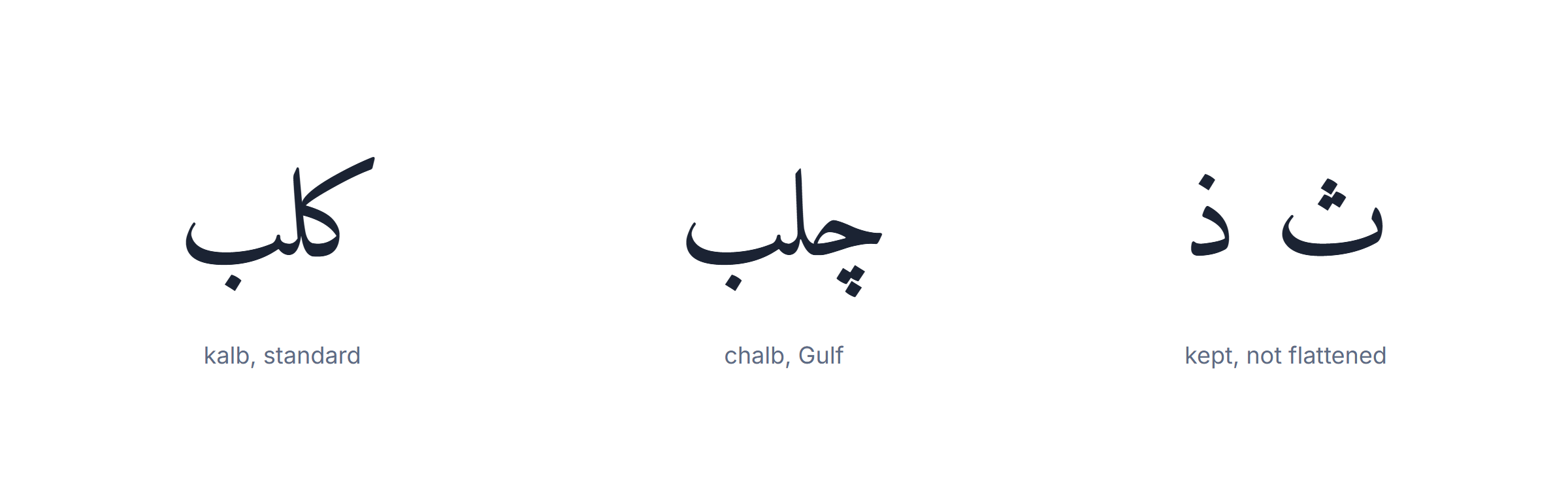
What marks Gulf out among the Arabic dialects
- Qāf as a hard g — gāl, he said.
- Kāf shifting to ch before front vowels — chalb for kalb, dog.
- Th kept — ث and ذ survive where Egypt and the Levant flatten them.
- Loans from Persian, Hindi, Urdu and English — saykal (bicycle), dirēsha (window).
Its internal spread
Kuwaiti, Emirati, Qatari, Bahraini and the Saudi east coast form the core. Najdi (central Saudi) and Hijazi (Jeddah, Mecca, Medina) sit alongside it and are distinct enough that Saudis place each other by a sentence.
For learners, Gulf Arabic is the most useful choice for work in Saudi Arabia or the Emirates and the least useful for consuming media, because far less popular entertainment is produced in it.
Maghrebi (Darija) — the outlier
Maghrebi Arabic — darija in Morocco, Algeria and Tunisia — is the one of the Arabic dialects that breaks the mutual-intelligibility chain, and the reasons are structural rather than a matter of accent.
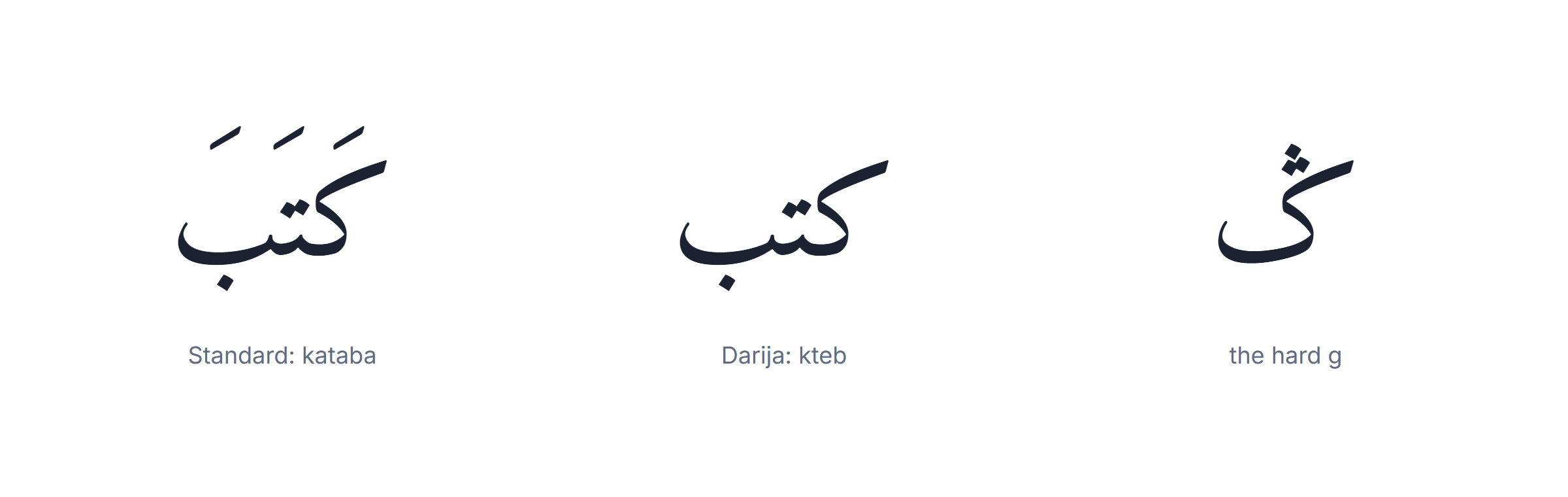
Short vowels collapse. Standard Arabic kataba (he wrote) becomes kteb. Whole syllables disappear, and words that a Mashriqi ear expects to be three syllables arrive as one consonant cluster. This alone accounts for most of the difficulty.
The substrate is Berber. Amazigh languages were spoken across North Africa before Arabic arrived and never stopped being spoken. They contributed vocabulary, some grammar and a good deal of the rhythm.
The borrowing is European. French in Morocco, Algeria and Tunisia; Spanish in northern Morocco; Italian in Libya. A Moroccan sentence can carry three languages without the speaker noticing — tilifun, tumubil, kuzina.
There is also a sound Standard Arabic does not have: a hard g, which is written several ways because no standard exists. You will see ݣ, گ, or simply ق because it is what the keyboard offers.
What marks Maghrebi out among the Arabic dialects
- Short vowels collapse — kteb for kataba, whole syllables gone.
- A Berber substrate in vocabulary, some grammar, and the rhythm.
- French, Spanish and Italian loans depending on which country.
- A hard g that Standard Arabic has no letter for, written three different ways.
- Western digits rather than the Eastern ١٢٣ used in the Mashriq.
Its internal spread
Moroccan, Algerian, Tunisian and Libyan run west to east and shade into each other; Tunisian is closest to the Mashriq and Moroccan furthest from it. Hassaniya, in Mauritania and Western Sahara, is far enough out that other Maghrebis struggle with it too.
If you plan to write darija rather than only speak it, our darija keyboard handles the sounds Standard Arabic has no letters for, and the franco-arabic converter takes the Latin-and-numbers spelling most people actually type.
Iraqi and the ones between
Among the Arabic dialects, Iraqi sits between Gulf and Levantine and shows influence from both, plus a substantial Persian and Turkish layer and traces of Aramaic older than either. Like Gulf Arabic it usually renders ق as a hard g, but its vowel system and vocabulary pull it towards the Levant.
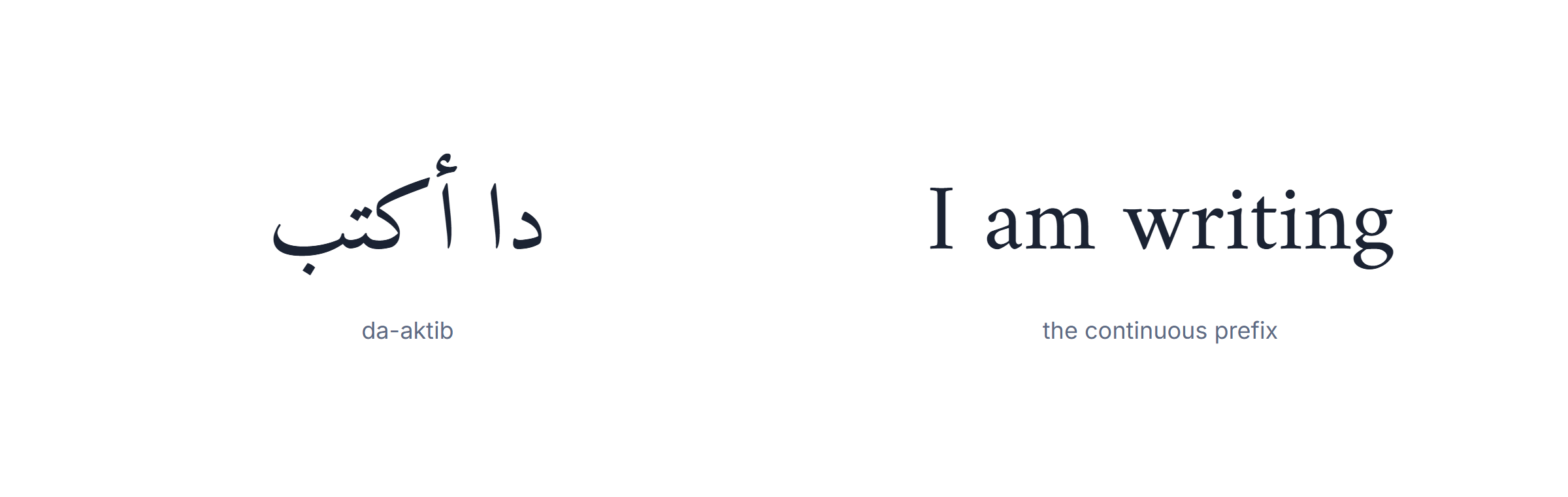
What marks Iraqi out among the Arabic dialects
- Qāf as a hard g, shared with the Gulf.
- The prefix da- for a continuous action — da-aktib, “I am writing”.
- Persian, Turkish and Aramaic vocabulary in layers, the oldest predating Arabic in the region.
Its internal spread
Iraqi divides internally more sharply than most groups: the Arabic of Baghdad, of Mosul in the north and of Basra in the south differ enough that speakers can place each other immediately, and the northern varieties share features with Syrian speech across the border.
The four sounds that give a speaker away
You do not need vocabulary to place a speaker among the Arabic dialects. Four letters do almost all the work, and each one is pronounced differently enough across the groups that a single word identifies the region.
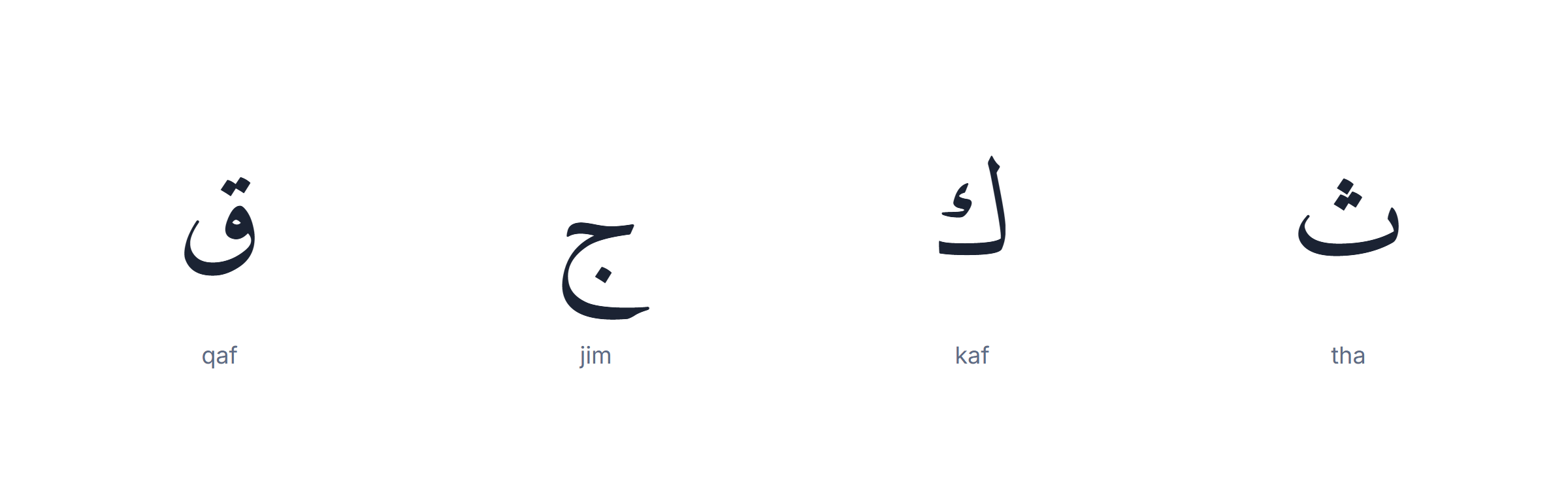
| Letter | Standard | Egyptian | Levantine | Gulf | Maghrebi |
|---|---|---|---|---|---|
| ق | deep k | glottal stop | glottal stop (urban) | hard g | deep k or g |
| ج | j as in jam | hard g | zh, as in measure | j or y | zh |
| ك | k | k | k | ch before front vowels | k |
| ث | th as in think | t or s | t or s (urban) | kept as th | t |
Two of these are worth more than the rest. The ج test is instant: a hard g means Egypt, almost without exception. The ث test separates conservative from innovative: keeping the English th sound points to the Gulf or to a rural speaker, while flattening it to t or s points to a city.
Notice that the same letter can carry a social meaning as well as a regional one. In Levantine speech, pronouncing ق rather than dropping it marks a rural, Bedouin or Druze background, so a listener hears geography and community in a single consonant.
The same sentence in five dialects
Tables of sounds only go so far. Here is one ordinary sentence across the Arabic dialects — what do you want? — across the groups, which shows that the differences are not accent alone but different words entirely.
| Dialect | Arabic | Roughly |
|---|---|---|
| Standard | ماذا تريد؟ | mādhā turīd |
| Egyptian | عايز إيه؟ | ʿāyiz ēh |
| Levantine | شو بدك؟ | shū biddak |
| Gulf | وش تبي؟ | wesh tabi |
| Iraqi | شنو تريد؟ | shinu trīd |
| Maghrebi | شنو بغيتي؟ | shnu bghiti |
Across the Arabic dialects, not one of the six shares a full word with the Standard version except Iraqi, which keeps turīd. The question word alone runs through five different forms — ēh, shū, wesh, shinu, shnu — and the verb for “want” changes completely in every group.
This is the reason two years of Standard Arabic does not produce conversation in any of the Arabic dialects. The grammar transfers; the everyday vocabulary largely does not. It is also why learners who start with a dialect and add Standard Arabic later usually report the second stage as much easier than the reverse order.
A useful calibration: the distance between Egyptian and Moroccan is roughly the distance between Spanish and Portuguese, or Italian and Romanian. Speakers can decode a good deal in writing, follow a slow speaker with effort, and lose a fast conversation entirely.
How much do speakers actually understand each other?
The honest answer is that intelligibility between Arabic dialects is asymmetric, and the asymmetry is caused by media exposure rather than by linguistic distance.
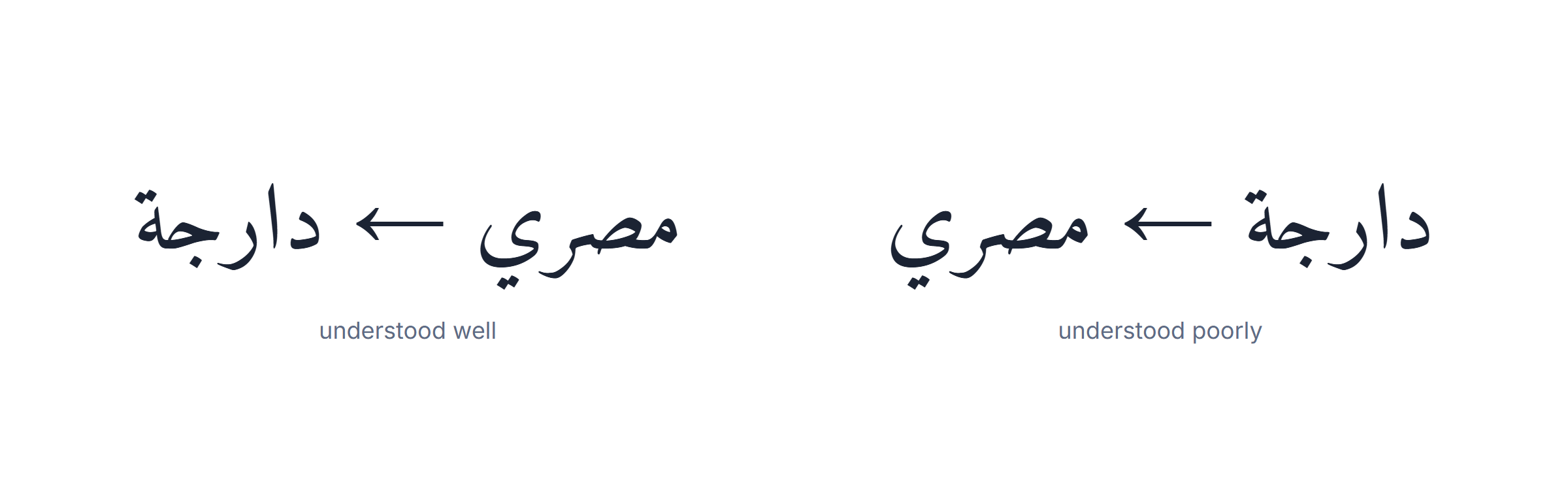
A Moroccan understands Egyptian well, because Egyptian films and songs were unavoidable for fifty years. An Egyptian understands Moroccan poorly, because almost no Maghrebi media travelled east. The linguistic distance is identical in both directions; the familiarity is not.
Where the gap is too wide, speakers do what bilinguals everywhere do: they meet in the middle. That usually means a slowed, vocabulary-simplified Egyptian, or a drift towards Modern Standard Arabic — which everyone has studied and nobody speaks comfortably, and which is why formal Arabic turns up in casual conversation between an Algerian and a Kuwaiti.
The Arabic dialects, most to least widely understood
- Egyptian — near-universal, on the back of fifty years of media.
- Levantine — close behind, helped by Syrian and Lebanese drama.
- Gulf — understood across the Mashriq, less so in North Africa.
- Iraqi — roughly level with Gulf.
- Maghrebi — understood in the Maghreb, poorly east of Libya.
- Hassaniya — difficult even for other Maghrebis.
What speakers do when the gap is too wide
- Slow down and strip vocabulary back toward the shared core.
- Drift toward Modern Standard Arabic, which everyone studied and nobody speaks comfortably.
- Switch to Egyptian as a lingua franca — the most common outcome in practice.
- Switch to English or French, which happens more often than anyone admits.
Which Arabic dialect should you learn?
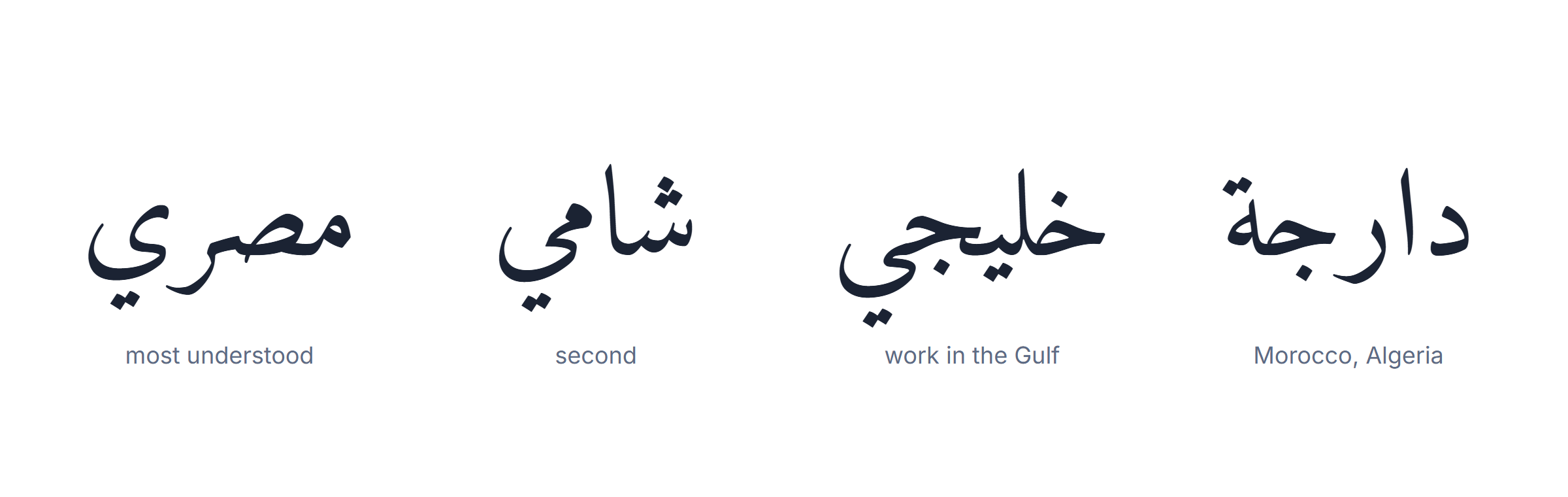
The Arabic dialects question has a short answer and a longer one. The short answer is: the dialect of the people you will actually speak to. Nothing else outranks that.
If there is no such group, the ordering below reflects how much practice material exists, which is what decides whether you keep going.
| If you want to… | Learn | Why |
|---|---|---|
| Be understood almost anywhere | Egyptian | Fifty years of shared media |
| Read news, books, documents | Standard Arabic | It is the only written layer |
| Work in the Gulf | Gulf | Local workplace speech |
| Live in Morocco or Algeria | Darija | Egyptian will not help you here |
| Study the Quran or classical texts | Standard Arabic | Classical Arabic is its ancestor |
One warning that saves months: do not try to learn a dialect and Standard Arabic at the same time from zero. The two overlap enough to interfere and differ enough to confuse. Choose the one matching your first real use, get comfortable, then add the other — at which point the shared vocabulary makes the second far quicker than the first.
Where to hear each of the Arabic dialects
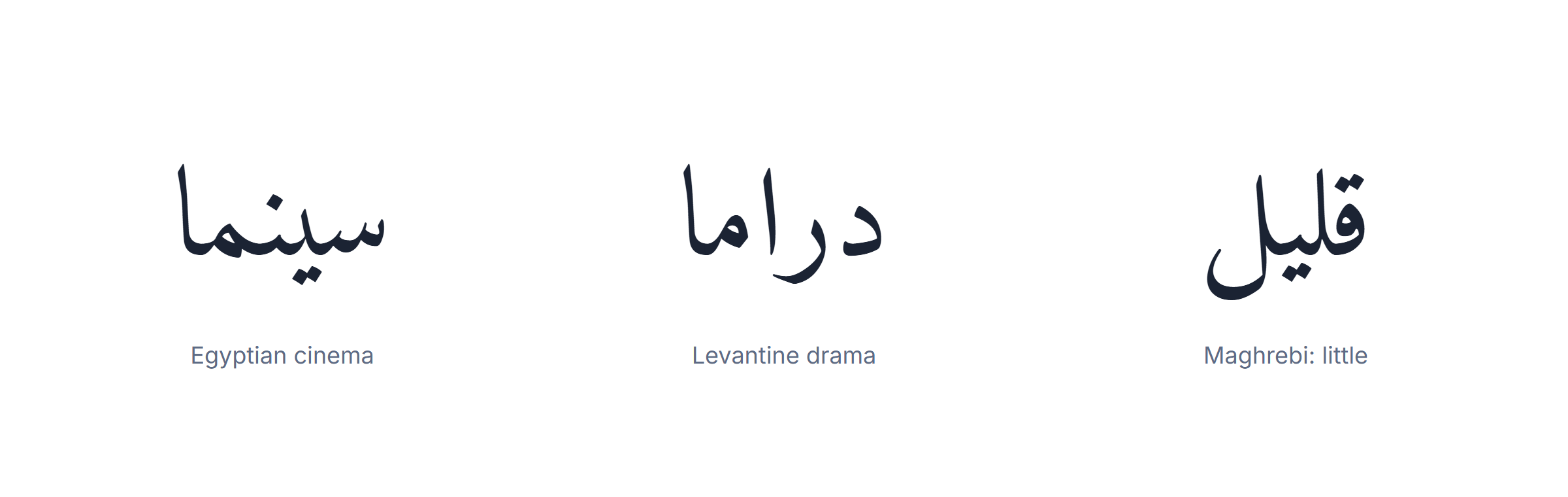
Choosing among the Arabic dialects is easy; finding enough of one to learn from is the part that decides whether you continue. The supply is very uneven, and it is worth knowing that before you commit.
Egyptian has more listening material than the rest combined — decades of cinema, an enormous music catalogue, and most of the Arabic dubbing of foreign content. If you want to learn by immersion rather than by textbook, this is the only dialect where immersion is effortless.
Levantine is second and closing the gap, carried by Syrian and Lebanese television drama, which is now widely watched across the region, and by a very active podcast and YouTube scene.
Gulf has grown recently through Khaliji series and a large Saudi social-media output, but there is still far less of it, and much of what exists assumes local knowledge.
Maghrebi is the hardest to find outside the region despite having roughly as many speakers as Egyptian. Moroccan and Algerian media circulate locally and travel poorly, which is precisely the mechanism that keeps Maghrebi hard for other Arabs to understand.
Iraqi is the thinnest of the five for a learner, and most available material is news rather than conversation.
Two habits matter more than the material itself, whichever of the Arabic dialects you picked. Use subtitles in Arabic, not in English, once you can read at all — reading and hearing the same sentence is what attaches the written form to the spoken one. And re-watch a short clip several times rather than watching new material constantly; comprehension comes from repetition of the same speech, not from volume.
One caution about Arabic dialects textbooks: many that claim to teach “Arabic” teach Standard Arabic with a dialect chapter appended. Check which variety the dialogues are actually in before buying, because the two are not interchangeable and the cover rarely says.
How dialects are written down
Every one of these Arabic dialects is written constantly, and none of them has an official spelling. That contradiction shapes everything about Arabic on the internet.
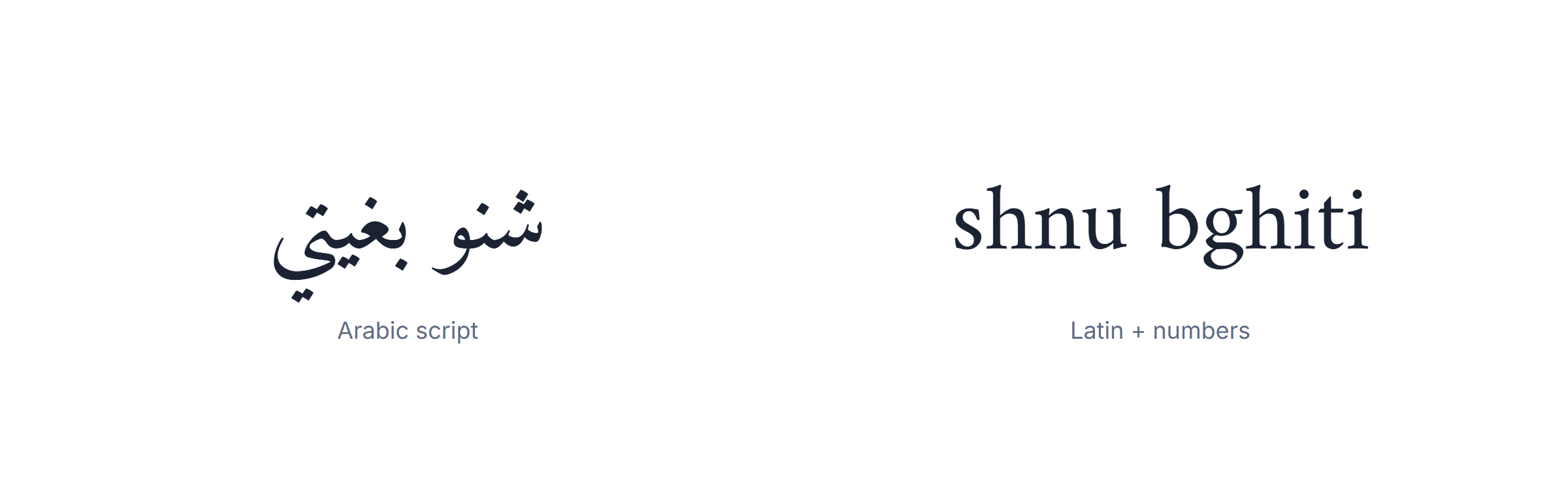
In Arabic script, by ear. People write the dialect using the standard alphabet and spell words the way they sound. Because there is no authority to consult, the same word appears several ways, and readers cope easily — they are reading a transcription of speech, not a document.
In Latin letters with numbers. The system invented by teenagers with phones that could not display Arabic: 3 for ع, 7 for ح, 9 for ق. It survived the phones that caused it because a generation now types it faster than the Arabic layout.
Which one you meet depends on which of the Arabic dialects you are reading. Maghrebi is written in Latin letters more than any other dialect, partly because French keyboards were what people had. Egyptian and Levantine skew towards Arabic script. Gulf sits in between.
Neither convention appears in print. A newspaper, a novel or a government form is in Standard Arabic, which is the other half of the diglossia: the dialects own speech and the internet, the standard owns everything printed.
One last point that surprises people: none of this is decay, and the Arabic dialects are not broken Arabic. Every branch of a living language does this, and the Arabic situation is unusual only in how long the written standard has stayed still. Latin split into French, Spanish and Italian in roughly the same span; Arabic kept a shared written form throughout, which is why the dialects are still called dialects and the Romance languages are called languages.
Quick answers on the Arabic dialects
How many speakers, roughly
| Group | Native speakers | Share |
|---|---|---|
| Egyptian | ~100 million | largest single group |
| Maghrebi | ~90 million | close second, least understood |
| Levantine | ~40 million | widely understood |
| Gulf | ~35 million | growing with the region |
| Iraqi | ~30 million | internally varied |
The figures are approximations and every source gives slightly different ones, because the boundaries between the Arabic dialects are gradients and censuses record countries rather than varieties. The ordering, though, is stable across sources — and the thing worth noticing in it is that Maghrebi has nearly as many speakers as Egyptian while travelling a fraction as far. Speaker count does not decide reach; media production does.
Is one dialect “purer” than the others?
No, and the question comes from a misunderstanding. Gulf and Yemeni varieties preserve more of the older sound system, which people sometimes read as purity. But every one of the Arabic dialects descends from the same ancestor by the same process; none is a degraded copy of Standard Arabic, because Standard Arabic is not their parent — it is their formal sibling.
Can I get by with just Egyptian everywhere?
- In the Mashriq — Egypt, the Levant, Iraq, the Gulf — largely yes.
- In the Maghreb, you will be understood and answered in something you cannot follow.
- In writing, no: formal text is Standard Arabic wherever you are.
Which is hardest for an English speaker?
- Maghrebi — collapsed vowels, Berber substrate, least material available.
- Iraqi — thin learner resources rather than intrinsic difficulty.
- Gulf — conservative sound system, moderate material.
- Levantine — good material, gentle phonology.
- Egyptian — easiest, purely because of supply.
Do the Arabic dialects have their own grammar books?
Some do and the coverage is very uneven. Egyptian and Levantine are well served; Gulf is adequate; Iraqi and Maghrebi are thin, and most Maghrebi material is written in French for a francophone audience rather than in English.
Will learning a dialect hurt my Standard Arabic?
- Not once either one is established.
- It does interfere badly if you start both at zero simultaneously.
- Native speakers mix the two constantly, so the “contamination” worry is not a real one.
What about Arabic for reading the Quran?
That is Classical Arabic, the ancestor of Standard Arabic, and no dialect is a route to it. If Quranic reading is the goal, Standard Arabic is the path and the Arabic dialects are irrelevant to it — a rare case where the answer is genuinely one-sided.
Is there an “Arabic” I can use in writing that everyone accepts?
- Yes — Modern Standard Arabic, for anything formal or printed.
- For messaging, write the dialect the way the person you are writing to does.
- There is no third option, and inventing one is what makes text read as machine-translated.
Where the grammar of the Arabic dialects differs
Pronunciation gets the attention, but grammar is where a Standard-Arabic student actually stalls. Four differences account for most of it.
1. Case endings are gone
Standard Arabic marks the role of a noun with a vowel ending — -u, -a, -i. No dialect uses them. Two years of drilling iʿrāb transfers to nothing in conversation, which is the single biggest shock for classroom learners.
2. The dual and the feminine plural mostly go
- Standard Arabic has singular, dual and plural, and separate feminine plural verb forms.
- Most Arabic dialects keep a dual for nouns and drop it everywhere else.
- The feminine plural verb survives in some Gulf and Bedouin speech and nowhere else.
3. Negation is built differently
| Variety | “I did not write” | Pattern |
|---|---|---|
| Standard | لم أكتب | particle + jussive verb |
| Egyptian | ما كتبتش | ma- … -sh around the verb |
| Levantine | ما كتبت | ma- before, no suffix |
| Gulf | ما كتبت | ma- before |
| Maghrebi | ما كتبتش | ma- … -sh, as in Egypt |
The wrapped ma- … -sh shared by Egypt and the Maghreb across two thousand kilometres, with the Levant and Gulf not using it, is one of the better clues that the Arabic dialects did not spread outward in a simple line.
4. The present tense takes a prefix
Standard Arabic has no marker for “he writes” as an ongoing action. Egyptian and Levantine add bi-, Iraqi adds da-, Gulf usually adds nothing. It is a small change that makes the same verb unrecognisable to an ear trained only on the standard.
Numbers, dates and money across the Arabic dialects
Two digit sets, split by geography
- Eastern ٠١٢٣٤٥٦٧٨٩ — Egypt, Sudan, Yemen, the Gulf.
- Western 0–9 — Morocco, Algeria, Tunisia, Libya.
- Both are correct Arabic. Neither is “more authentic” than the other.
Numbers do not reverse
Arabic runs right to left and a number inside it still reads left to right: 2026 is 2026. If a figure appears flipped, the display is at fault and the stored text is fine.
The separators are different characters
- Decimal ٫ — not a comma.
- Thousands ٬ — not an apostrophe.
- Percent ٪ — not the Latin sign.
Counting itself changes
Standard Arabic makes the numbers 3–10 take a plural noun and reverse gender agreement, a rule that defeats most learners. The Arabic dialects simplify it heavily and inconsistently, so the counting you learn for one variety will be slightly wrong in the next.
Money and dates
- Currencies differ by country and the names are not shared vocabulary.
- Month names split: the Levant and Iraq use Aramaic-derived names, Egypt and the Maghreb use the Latin-derived ones.
- The Hijri calendar runs alongside the Gregorian in official use in several countries.
How the Arabic dialects formed
The split is not decay and it is not recent. It is the ordinary fate of any language carried fast over a large area, and three forces did most of the work.
1. Speed of expansion
- Arabic went from the Arabian peninsula to the Atlantic in roughly a century.
- Garrison towns were founded far apart and rarely spoke to each other.
- Each town’s Arabic drifted from the others’ with nothing to hold them together.
2. The languages already there
- Coptic under Egyptian Arabic.
- Aramaic and Syriac under Levantine and Iraqi.
- Berber (Amazigh) under Maghrebi — the deepest substrate of the group.
- Persian alongside Iraqi and Gulf, through trade and rule.
A substrate does not only donate words. It shapes rhythm, syllable structure and which sounds survive, which is why the Arabic dialects differ most in exactly the places their substrates differed most.
3. Later contact
- Ottoman Turkish across the Levant, Iraq and Egypt.
- French in the Maghreb and Lebanon; Spanish in northern Morocco; Italian in Libya.
- English across the Gulf, and now everywhere online.
The three forces, in one list
- Distance — an empire crossed in a century, garrison towns far apart.
- Substrate — Coptic, Aramaic, Berber, Persian, each under a different group.
- Later contact — Ottoman Turkish, then French, Spanish, Italian, now English.
What did NOT cause the split
- Not carelessness. No language community has ever preserved a spoken form across an empire for fourteen centuries.
- Not isolation from the standard. Every region kept teaching it; the speech drifted anyway, which is what speech does.
- Not a lack of prestige. Egyptian and Levantine carry enormous cultural weight and are still called dialects.
It is worth saying plainly because the framing matters: describing the Arabic dialects as broken or lazy Arabic is not a linguistic position, it is a social one, and it is the reason so many learners arrive expecting the spoken language to be a simplified version of the written one. It is not. It is a parallel one with its own rules, and treating it that way is the single change that makes the language learnable.
Why the written standard never split
This is the part that makes Arabic unusual. Latin fractured into French, Spanish and Italian because each region eventually wrote its own speech. Arabic never did — the Quran fixed a written form that every region kept teaching, so the writing stayed one language while the speech became many. That is the whole reason we call them Arabic dialects and not Arabic languages.
Where the Arabic dialects are going
Three things happening now
- They are being written more than at any point in history. Messaging and social media put dialect in text at a scale that print never allowed.
- Egyptian’s dominance is loosening. Streaming has broken the Cairo monopoly on production; Gulf and Levantine series now travel on their own.
- The prestige gap is narrowing. Dialect appears in advertising, in subtitles and increasingly in published fiction, which was unthinkable two generations ago.
What is not happening
- The Arabic dialects are not converging into one spoken language.
- Standard Arabic is not disappearing — it still owns everything printed and official.
- No dialect is acquiring an official spelling, and none looks likely to.
What to watch over the next decade
- Whether dialect spelling starts to standardise by convention rather than by decree.
- Whether streaming keeps eroding the Cairo production monopoly.
- Whether machine translation learns the dialects, which would change how they are written.
What it means if you are learning
The practical answer has not changed and probably will not: learn the variety of the people you will actually speak to, and add Standard Arabic for everything written. The supply of material for the smaller Arabic dialects is improving faster than the linguistic distances are shrinking, which means the main obstacle a learner faces today is easier than it was five years ago even though the language itself has not moved.
Mistakes learners make with the Arabic dialects
The five that cost the most time
- Learning Standard Arabic and expecting to speak it. It will be understood and not answered in kind.
- Studying two varieties at once from zero. They overlap enough to interfere.
- Choosing a dialect by how it sounds rather than by who you will speak to.
- Trusting a textbook labelled just “Arabic”. Check which variety the dialogues are in before buying — the cover rarely says.
- Waiting to be perfect. Every one of the Arabic dialects is spoken by people who will meet a beginner halfway.
Three habits that shorten the road
- Pick the variety first, before buying anything.
- Re-watch short clips instead of consuming new material constantly.
- Use Arabic subtitles, not English ones, as soon as you can read at all.
The one that is not a mistake
Mixing Standard Arabic into dialect speech feels wrong to learners and is completely normal for natives. Educated speakers slide up and down the register constantly, and reaching for a formal word when the dialect one will not come is what everyone does.
If you want to write any of them yourself, the practical route is to type the sounds and let a converter produce the Arabic — that is what the English-to-Arabic converter does, and the on-screen Arabic keyboard covers the cases where you want to place a specific letter yourself.