How to Learn Arabic: The Complete 6-Month Plan for Beginners
Most people who quit Arabic quit in month two, and almost always for the same reason: they never decided which Arabic they were learning. Here is the decision, the honest timeline, and what to do in your first four weeks.

First decide which Arabic you are learning
This is the decision that quietly wrecks most beginners, and almost nobody makes it deliberately.
Modern Standard Arabic (MSA) — الفصحى, al-fus·ḥā — is the Arabic of news, books, official speeches and almost every textbook and app. It is nobody’s mother tongue. An Egyptian and a Moroccan will both understand it, and neither will use it to order coffee.
The dialects — Egyptian, Levantine, Gulf, Moroccan Darija and others — are what people actually speak. They differ enough that a Moroccan and an Iraqi may struggle with each other’s, but they share most of their grammar with MSA and nearly all of their script.
The one answer that fails is “both, equally, at the same time”. Pick a primary. The other one gets much easier once the first is solid.
Whichever you choose, the script is the same. That is the good news, and it is why the alphabet is where everyone should start regardless.
The honest time cost
The US Foreign Service Institute groups languages by how long its diplomats — full-time, in class, with tutors — need to reach professional working proficiency. English speakers reach that level in Spanish or French in roughly 600–750 hours. Arabic is in the hardest group, Category IV, at around 2,200 hours, alongside Mandarin, Japanese and Korean.
Do not let that number scare you off, but do let it kill the fantasy. Some honest arithmetic:
| If you study… | …you reach ~2,200 hours in | Realistic milestone at 6 months |
|---|---|---|
| 20 min/day | about 18 years | read slowly, greetings, ~300 words |
| 1 hour/day | about 6 years | read comfortably, simple conversations |
| 3 hours/day | about 2 years | follow slow news, hold a real conversation |
Two things follow. First, 20 minutes a day is not a plan to become fluent — it is a plan to become literate and conversational, which is a perfectly good goal and worth saying out loud. Second, professional fluency is not the only prize. Reading the script takes weeks, not years. Understanding the words in a song takes months. Those are real, and they arrive early.

Weeks 1–4: the alphabet, properly
The 28-letter Arabic alphabet is genuinely the easiest part of the language, and it is where the fastest visible progress lives. Most people can read Arabic aloud — slowly, without understanding much — inside a month.
Three things make it feel harder than it is:
- Letters change shape by position. Each letter has up to four forms: isolated, initial, medial and final. They are not four new letters. They are the same skeleton with the joining strokes added or removed, and after two weeks you stop noticing.
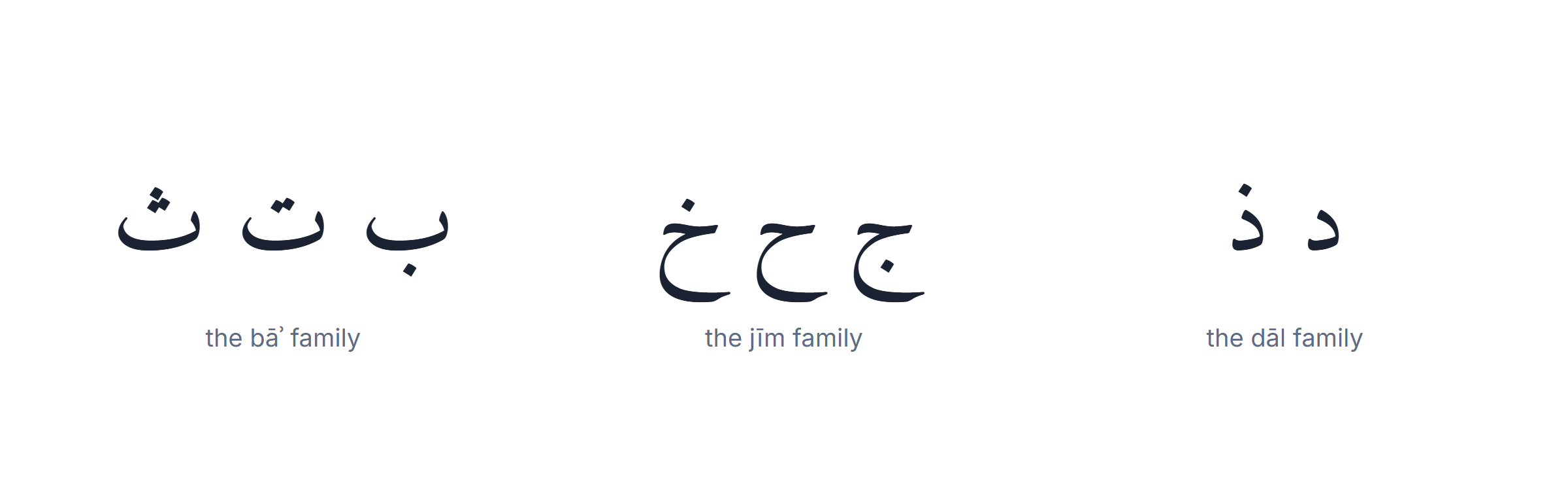
- Some letters are distinguished only by dots. ب ت ث are one shape with one dot below, two above, three above. Learn them as a family, not as three unrelated symbols.
- A few sounds do not exist in English. ع (ʿayn), ح (ḥāʾ), ق (qāf) and the emphatic ص ض ط ظ need to be heard, not read about. No transliteration will teach them to you.
What to actually do
- Learn the letters in groups by shape, not in alphabetical order: ب ت ث, then ج ح خ, then د ذ, then ر ز, and so on. Six groups covers the alphabet.
- Write each one by hand. Not typed — by hand, right to left, ten times. Arabic is a cursive script and your hand learns the joins faster than your eye does.
- Say every letter out loud as you write it. The emphatic letters in particular are muscle memory, and silent study builds none.
- Type it as well. Recognising ه and producing it are different skills, and typing forces production without the handwriting getting in the way.
Weeks 5–12: reading without the vowels
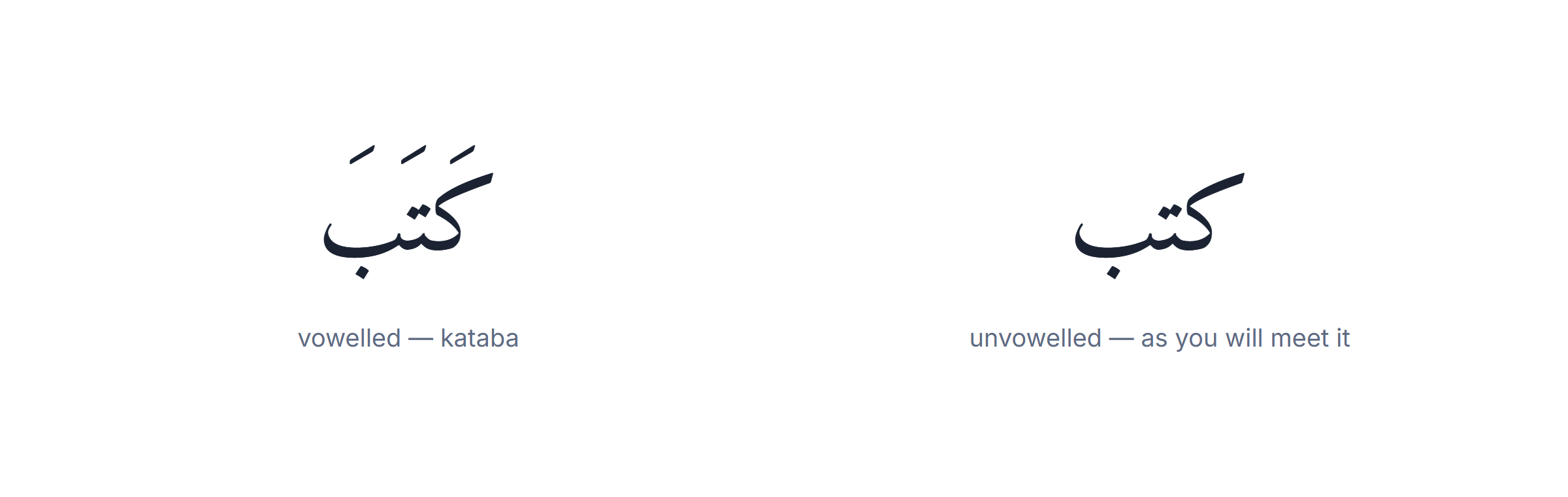
Here is the thing textbooks tend to introduce gently and learners discover brutally: real written Arabic leaves out the short vowels.
The marks above and below letters — harakat, الحركات — appear in the Qur’an, in children’s books, in dictionaries and in learning materials. They appear almost nowhere else. A newspaper gives you consonants and long vowels only, and expects you to supply the rest from vocabulary and grammar you have not learned yet.
This is why learners who felt fine in month one hit a wall in month three. It is not that your reading got worse. The training wheels came off.
If you want to see exactly which mark does what, we keep a working Arabic keyboard with harakat where every diacritic is on a key — fatha, kasra, damma, sukun, shadda and the tanwin endings — so you can type a word both ways and compare.
Months 4–9: the words that actually pay
Vocabulary in Arabic behaves differently from vocabulary in French or Spanish, and using that difference is the single biggest efficiency gain available to you.
Almost every Arabic word is built from a root of three consonants, poured into a pattern. Take the root ك-ت-ب (k-t-b), which carries the idea of writing:
| Word | Pattern | Meaning |
|---|---|---|
| كَتَبَ kataba | faʿala | he wrote |
| كِتاب kitāb | fiʿāl | book |
| كاتِب kātib | fāʿil | writer |
| مَكتَب maktab | mafʿal | office, desk |
| مَكتَبة maktaba | mafʿala | library, bookshop |
Five words, one root, one afternoon. Once you know that ma- patterns tend to mark a place and -ā-i- patterns tend to mark the doer, you stop memorising words one at a time and start recognising families. Learn roots, not words.
On volume: the usual honest figure is that a few thousand words gets you a long way in any language, because frequency is brutally top-heavy. Aim for the most common 1,000 words first, and get them properly — with their plural, their root, and the preposition they take.
When to start speaking
Earlier than feels comfortable, and later than the internet tells you.
“Speak from day one” advice mostly comes from people learning languages that share an alphabet and half a vocabulary with English. In Arabic, day-one speaking usually means memorising sounds you cannot yet distinguish, which quietly cements a bad accent that takes longer to fix than it took to build.
A more defensible sequence:
- Weeks 1–4: say every letter and every practice word out loud. That is speaking, and it is the part that matters most.
- Month 2: memorise ten complete sentences — greetings, introducing yourself, ordering something. Whole sentences, not word lists.
- Month 3 onwards: find a human. A weekly tutor in your target dialect beats any app, and it is the point at which progress stops being theoretical.
One warning worth stating plainly: if you learn MSA and then speak it in a café in Cairo, you will be understood and you will sound strange — roughly like speaking Shakespearean English to a barista. That is not a reason to skip MSA. It is a reason to know what you are choosing.
Learn to type Arabic early
This gets skipped and it should not. Typing is how you look words up, how you message a tutor, how you search Arabic sources, and how you make the language part of an ordinary day rather than a study session.
You have three routes, and you do not have to choose only one:
- An on-screen keyboard — nothing to install, works on any machine, best while you are still hunting for letters. That is what our keyboard is for.
- Type phonetically — write salaam, get سلام. Fastest to start with, and the route most learners actually use for the first year. Try English to Arabic typing, or franco-arabic (arabizi) if you already write 3 for ع and 7 for ح.
- The real system layout — slowest to learn, fastest forever after. Worth it around month three. We have setup guides for Windows, Mac, iPhone and Android.
Five mistakes that cost months
- Staying on transliteration. Reading kataba instead of كتب feels faster for three weeks and then caps your progress permanently. Transliteration cannot represent ع or ح honestly, and every hour spent in it is an hour not spent reading. Use it to get started, drop it by week four.
- Learning MSA while wanting to chat. Covered above, and it is the most common mismatch of all.
- Collecting apps. Four apps at 10 minutes each is not 40 minutes of study, it is four introductions. One resource, finished, beats six started.
- Skipping handwriting. It feels obsolete. It is the fastest way to stop confusing ن, ب and ت in the middle of a word.
- Waiting to feel ready. Nobody feels ready to read a headline. Read it badly. That is the exercise.
The whole plan on one card
| When | Goal | How you know it worked |
|---|---|---|
| Week 1–2 | Decide MSA or a dialect. Learn 14 letters by shape group. | You can write your own name in Arabic |
| Week 3–4 | The other 14 letters. All four positional forms. | You can read a vowelled sentence aloud, slowly |
| Month 2 | 200 words by root. Ten memorised sentences. | You can introduce yourself without reading |
| Month 3 | Drop the vowels. Start weekly speaking practice. | You can read a headline and get the gist |
| Months 4–9 | Toward 1,000 words. Real input every day. | You follow a slow news clip |
What to use, and what to skip
The resource question eats more time than the studying does, so here is a short answer.
Worth the money: a tutor, once a week, from month two. Nothing else buys correction, and uncorrected practice sets errors in permanently. Rates on the usual marketplaces run roughly $8–20 an hour for Arabic, and one hour a week with homework beats three hours of apps.
Worth the time, free: the Madinah Arabic Reader series for grammar in order, a spaced-repetition deck you build yourself from words you actually met, and any Arabic news site with an audio version so you read and hear the same sentence.
Skip: apps that teach you to tap the right tile rather than produce the word yourself — recognition is not recall, and Arabic punishes the difference. Skip any course that keeps transliteration past week four. Skip “learn Arabic in 30 days” entirely: the FSI number for Arabic is 2,200 class hours, and no method deletes 2,190 of them.
One rule that matters more than the list: finish one thing before adding a second. Four resources at ten minutes each is four introductions.
How to learn Arabic: the whole plan in one line
If you take one thing from this: how to learn Arabic is a sequencing problem, not a talent problem. Choose MSA or a dialect in week one, finish the alphabet in four weeks, learn roots instead of words, and move to unvowelled text on purpose in month three. Everyone who asks how to learn Arabic and then quits, quits because one of those four never happened — not because the language beat them.
Sources and further reading
Everything factual on this page can be checked. These are the sources worth going to directly if you want more depth than an article can give:
- US Department of State — Foreign Service Institute language training
- Wikipedia — Varieties of Arabic
- Google Fonts — Arabic typefaces