Arabic Grammar Rules: The 18 That Actually Matter
Arabic grammar has a reputation it half deserves. The endings are genuinely difficult and almost never pronounced; the root system is genuinely simple and does most of the work. Almost every course teaches them in the wrong order.
How Arabic grammar is organised
Arabic grammar rules are split into two halves that Arab grammarians have kept separate for twelve centuries, and almost every beginner’s confusion comes from mixing them.
Arabic grammar rules, part one: sarf, how a word is built
Sarf (morphology) covers what happens inside a word: how a root becomes a noun, a verb, an active participle, a place. It is pattern work, and it is largely mechanical once you see the patterns.
Arabic grammar rules, part two: nahw, how words behave in a sentence
Nahw (syntax) covers what happens between words: which word governs which, and what ending each one therefore takes. This is where the Arabic grammar rules that intimidate people live, and it is smaller than it looks.
Keeping the two halves apart is the first practical step in learning the Arabic grammar rules at all. The practical consequence: learn sarf first. The patterns give you vocabulary for free, and half the nahw becomes obvious once you can see which word is a verb and which is a participle.
Rule 1: almost every word grows from a three-letter root
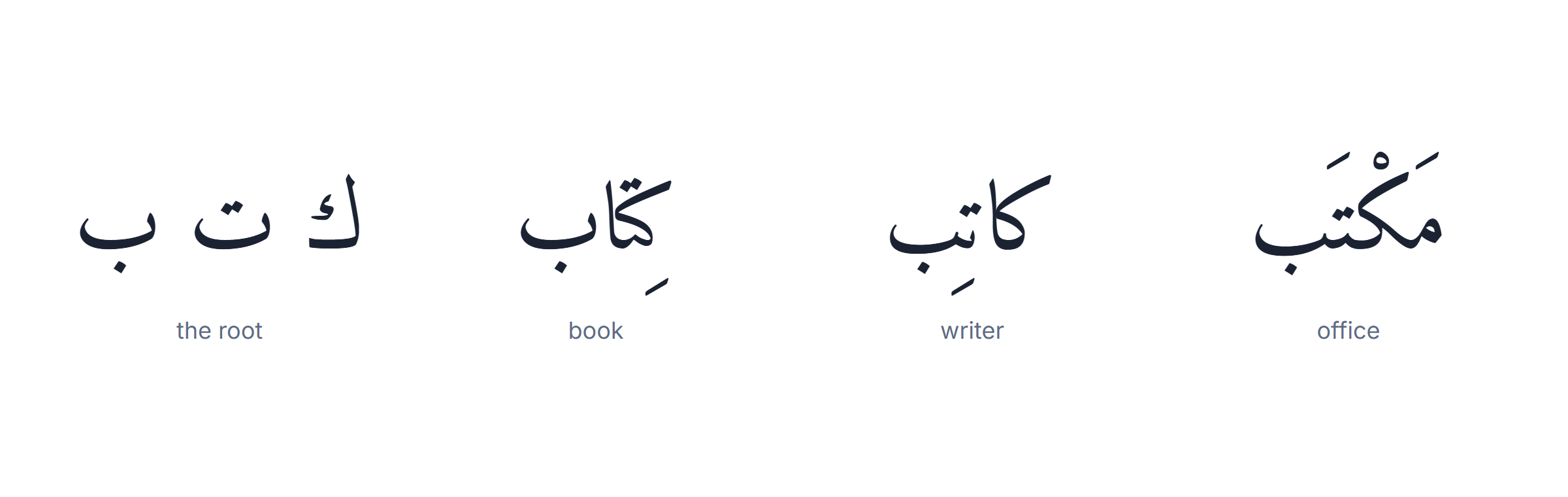
This is the first and most useful of the Arabic grammar rules, because it converts vocabulary from memorisation into arithmetic. Take the root k-t-b, which carries the idea of writing:
- kataba — he wrote
- kitab — a book
- katib — a writer
- maktab — an office, a place of writing
- maktaba — a library
- maktub — written, a letter
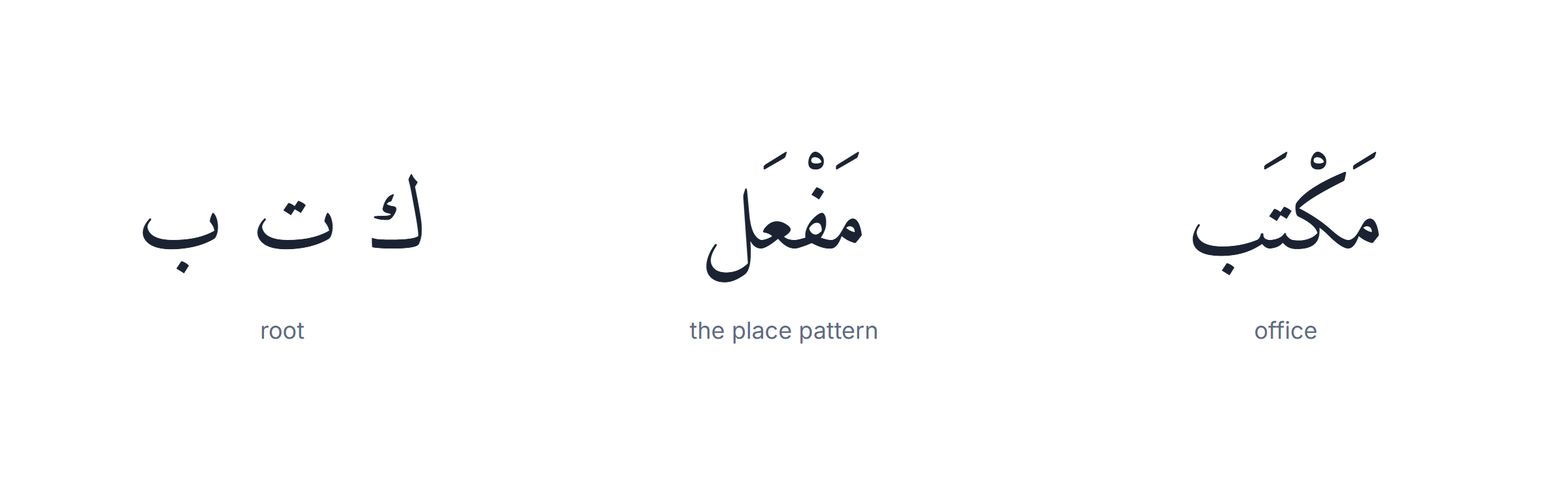
That single mechanism carries more of the Arabic grammar rules than any other. Six words, one root, and the pattern that produced each one repeats across thousands of other roots. maCCaC is nearly always a place: maktab office, matbakh kitchen, madrasa school. Learn the pattern once and you can guess a word you have never seen.
Where this Arabic grammar rule fails
Loanwords have no root — tilifizyun, bank, kumbyutar — and a small set of very common words are irregular. But the root system covers the overwhelming majority of the language, which is why it heads any honest list of Arabic grammar rules.
Rule 2: there are exactly two kinds of sentence
Every Arabic sentence is either nominal or verbal, and this classification drives more of the Arabic grammar rules than any other single idea.
The two frames, in one line each:
- Nominal — starts with a noun, has no verb in the present, both halves nominative.
- Verbal — starts with a verb, then the doer, then the object.
The nominal sentence (jumla ismiyya)
It begins with a noun and has no verb at all in the present tense. al-bayt kabir — “the house [is] big”. Arabic simply does not use a present-tense “to be”. The two halves have names: mubtada (the subject you start with) and khabar (what you say about it), and both take the nominative ending.
The verbal sentence (jumla filiyya)
It begins with a verb. kataba al-walad ar-risala — “wrote the boy the letter”. Verb, then doer, then object.
Why the Arabic grammar rules hang on this distinction
Almost all the remaining Arabic grammar rules are stated relative to one of these two frames. The endings depend on which type you are in. Mistaking a nominal sentence for a verbal one is the commonest source of wrong case endings, and it is the reason Arabic grammar rules are usually taught in this order.
Rule 3: the default word order is verb first
Classical Arabic prefers verb – subject – object, which is unusual among world languages and immediately foreign to an English speaker. Modern written Arabic uses both VSO and SVO, and the choice carries emphasis: starting with the subject foregrounds it.
The agreement trap in the Arabic grammar rules for word order
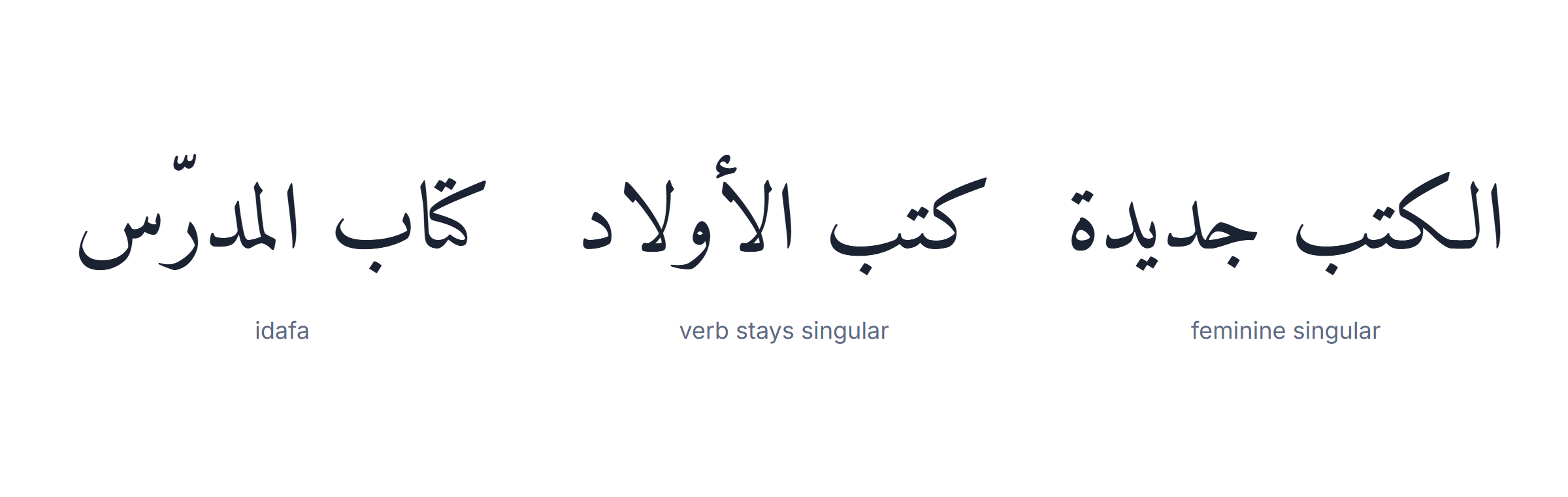
When the verb comes first, it stays singular even if the subject is plural. kataba al-awlad — “wrote the boys”, not “wrote-they the boys”. When the subject comes first, the verb agrees fully. This is one of the Arabic grammar rules that native speakers apply without noticing and learners get wrong for years.

Rule 4: everything has a gender, and the marker is one letter
Gender is the shortest of the Arabic grammar rules to state and the easiest to forget in practice. Every Arabic noun is masculine or feminine. In the great majority of cases the feminine is marked by ta marbuta, a letter that looks like a ha with two dots and appears only at the end of a word.
- mudarris a male teacher, mudarrisa a female teacher
- kabir big (m.), kabira big (f.)
Two markers, and one of them is not written:
- Ta marbuta — the visible feminine ending.
- Nothing at all — a closed list of nouns that are feminine anyway.
The exceptions worth learning early
A short list of nouns is feminine without the marker: body parts that come in pairs (yad hand, ayn eye), most countries and cities, shams the sun, nar fire, ard the earth, rih wind. And a handful of words ending in ta marbuta are masculine, khalifa being the famous one.
Rule 5: the definite article is one word and it half-disappears
Two of the Arabic grammar rules meet in the article, and only one of them is easy. Arabic has al- and no indefinite article at all. bayt is “a house”; al-bayt is “the house”. So far this is the easiest of the Arabic grammar rules.
Sun letters and moon letters, the noisiest of the Arabic grammar rules
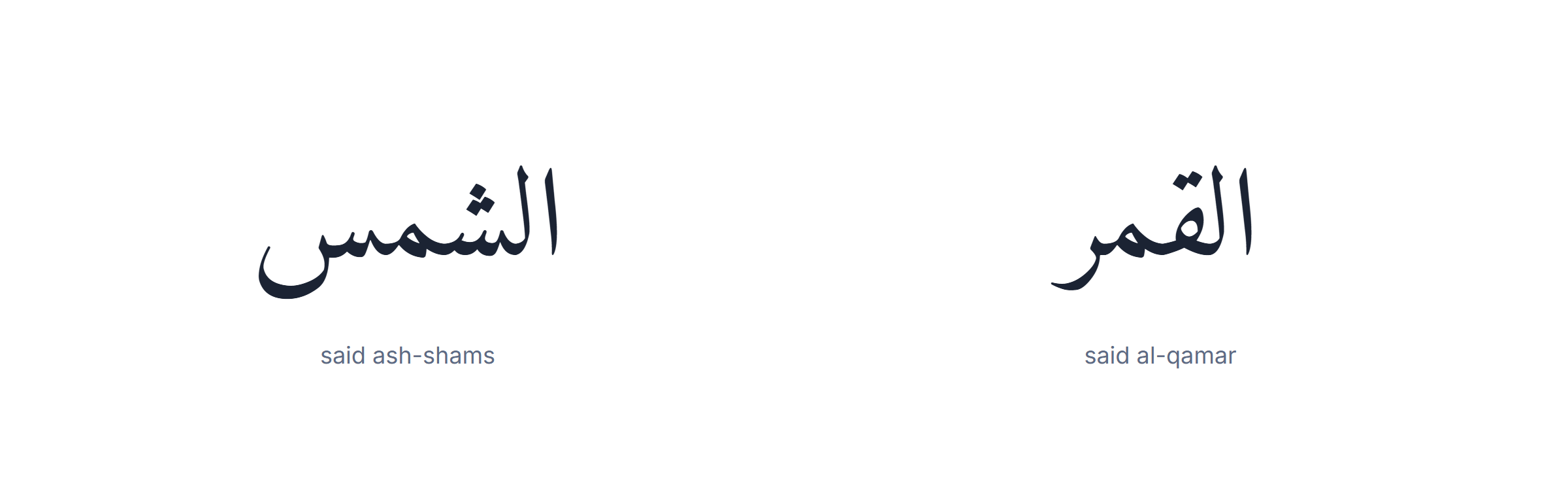
Then it stops being easy. Before fourteen of the twenty-eight letters — the sun letters — the l of al- is not pronounced; the following letter doubles instead. al-shams is written with the l and said ash-shams. Before the other fourteen — the moon letters — the l is pronounced normally: al-qamar.
The sun letters are the ones made with the tongue near the teeth or the ridge behind them:
- Sun letters — t, th, d, dh, r, z, s, sh, s, d, t, z, l, n. The l goes silent; the next letter doubles.
- Moon letters — everything else, including the letters made at the back of the mouth. The l is pronounced.
Nothing in the writing tells you which is which, which is why this is the first place a reader is exposed as a learner.
Rule 6: possession is built by placing two nouns together
The idafa construction is how Arabic says “the door of the house”, and it has no equivalent word for “of”. You simply place the two nouns in order: bab al-bayt, literally “door the-house”.
The three conditions the Arabic grammar rules impose on an idafa
- The first noun never takes al-, even though English translates it as definite.
- The first noun never takes tanwin.
- The second noun takes the genitive ending.
Of all the Arabic grammar rules, this is the one that pays back fastest in reading. Once you can see an idafa you can read a great deal of formal Arabic, because titles, addresses, institutions and most compound terms are built this way. It is the single most practically valuable of the Arabic grammar rules for reading signs and headlines.
Rule 7: three cases, and you can usually hear none of them
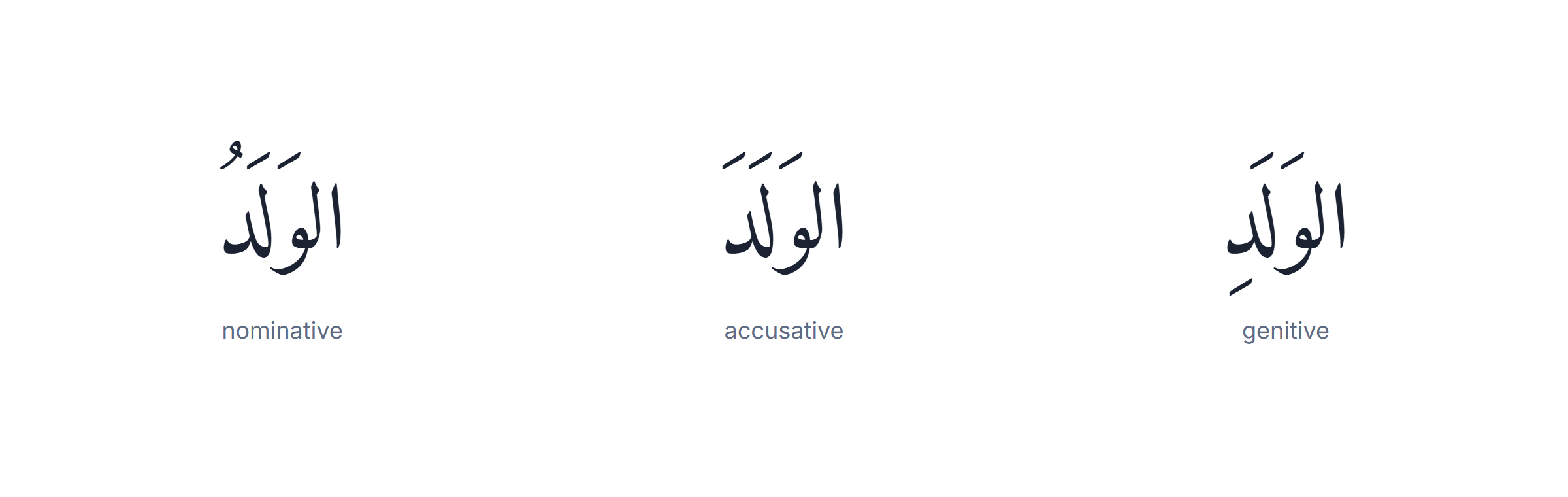
Arabic nouns take one of three cases, marked by a short vowel on the last letter:
| Case | Ending | Used for | Example |
|---|---|---|---|
| Nominative (raf) | -u | Subject, khabar | al-waladu |
| Accusative (nasb) | -a | Object, after inna | al-walada |
| Genitive (jarr) | -i | After a preposition, second of an idafa | al-waladi |
Where the endings do and do not matter:
- They matter in the Quran, in classical poetry, in formal broadcast, and any time you read aloud.
- They do not matter for reading a newspaper, for messaging, or for any spoken dialect, none of which uses them.
The one set of Arabic grammar rules beginners can safely defer
These endings are almost never written in ordinary text and almost never pronounced in speech, because Arabic normally stops on a silent final consonant. They matter for reading aloud, for the Quran, for poetry and for formal broadcast. They matter far less for understanding a newspaper, so the honest advice inside any list of Arabic grammar rules is: recognise them, do not drill them first.
Rule 8: there is a number between one and many
Number is a three-way system in the Arabic grammar rules, not a two-way one. Arabic marks the dual — exactly two — with its own ending, and it applies to nouns, adjectives, pronouns and verbs alike. kitab a book, kitaban two books, kutub books. English has nothing like it and learners consistently forget it exists.
It is one of the Arabic grammar rules that modern dialects have largely dropped for verbs and pronouns while keeping it for nouns, which is why you will hear it far less than you read it.
Rule 9: most plurals are irregular by design
This is the one place where the Arabic grammar rules stop being predictive. Arabic has two plural systems. The sound plural adds an ending and is predictable: mudarris becomes mudarrisun. The broken plural rebuilds the word from the inside: kitab becomes kutub, rajul becomes rijal, bayt becomes buyut.
The two systems, side by side:
- Sound plural — adds an ending, fully predictable, used mainly for people and for participles.
- Broken plural — rebuilds the word internally, roughly thirty patterns, not derivable.
Broken plurals are the majority, and there are roughly thirty patterns. There is no reliable way to derive which one a word takes, so this is the one place where the Arabic grammar rules genuinely require memorisation. Learn every noun with its plural attached from the first day and the problem never appears.
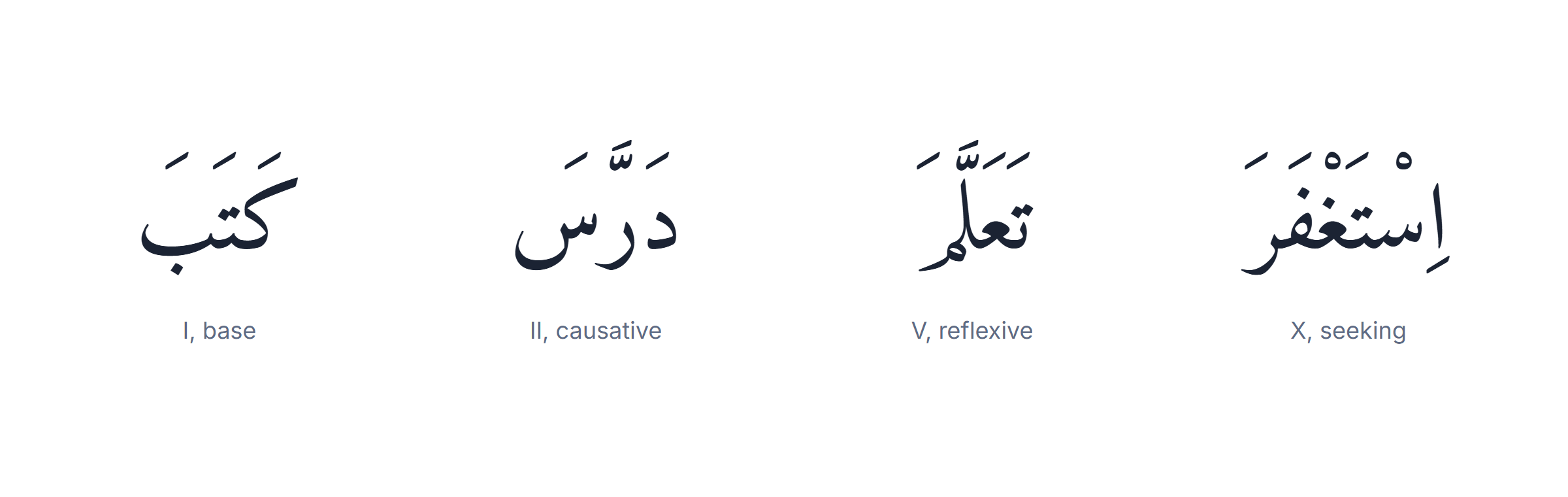
Rule 10: the ten verb forms are a meaning machine
A root can be poured into ten standard verb patterns, each of which shifts the meaning in a predictable direction. Using the root f-l-h is traditional, but k-t-b is clearer:
| Form | Pattern | Shift in meaning | Example |
|---|---|---|---|
| I | faala | The base action | kataba, he wrote |
| II | faaala | Intensive or causative | darrasa, he taught |
| III | faaala | Doing it to someone | katabahu, he corresponded |
| IV | afala | Causative | aslama, he submitted |
| V | tafaaala | Reflexive of II | taallama, he learned |
| VI | tafaaala | Mutual action | tarasala, they corresponded |
| VII | infaala | Passive, it happened | inkasara, it broke |
| VIII | iftaala | Reflexive of I | iktataba, he registered |
| IX | ifalla | Colours and defects | ihmarra, it turned red |
| X | istafala | Seeking or considering | istaghfara, he sought pardon |
No other part of the Arabic grammar rules returns as much for as little memorisation. Forms I, II, V, VII, VIII and X carry most of the traffic. Learning to recognise the shape of a form on sight — the ist- of form X is unmistakable — turns unknown verbs into guessable ones, which is exactly what the Arabic grammar rules are for.
Rule 11: non-human plurals are grammatically feminine singular
This is the strangest of the common Arabic grammar rules and the one that most often makes a learner think the text is wrong. A plural of things — not people — is treated as a feminine singular. “The books are new” is al-kutub jadida, using the feminine singular adjective, not a plural one. “The cars arrived” takes a feminine singular verb.
It is the least intuitive of the common Arabic grammar rules and the easiest to verify: check any newspaper. Human plurals behave normally. The rule applies only to objects, animals and abstractions, and once you have seen it three times it stops looking like an error.
Rule 12: negation changes with tense
Negation is where the Arabic grammar rules interact with tense most visibly. Arabic uses a different negator for each tense, and picking the wrong one is a giveaway.
- la + present — la aktub, I do not write
- ma + past — ma katabtu, I did not write
- lam + jussive present — lam aktub, also I did not write, and more formal
- lan + subjunctive present — lan aktuba, I will not write
- laysa — negates a nominal sentence: laysa al-bayt kabiran
The two worth drilling separately:
- lam + present form = past meaning. No English parallel at all.
- laysa conjugates like a verb but negates a verbless sentence.
lam is the one to notice: it is followed by a present-tense verb but means the past. That combination has no English parallel and is worth drilling on its own.
Rule 13: pronouns attach to the word
Attached pronouns are among the Arabic grammar rules that have no English analogue at all. English needs a separate word for “my”, “his”, “them”. Arabic attaches a suffix, and the same suffix set works on nouns, verbs and prepositions alike. This is one of the Arabic grammar rules that makes written Arabic look much denser than its translation.
- kitab book, kitabi my book, kitabuhu his book, kitabuhum their book
- ra’aytu I saw, ra’aytuhu I saw him
- ma’a with, ma’aha with her
The same suffix set attaches to three different hosts:
- On a noun it means possession — kitabi, my book.
- On a verb it is the object — raaytuhu, I saw him.
- On a preposition it is the complement — maaha, with her.
Why these Arabic grammar rules compress the language
Three English words — “I saw him” — become one Arabic word. A sentence that looks impossibly short in Arabic often carries a full English clause, and learners who count words rather than morphemes badly underestimate how much a line contains.
Rule 14: adjectives follow the noun and agree four ways
Two of the Arabic grammar rules combine here, agreement and definiteness. An Arabic adjective comes after its noun, never before, and it must match on four separate axes at once: gender, number, case and definiteness.
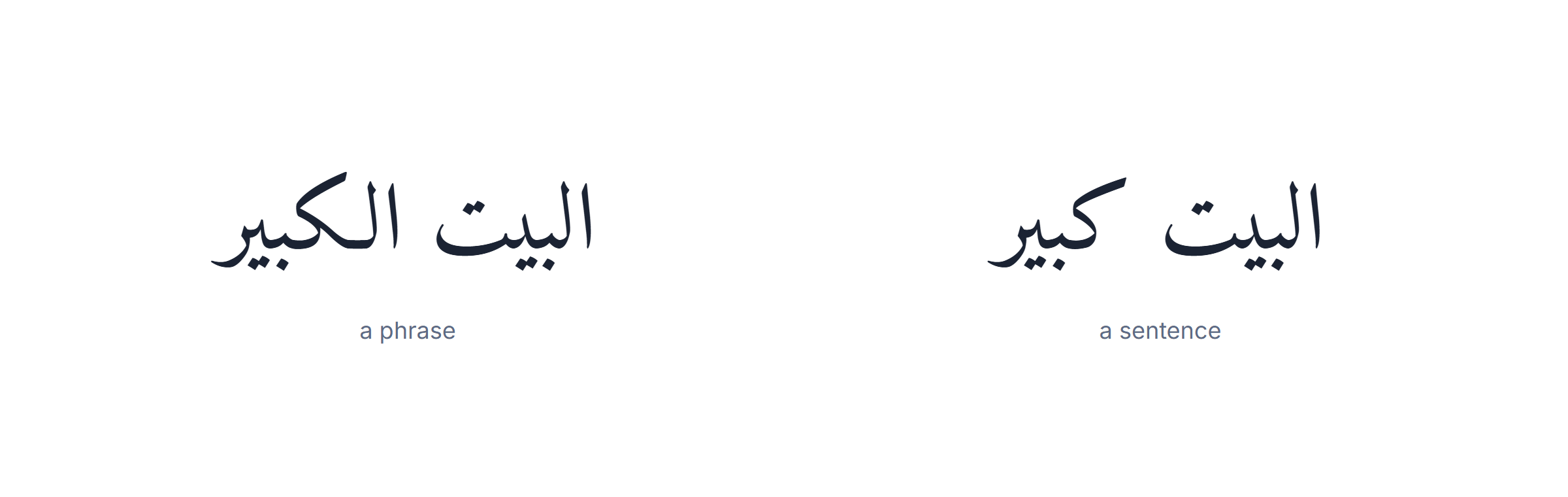
al-bayt al-kabir — “the big house”, literally “the-house the-big”. Both words carry the article. Drop the article from the adjective and the meaning changes entirely: al-bayt kabir is a complete sentence, “the house is big”.
The definiteness trap, and why it beats every other Arabic grammar rule for damage
That single difference — whether the adjective carries al- — is the line between a noun phrase and a sentence. No other rule in this list changes meaning so much on so small a signal, and it is worth stopping on until it is automatic.
Rule 15: tanwin marks indefiniteness
Tanwin is the doubling of the final short vowel, written as a doubled mark and pronounced with an -n: baytun, baytan, baytin. It means the noun is indefinite — “a house” rather than “the house” — and it is mutually exclusive with the definite article.
Tanwin closes the definiteness system that the Arabic grammar rules opened with the article. So an Arabic noun is in exactly one of three states, and this is one of the tidier Arabic grammar rules:
- Carries al- — definite.
- Carries tanwin — indefinite.
- First term of an idafa — definite by association, and takes neither.
Which tanwin you will actually see written:
- Accusative — yes, because it carries an extra alif. shukran.
- Nominative and genitive — rarely, because nothing extra is written.
The accusative tanwin is the one you will see written even in unvowelled text, because it takes an extra alif: shukran, thank you, ends with that alif for exactly this reason.
Rule 16: there are two tenses, not three
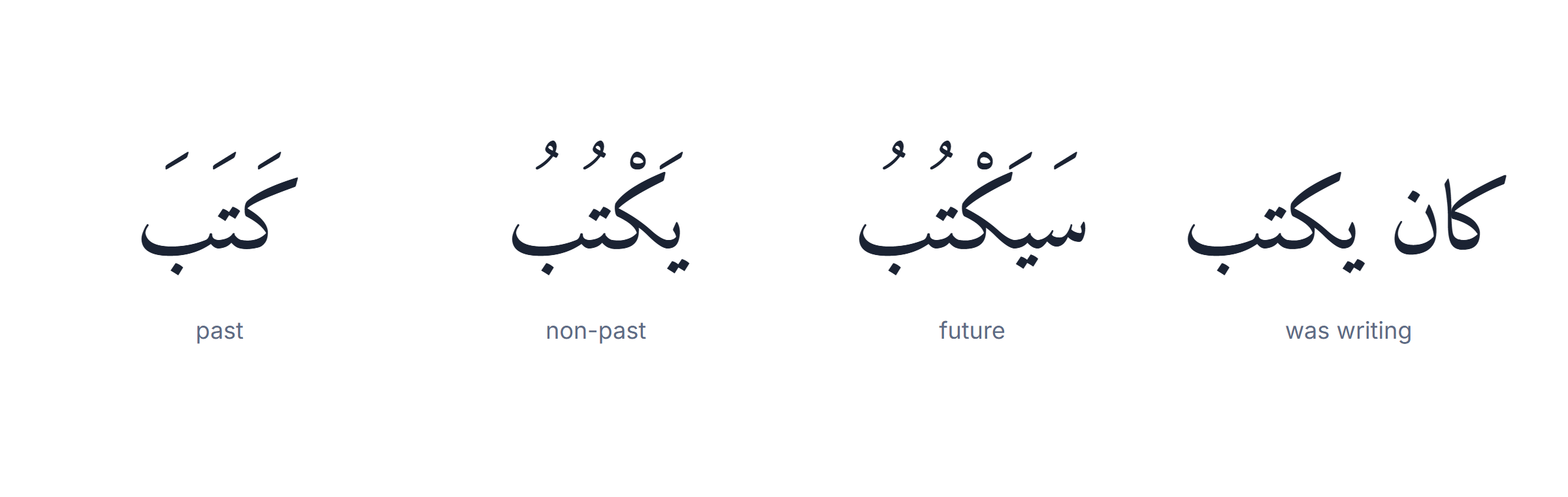
Tense is where the Arabic grammar rules are simpler than English, not harder. Arabic verbs have a past form and a non-past form. That is all. There is no separate future tense and no separate present continuous.
| Meaning | How Arabic builds it | Example |
|---|---|---|
| Past | Past form | kataba, he wrote |
| Present | Non-past form | yaktubu, he writes |
| Future | sa- or sawfa + non-past | sayaktubu, he will write |
| Past continuous | kana + non-past | kana yaktubu, he was writing |
| Past perfect | kana qad + past | kana qad kataba, he had written |
The helpers, in full:
- sa- and sawfa — future.
- kana — shifts anything into the past.
- qad — adds completion, or with the non-past, possibility.
- ma zala — still, continuing.
Every tense English has, Arabic builds out of two forms plus a helper. Once you see that, the verb system stops looking large.
Rule 17: numbers disagree on purpose
Every list of Arabic grammar rules has one entry that is pure irregularity, and this is it. This is the rule that Arab schoolchildren dread and the one that most reliably identifies a learner. Numbers from 3 to 10 take the opposite gender to the thing counted.
- thalathatu kutubin — three books. Kitab is masculine, so the number takes the feminine ending.
- thalathu banatin — three girls. Bint is feminine, so the number takes the masculine form.
The four behaviours, by range:
- 1 and 2 — the noun alone, or the dual. No number word needed.
- 3 to 10 — opposite gender, noun plural and genitive.
- 11 to 99 — noun singular and accusative.
- 100 and above — noun singular and genitive.
The counted noun is plural and genitive from 3 to 10, then singular and accusative from 11 to 99, then genitive singular after 100. Four different behaviours in one system. It is comfortably the most irregular of the Arabic grammar rules, and it is also one that spoken dialects have largely simplified away.
Rule 18: questions are marked at the front
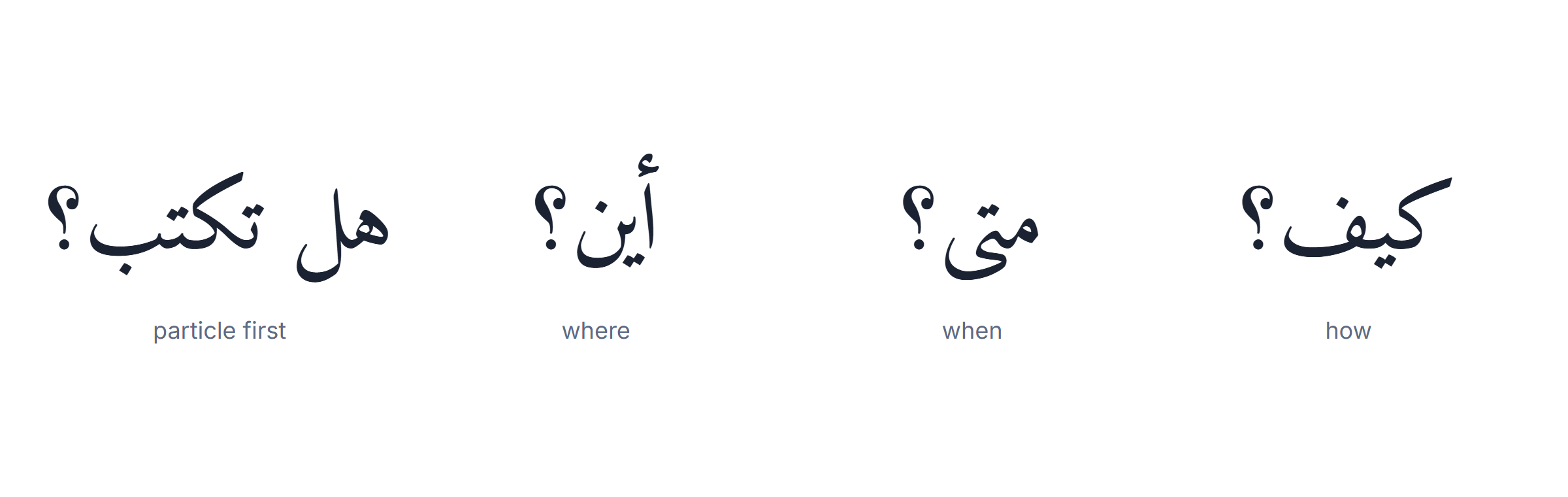
Questions need only one of the Arabic grammar rules, and it is a short one. Arabic does not invert word order to ask a question. It puts a particle at the start and leaves everything else alone.
- hal — the neutral yes/no marker: hal taktub? do you write?
- a- — a prefixed alternative, more formal and used for both yes/no and either/or questions
- ma / madha what, man who, ayna where, mata when, kayfa how, limadha why, kam how many
Two ways to ask, and one to avoid:
- hal — neutral, unambiguous, safe in any register.
- a- — more formal, and the only option for either/or questions.
- Intonation alone — works in speech, invisible in writing.
Because nothing else changes, the question mark carries more weight in Arabic than in English: strip it out and a written yes/no question with hal is still identifiable, but one formed by intonation alone is not. Which marks belong where is covered in our guide to Arabic punctuation.
The conjugation table the rules assume you have
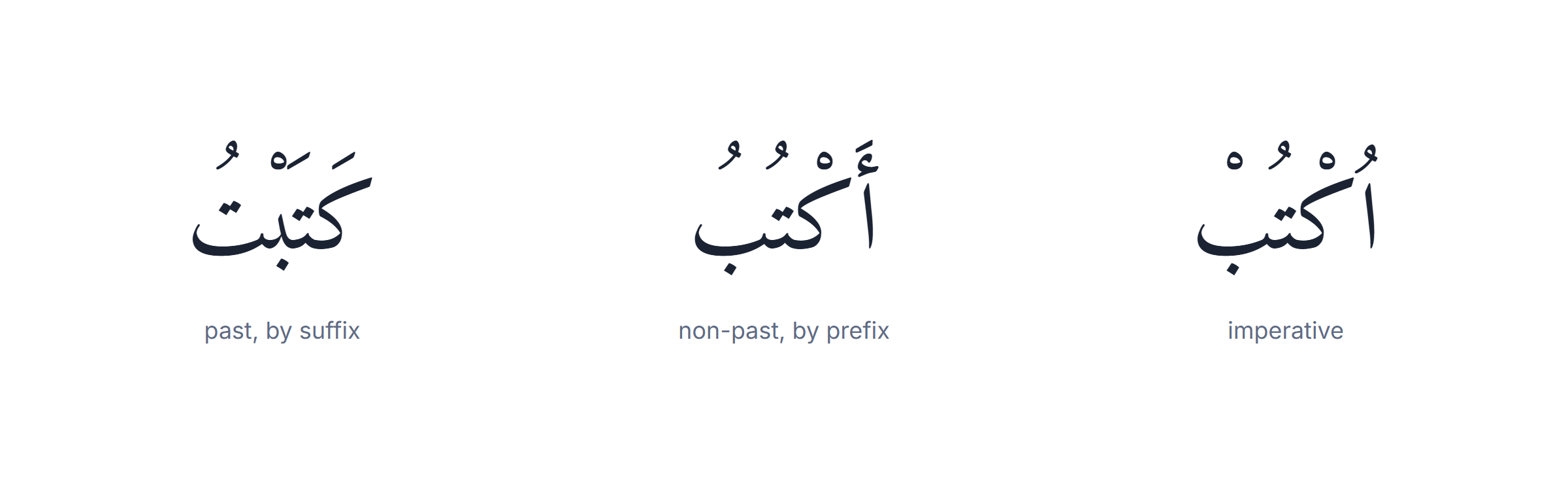
Almost every one of the Arabic grammar rules about verbs assumes you can already conjugate one. Here is form I of kataba across both tenses, which is the table everything else is stated against.
| Person | Past | Non-past | Imperative |
|---|---|---|---|
| I | katabtu | aktubu | — |
| You, m. sg. | katabta | taktubu | uktub |
| You, f. sg. | katabti | taktubina | uktubi |
| He | kataba | yaktubu | — |
| She | katabat | taktubu | — |
| We | katabna | naktubu | — |
| You, m. pl. | katabtum | taktubuna | uktubu |
| You, f. pl. | katabtunna | taktubna | uktubna |
| They, m. | katabu | yaktubuna | — |
| They, f. | katabna | yaktubna | — |
| You two | katabtuma | taktubani | uktuba |
| They two, m. | kataba | yaktubani | — |
Two things to notice before memorising anything
- The past conjugates by suffix; the non-past conjugates by prefix. That single observation halves the table: once you know the four prefixes — a-, ta-, ya-, na- — the non-past is mostly predictable.
- The dual rows are the ones dialects dropped. If you are learning to speak rather than read, four of the twelve rows can wait indefinitely.
Moods: the endings that change on the non-past
The non-past has three moods, and this is where the Arabic grammar rules about particles bite.
- Indicative — ends in -u. The default. yaktubu.
- Subjunctive — ends in -a, after an, lan, likay, hatta. lan yaktuba.
- Jussive — ends in nothing at all, after lam, la of prohibition, and in conditionals. lam yaktub.
Three moods, three triggers, and the triggers are a short closed list. This is one of the Arabic grammar rules that looks like memorisation and is really pattern matching.
Weak verbs: where the regularity finally breaks
A root containing waw, ya or hamza behaves irregularly, because those letters shift or disappear when the pattern squeezes them. Around a fifth of common verbs are affected, and every list of Arabic grammar rules eventually has to admit it.
| Type | Where the weak letter is | What happens | Example |
|---|---|---|---|
| Mithal | First radical | Drops in the non-past | wasala → yasilu |
| Ajwaf | Middle radical | Becomes a long vowel | qala, he said |
| Naqis | Last radical | Shifts or vanishes at the end | rama, he threw |
| Mahmuz | Any, and it is hamza | Spelling of the seat changes | saala, he asked |
| Mudaaf | Last two identical | They merge with a shadda | madda, he stretched |
How to handle them without despair
- Learn the five names. Recognising which type a verb is turns an irregular form into a predictable one.
- Learn kana, qala, raa, jaa and atta as whole words — the five commonest weak verbs carry an enormous share of ordinary text.
- Ignore the rest until you meet them. Weak-verb tables memorised in advance do not stick.
Where these rules came from
The Arabic grammar rules are not a modern teaching scheme. They were codified in the eighth century, and the framework has barely moved since.
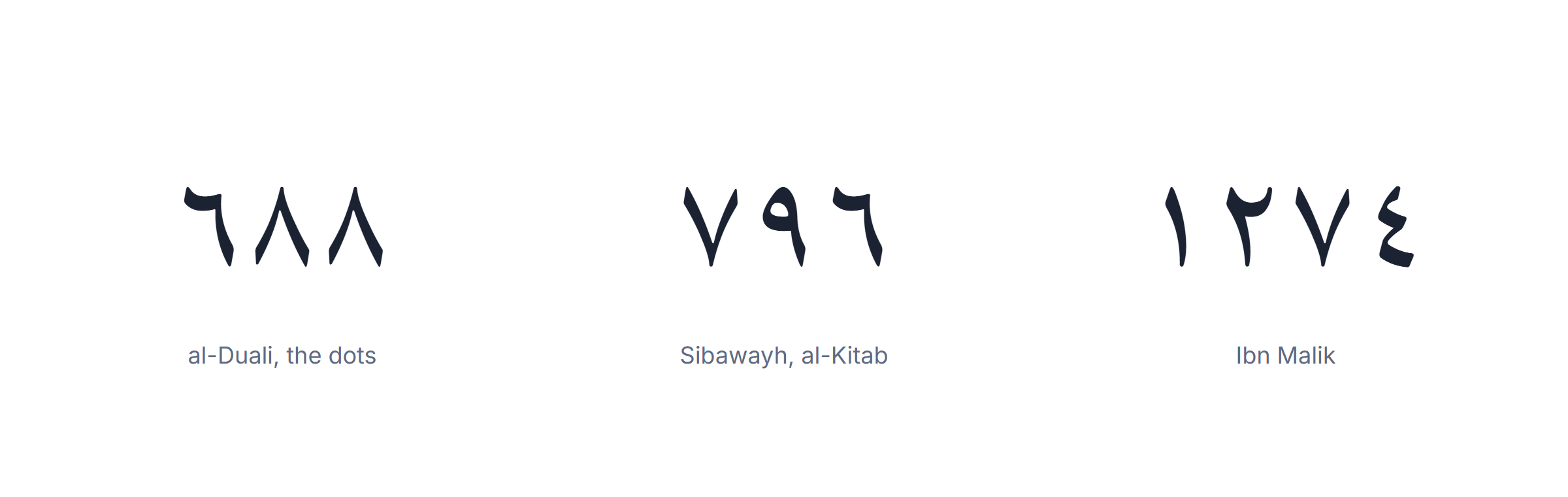
- Abu al-Aswad al-Duali (d. 688) is credited with the first dots and vowel marks, introduced because non-native converts were misreading the Quran.
- Sibawayh (d. c. 796) wrote al-Kitab, simply “The Book”, which described the whole language in one volume and is still cited. The categories used above — nahw and sarf, the sentence types, the three cases — are his.
- The Basra and Kufa schools spent two centuries arguing over the analysis, in what is probably the oldest sustained linguistics debate on record.
- Ibn Malik (d. 1274) compressed the system into the Alfiyya, a thousand-line poem still memorised in traditional schools today.
This matters practically for one reason. Because the Arabic grammar rules were fixed so early and so completely, the written language has changed far less over 1,300 years than English has over 600. A literate Arabic speaker can read ninth-century prose with effort rather than translation, which is why the standard is worth learning even though nobody speaks it at home.
Arabic nouns: the categories the rules keep referring to
Several of the Arabic grammar rules above are stated in terms of noun categories that nobody defined first. Here they are.
The three states of definiteness
- Definite by article — al-kitab, the book.
- Definite by annexation — kitab al-walad, the boy’s book. The first term is definite without carrying al-.
- Definite by nature — proper names and pronouns are definite already. Muhammad never takes the article.
- Indefinite — marked by tanwin, kitabun.
Diptotes: the nouns that refuse one of the three cases
A small class of nouns — most proper names of foreign origin, most place names, colours and defects on the afal pattern, and broken plurals on certain patterns — take only two case endings instead of three and never take tanwin. Ibrahim, masajid, ahmar. This is one of the Arabic grammar rules that explains a great many apparent exceptions once you know it exists: the word is not irregular, it is a diptote.
Masdar: the verbal noun
Every verb has a noun form for the action itself — kataba he wrote, kitaba writing. English uses the gerund; Arabic uses the masdar, and it is used far more heavily. Formal Arabic will prefer arada al-kitaba, “he wanted the writing”, where English says “he wanted to write”. Reading formal Arabic without recognising masdars is the single most common reason a sentence looks impenetrable.
Active and passive participles
Two more patterns off the same root: katib, the one writing, and maktub, the thing written. Both behave as nouns or adjectives. Between the masdar and the two participles, a single root routinely produces four everyday words before you touch the verb forms at all.
The four pronoun systems
Arabic has four separate pronoun sets, and mixing them up is the most visible learner error after the idafa article.
| Type | Form | Used for | Example |
|---|---|---|---|
| Separate | ana, anta, huwa, hiya, nahnu | Subject of a nominal sentence | ana mudarris, I am a teacher |
| Attached | -i, -ka, -hu, -ha, -na | Possession and object | kitabuhu, his book |
| Demonstrative | hadha, hadhihi, dhalika, tilka | This and that, with gender and number | hadha al-kitab, this book |
| Relative | alladhi, allati, alladhina | Who, which, that | al-kitab alladhi qaratuhu |
The relative-clause rule that has no English equivalent
A relative pronoun is used only when the noun it describes is definite. If the noun is indefinite, the clause simply follows with no pronoun at all: kitabun qaratuhu, “a book [that] I read”. English always needs the word; Arabic forbids it here. It is a small rule and it silently breaks half of what learners write.
Demonstratives agree, and they come first
Unlike adjectives, a demonstrative precedes its noun and the noun keeps its article: hadha al-bayt, this house. Drop the article and it becomes a sentence again — hadha baytun, this is a house — which is the same trap as Rule 14 wearing a different hat.

Prepositions, and what they do to the word after them
Every Arabic preposition forces the genitive on the noun that follows it. That single fact is half of what the Arabic grammar rules say about prepositions; the other half is that Arabic verbs take prepositions that do not match the English ones.
| Preposition | Core meaning | Also used for |
|---|---|---|
| fi | in | Time periods, subjects, about |
| min | from | Partitive, comparison than |
| ila | to, towards | Destination, up until |
| ala | on | Obligation, against |
| bi | with, by | Instrument, price, oaths |
| li | for, to | Possession, purpose |
| an | about, away from | Reporting speech |
| maa | with | Accompaniment only |
Verbs that own their preposition
- bahatha an — to search for, literally to search away-from.
- hasala ala — to obtain, literally to get on.
- rraghiba fi — to want, literally to desire in.
- ijaba an — to answer, literally to answer about.
These pairings are not derivable from the Arabic grammar rules and have to be learned with the verb, exactly as English speakers learn “depend on” rather than “depend of”.
Inna and kana: the two families that rewrite the endings
Two small groups of words reach into a finished nominal sentence and change its case endings. They are traditionally taught as families, and they account for a large share of the case errors in written Arabic.
Inna and her sisters
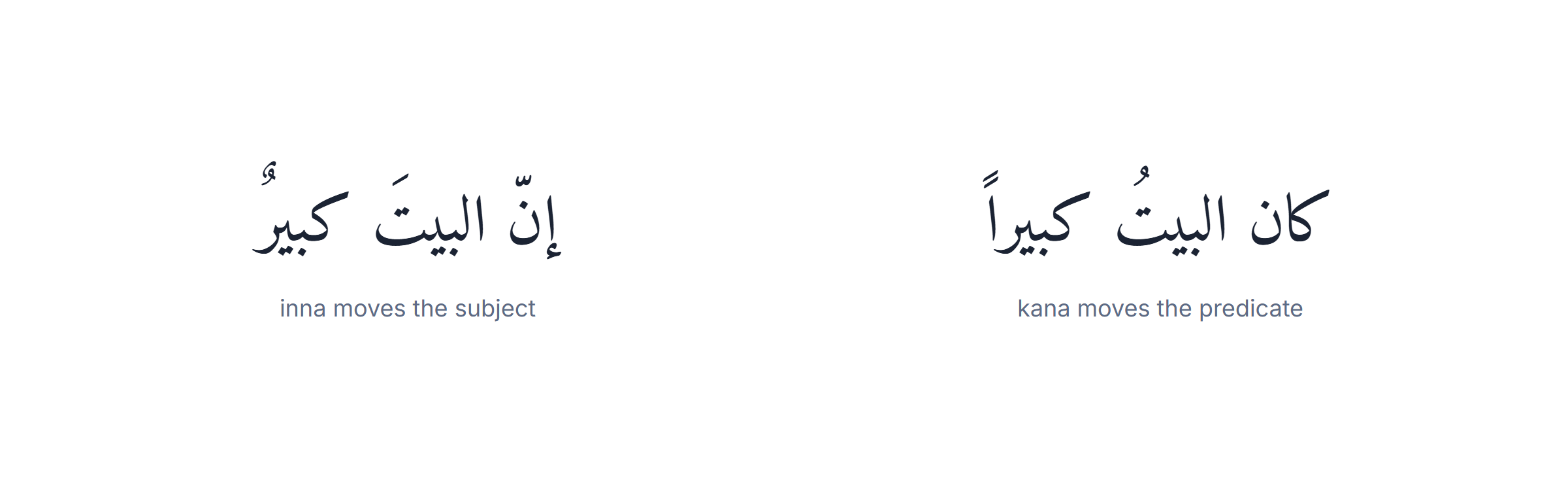
inna, anna, lakinna, kaanna, layta, laalla. Each puts the subject into the accusative and leaves the predicate nominative.
al-baytu kabirun becomes inna al-bayta kabirun. The meaning shifts only slightly — “indeed the house is big” — but the ending has moved.
Kana and her sisters
kana, sara, asbaha, zalla, laysa, ma zala. These do the opposite: they leave the subject nominative and put the predicate into the accusative.
al-baytu kabirun becomes kana al-baytu kabiran, “the house was big”.
Why this pair is worth learning together
They are mirror images, and remembering them as a pair means remembering one fact instead of two. Of all the Arabic grammar rules that touch case, these two families cause the most trouble and take the least time to fix.
Putting it together: how an Arabic sentence is actually built
The Arabic grammar rules are usually presented as a list. In use they apply in a fixed order, and knowing that order makes writing far quicker than knowing the rules individually.
- Decide the sentence type. Is there a verb? Verbal. No verb? Nominal.
- Place the verb, if any, first — and keep it singular if the subject follows it.
- Set the subject in the nominative.
- Set the object in the accusative, with tanwin if indefinite.
- Attach adjectives after their nouns, matching gender, number, case and definiteness.
- Build any idafa: first term bare, second term genitive.
- Add prepositional phrases, each forcing the genitive.
- Check for inna or kana at the front and adjust the two endings if present.
Eight steps, and every one of them is one of the Arabic grammar rules already covered above.
Practice: eight sentences with the rule that decides each one
Cover the right-hand column and work out which of the Arabic grammar rules applies before reading it.
| Say this in Arabic | The trap | Rule |
|---|---|---|
| The teacher’s book | kitab al-mudarris, not al-kitab al-mudarris | 6 — idafa, first term bare |
| The boys wrote | kataba al-awlad, verb stays singular | 3 — verb-first agreement |
| The books are new | al-kutub jadida, feminine singular adjective | 11 — non-human plural |
| I did not write | lam aktub, present verb, past meaning | 12 — negation by tense |
| Three books | thalathatu kutubin, feminine number, masculine noun | 17 — number polarity |
| This house | hadha al-bayt, demonstrative first, article kept | Pronouns — demonstratives |
| Indeed the house is big | inna al-bayta kabirun, subject accusative | Particles — inna |
| A book I read | kitabun qaratuhu, no relative pronoun | Pronouns — indefinite antecedent |
What to do with the ones you got wrong
- Write the correct sentence out three times rather than re-reading the rule.
- Then write two more sentences of your own using the same structure.
- Come back to the table a week later; the Arabic grammar rules you actually failed on will be the same two, and those are the only ones worth drilling.
All eighteen rules on one screen
| # | Rule | One-line version | Kept in dialects? |
|---|---|---|---|
| 1 | Root and pattern | Three letters plus a shape equals a word | Yes |
| 2 | Two sentence types | Nominal has no verb; verbal starts with one | Yes |
| 3 | Verb first | VSO, and the verb stays singular | No, SVO wins |
| 4 | Gender | Ta marbuta marks the feminine | Yes |
| 5 | The article | al-, silent l before sun letters | Yes |
| 6 | Idafa | Two nouns, no word for of | Yes |
| 7 | Three cases | -u subject, -a object, -i after a preposition | No |
| 8 | The dual | A number between one and many | Nouns only |
| 9 | Broken plurals | Most plurals rebuild the word | Yes |
| 10 | Ten verb forms | The pattern shifts the meaning | Mostly |
| 11 | Non-human plurals | Objects take feminine singular agreement | Often no |
| 12 | Negation | A different negator per tense | Simplified |
| 13 | Attached pronouns | Possession and object are suffixes | Yes |
| 14 | Adjectives | Follow the noun, agree four ways | Yes |
| 15 | Tanwin | Doubled ending means indefinite | Mostly gone |
| 16 | Two tenses | Past and non-past plus helpers | Yes |
| 17 | Number polarity | 3 to 10 take the opposite gender | Simplified |
| 18 | Questions | A particle at the front, no inversion | Yes |
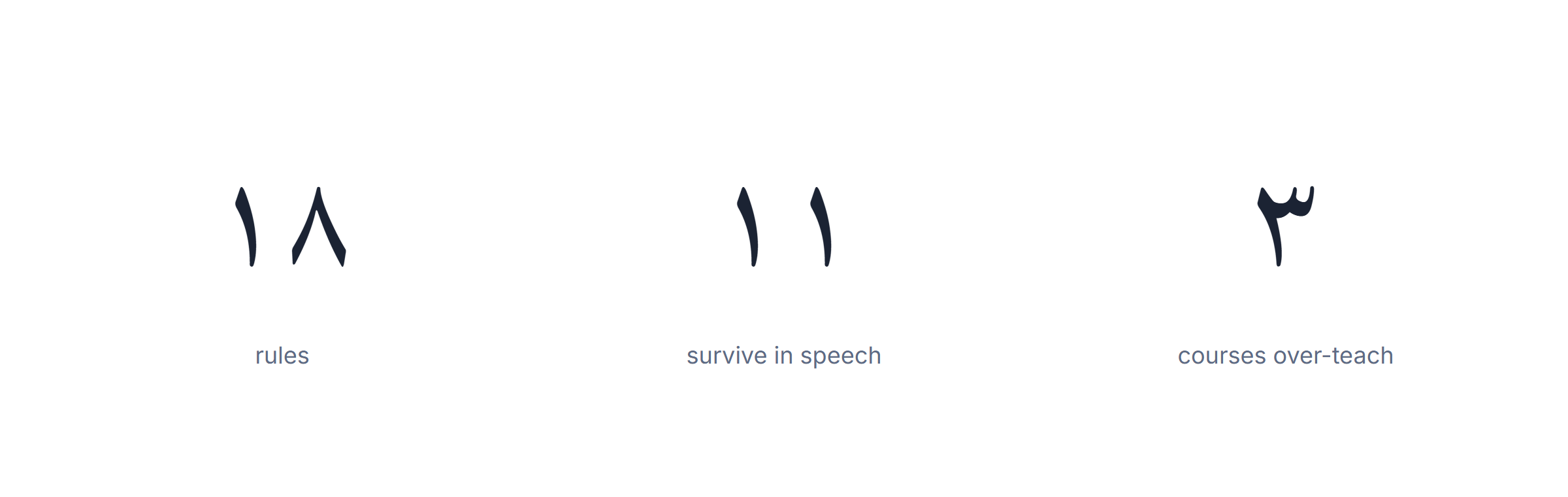
The right-hand column is the one to read if you are learning Arabic to speak it rather than to read it: eleven of the eighteen Arabic grammar rules survive intact into everyday speech, and the three that do not are precisely the three most courses spend the most time on.
The pattern tables the root system runs on
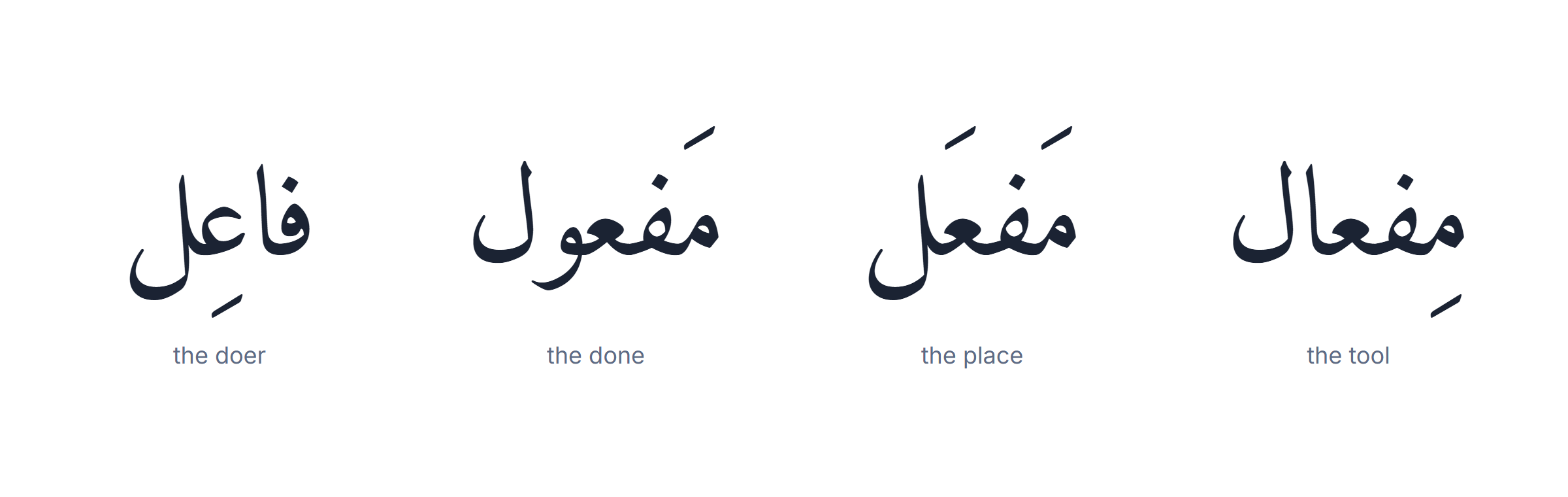
Rule 1 says a root plus a pattern gives a word. This is the pattern list that statement is really pointing at, and it is short enough to read in one sitting.
| Pattern | What it makes | From k-t-b | Another root |
|---|---|---|---|
| faaal | Intensive doer, professions | kattab, a scribe | khabbaz, a baker |
| faail | Active participle, the one doing | katib, a writer | talib, a student |
| mafaul | Passive participle, the thing done | maktub, written | mashghul, busy |
| mafaal | Place | maktab, an office | matbakh, a kitchen |
| mifaal | Instrument | miktab, a writing tool | miftah, a key |
| fiaala | Craft or activity | kitaba, writing | tijara, trade |
| afal | Comparative, colours, defects | — | akbar, bigger |
| fual | Common broken plural | kutub, books | rusul, messengers |
| afaal | Another broken plural | — | aqlam, pens |
| fuaala | Plural of professions | kuttab, scribes | tullab, students |
How to use this table rather than memorise it
- When you meet an unknown word, strip the prefixes and suffixes and look for three consonants.
- Match what is left against the shapes above.
- Guess the meaning from the pattern, then check it. You will be right more often than not.
This is the mechanical core of the Arabic grammar rules, and it is why Arabic vocabulary grows faster than the number of words you have deliberately learned. A learner who knows two hundred roots and these ten patterns can recognise a great deal more than two thousand words.
Where the pattern lies to you
- Frozen meanings. maktaba should be “a place of writing” and means a library or a bookshop. The pattern got there first; usage moved on.
- Homographs. Some patterns collide once the vowels are unwritten, and only context separates them.
- Loanwords wearing a pattern. film takes the broken plural aflam as if it had an Arabic root. It does not.
Reading unvowelled Arabic, which is all of it
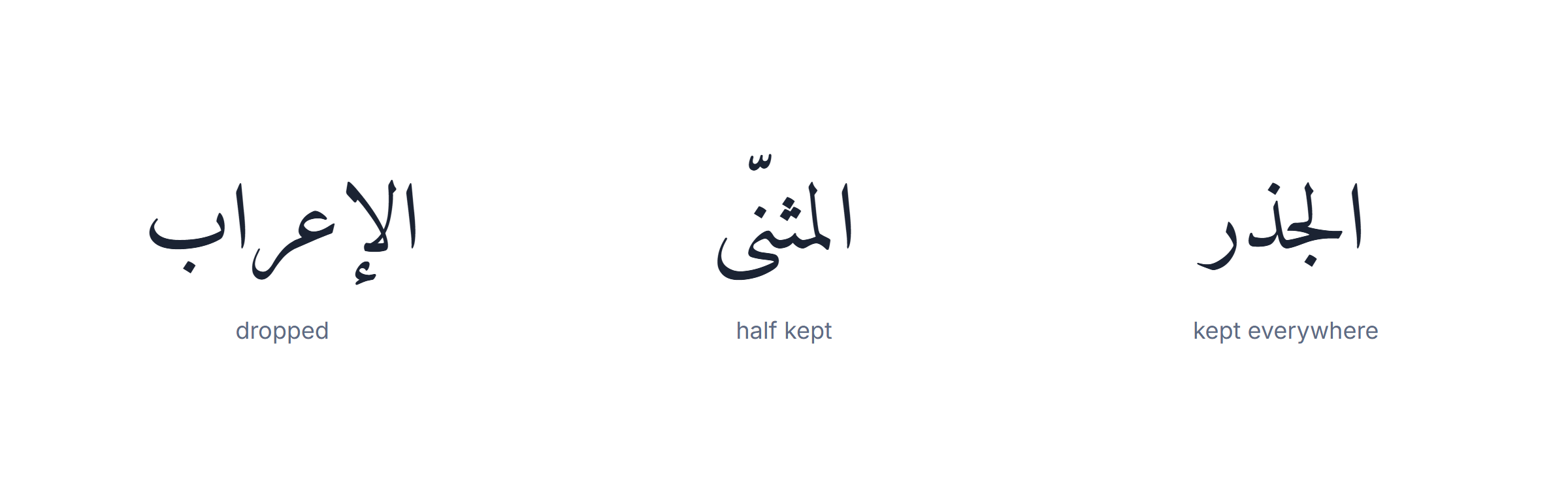
Every rule above is stated with the vowels written in. Real Arabic almost never writes them, and that gap is where learners stall. Three of the Arabic grammar rules do most of the work of closing it.
The pattern tells you the vowels
Seeing the consonant skeleton k-t-b with an m in front and nothing else tells you it is maktab, because mafaal is the place pattern. You are not guessing the vowels; you are recognising the shape.
Position tells you the ending
You do not need the case ending written to know what it is. After a preposition it is genitive. After a verb it is accusative. Starting a nominal sentence it is nominative. The ending is predictable from Rule 7, which is exactly why it is not written.
The particle tells you the mood
lam, lan, an and hatta each force a specific mood on the verb that follows. The particle is written; the mood ending often is not. Again, the rule supplies what the page leaves out.
The practical order to read in
- Find the verb. If there is none, it is a nominal sentence.
- Find the three-consonant root of every content word.
- Match each to a pattern and read the vowels off the pattern.
- Assign cases from position, not from marks.
- Only then translate.
Learners who translate first and parse second find unvowelled Arabic impossible. Learners who apply the Arabic grammar rules first find it merely slow, and the slowness goes away.
How the Arabic grammar rules compare with English, French and Turkish
Most people arrive at Arabic from one of three grammars, and which one you arrive from decides exactly which of the Arabic grammar rules will feel impossible.
| Feature | Arabic | English | French | Turkish |
|---|---|---|---|---|
| Word order | VSO preferred | SVO | SVO | SOV |
| Grammatical gender | 2 | None | 2 | None |
| Case endings | 3, rarely written | None | None | 6, always written |
| Dual number | Yes | No | No | No |
| Definite article | al-, prefixed | the | le/la/les | None |
| Indefinite article | None (tanwin) | a/an | un/une | bir |
| Present-tense “to be” | None | Required | Required | Suffix |
| Adjective position | After the noun | Before | Usually after | Before |
| Word building | Root + pattern | Affixes | Affixes | Agglutination |
| Plural formation | Mostly irregular | Mostly -s | Mostly -s | Fully regular -lar |
If you come from English
Three of the Arabic grammar rules have no English parallel at all and cost the most time: the dual, the case system, and the absence of a present-tense verb “to be”. Against that, the two genders are easier than French and the verb tenses are far simpler than English.
If you come from French
Gender and post-nominal adjectives transfer almost directly, which removes two of the harder Arabic grammar rules before you start. What does not transfer is the root-and-pattern system, and French speakers reliably underestimate how much vocabulary it gives away free.
If you come from Turkish
Turkish already has case endings, so irab feels natural rather than alien — but the directions are opposite: Turkish always writes them and Arabic almost never does. Turkish has no gender at all, which makes agreement the hardest of the Arabic grammar rules for a Turkish speaker, and word order flips from SOV to VSO.
If you come from Darija or another dialect
This is the commonest starting point of all and the least often described. A dialect speaker already has the root system, the gender system, the idafa and the pronoun suffixes — four of the hardest Arabic grammar rules arrive free. What has to be added is the case system, the dual on verbs and pronouns, verb-first word order, and the non-human plural agreement. That is a much shorter list than a foreign learner faces, and it is why a Moroccan or Egyptian speaker reaches readable Modern Standard Arabic in months rather than years.
The trap is the opposite one: assuming the dialect form is the standard form. Kayn, bghit and daba have no place in written Arabic, and no rule above will flag them, because they are vocabulary rather than grammar.
The one thing all three share
None of them has anything like root and pattern. It is the single most foreign idea in Arabic for every learner regardless of first language — and, as Rule 1 says, the one that repays the effort fastest.
The one-page cheat sheet
Everything above, compressed to what you would write on a card.
| If you see | It means |
|---|---|
| al- on a word | Definite. It cannot also carry tanwin. |
| Two nouns in a row, first bare | Idafa. Translate with “of”. |
| A noun with tanwin | Indefinite. “A”, not “the”. |
| Verb, then noun | Verbal sentence. The verb stays singular. |
| Noun, then adjective, both with al- | A phrase, not a sentence. |
| Noun, then adjective, only the noun with al- | A complete sentence. “X is Y.” |
| ist- at the front of a verb | Form X: seeking or considering. |
| in- at the front of a verb | Form VII: it happened to the subject. |
| ma- at the front of a noun | A place, or a passive participle. |
| lam + present verb | Past tense, despite the present form. |
| A plural of objects + feminine singular adjective | Correct. Not an error. |
| A number 3-10 with the “wrong” gender | Correct. Polarity. |
The five-minute daily drill
- Take one sentence from any Arabic page.
- Find the verb, or decide there is none.
- Strip every content word to three consonants.
- Name the pattern of each.
- Assign a case to every noun from its position, not from a written mark.
Five minutes a day on real text applies more of the Arabic grammar rules than an hour of exercises, because real text mixes them the way the language actually does.
What to ignore for the first year
- The full case-ending tables. Recognise, do not drill.
- The rarer verb forms — IX, XI and above.
- Diptotes, until a word refuses tanwin and you want to know why.
- Poetic licence and classical exceptions entirely.
Every one of those is a real part of the Arabic grammar rules, and none of them stops you reading a newspaper.
Which of these rules the dialects actually drop
The Arabic grammar rules above describe Modern Standard Arabic and nothing else. Everything above describes Modern Standard Arabic. Spoken Arabic keeps the skeleton and discards a surprising amount of the machinery, which is why the Arabic grammar rules you study and the ones you hear differ so much.
| Rule | Standard Arabic | Most dialects |
|---|---|---|
| Case endings | Three, marked | Gone |
| Dual | Nouns, verbs, pronouns | Nouns only |
| Word order | VSO preferred | SVO |
| Feminine plural verb | Distinct form | Merged with masculine |
| Non-human plural agreement | Feminine singular | Often plural |
| Root and pattern | Yes | Yes, unchanged |
The last row is the important one. The root system survives everywhere, so the single most transferable thing you can learn is Rule 1. More on how far apart the varieties really are in our guide to Arabic dialects.
The order to learn them in
- Root and pattern — pays back immediately, in vocabulary.
- The two sentence types — makes every sentence parseable.
- Gender and the definite article — needed to read anything aloud.
- Idafa — unlocks signs, titles and headlines.
- Verb forms I, II, V, VIII, X — the six that carry the language.
- Broken plurals — start collecting them from day one, do not study them as a block.
- Case endings — last, and only when you need to read aloud.
Ordering matters more than coverage when you are learning the Arabic grammar rules. Most courses invert this list, opening with case endings because they are the tidiest thing to teach. That order is the reason so many people describe the Arabic grammar rules as impenetrable when the useful three-quarters of them are not.
Practising without installing anything
The Arabic grammar rules only settle once you have produced them yourself. Grammar sticks when you write it rather than read it. You do not need an Arabic keyboard layout on your machine to do that: type in our online Arabic keyboard and copy the result out. If you prefer to type in Latin letters, the transliteration tool converts as you go, and harakat adds the short vowels — which is exactly what you need when you are practising case endings, because the endings are invisible without them.
For the vocabulary side, our lists of common Arabic phrases and Arabic greetings give you real sentences to take the rules apart on.
One sentence, taken apart
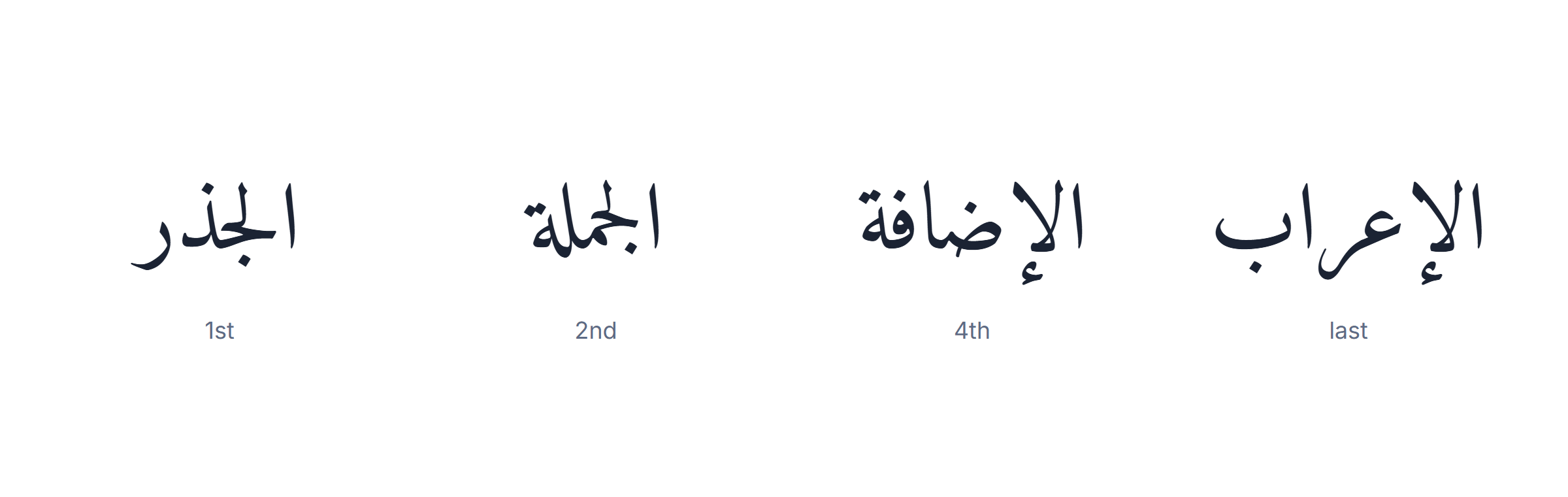
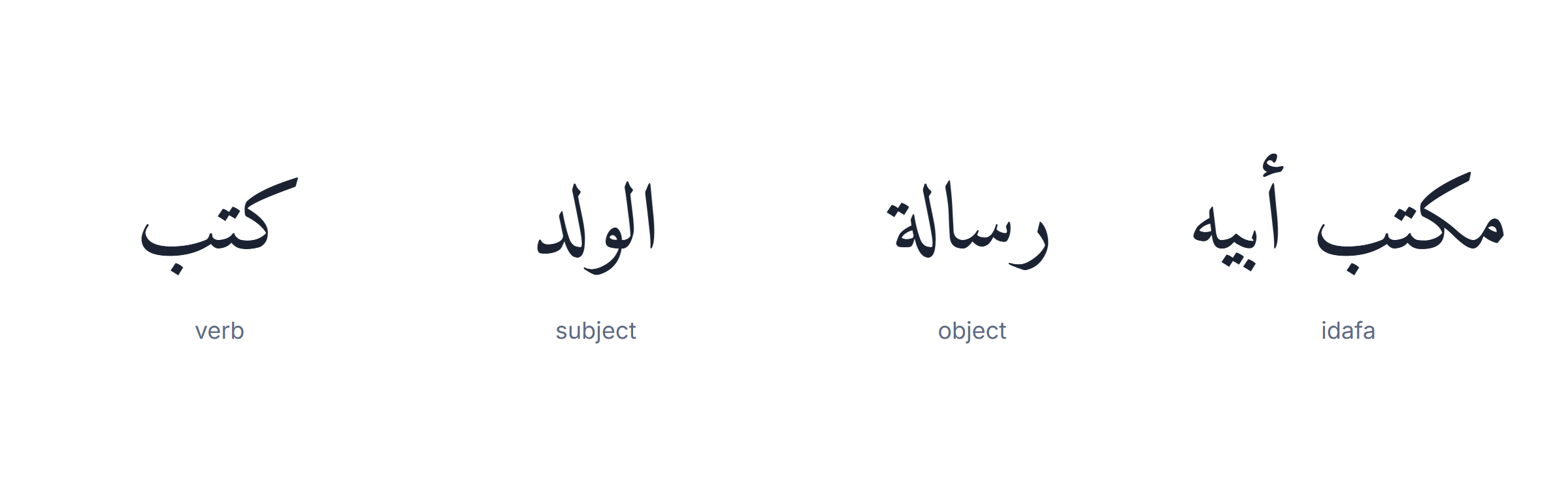
Nine of the Arabic grammar rules above appear in a single ordinary sentence. Take kataba al-walad risalatan tawilatan fi maktabi abihi — “the boy wrote a long letter in his father’s office”.
| Word | What it is | Rule at work |
|---|---|---|
| kataba | Verb, past, form I | Rules 1, 10, 16 — root k-t-b, base form, past tense |
| al-walad | Subject, nominative, definite | Rules 3, 5, 7 — verb first, article, nominative |
| risalatan | Object, accusative, indefinite | Rules 4, 7, 15 — feminine marker, accusative, tanwin |
| tawilatan | Adjective | Rule 14 — follows, agrees in gender, case and indefiniteness |
| fi | Preposition | Rule 7 — forces genitive on what follows |
| maktabi | First of an idafa, genitive | Rules 1, 6 — maCCaC place pattern, no article |
| abihi | Second of the idafa + attached pronoun | Rules 6, 13 — genitive, suffixed his |
Seven words, nine rules, and not one of them is exotic. That is the honest shape of Arabic grammar: a small number of rules applied constantly, rather than a large number applied rarely.
The mistakes these rules are meant to prevent
- Putting al- on the first word of an idafa. The most frequent error in written Arabic by learners.
- Making the verb plural when it comes first. It stays singular.
- Treating a plural of objects as plural. It is feminine singular.
- Using ma with a present verb to mean the past. That is lam.
- Learning a noun without its plural. Broken plurals cannot be derived later.