Arabic Name Generator
Generate authentic Arabic names with meanings, Arabic script, and regional origins. Filter by gender, origin (Quranic, Moroccan, Gulf, Persian), or meaning theme to find the perfect name.
What Is an Arabic Name Generator?
An Arabic name generator is a tool that produces authentic Arabic names drawn from classical, Quranic, modern, and regional traditions. Whether you’re choosing a baby name, creating a character for your story, or finding a meaningful business identity, this tool delivers real names with their Arabic script (الخط العربي), romanization, and full cultural meanings.
The Arabic language has one of the richest naming traditions in the world, spanning over 1,400 years of poetry, religion, and civilization. Names carry deep semantic weight — every Arabic name is built from a root that conveys a precise meaning. If you want to type these names yourself, our free Arabic keyboard tool lets you write in Arabic script directly in your browser.
How to Use This Arabic Name Generator
Select your preferred gender, origin region, and meaning theme from the filters above, then click Generate Arabic Names. The tool draws from a curated database of 200+ verified names. Click the ⭐ icon on any card to save it to your favorites list. Use the 📋 copy button to copy a name to your clipboard, or share your entire favorites list with family and friends via the Share button.
You can also search directly by meaning (e.g., “light” or “strength”), by romanized spelling, or by typing in Arabic script if you have an Arabic keyboard enabled.
Arabic Name Origins Explained
Each name in this generator is tagged with its origin tradition, which reflects both its linguistic history and cultural usage across the Arab world:
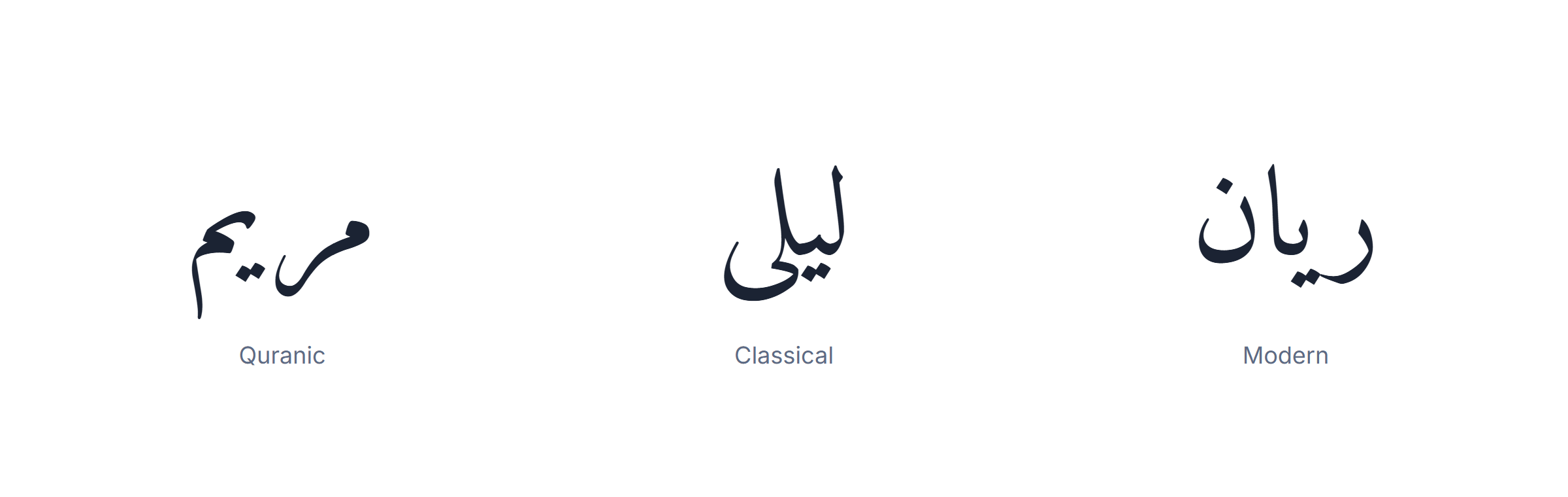
- Quranic names — These appear in or are derived from the Holy Quran. Verified through Quran.com, they carry deep spiritual significance in Muslim communities worldwide. Examples: Ibrahim (إبراهيم), Maryam (مريم).
- Classical Arabic names — Rooted in pre-Islamic and early Islamic poetry, literature, and history. Examples: Layla (ليلى), Khalid (خالد), Omar (عمر).
- Modern Arabic names — Contemporary names blending Arabic roots with current phonetic preferences, popular in urban Arab societies. Examples: Rayan (ريان), Zain (زين).
- Persian-Arabic names — Names shared or adapted between Arabic and Persian cultural traditions, common across Iran, Afghanistan, and parts of the Levant. Examples: Yasmin (ياسمين), Shirin (شيرين).
- Moroccan names — Names reflecting Maghrebi traditions, often Arabized Amazigh roots blended with Quranic and classical origins. You can explore more Moroccan Arabic with our clavier arabe (Arabic keyboard).
- Gulf names — Names popular in the Arabian Peninsula (Saudi Arabia, UAE, Qatar, Kuwait, Bahrain, Oman), reflecting Khaliji traditions. Examples: Fahd (فهد), Moudhi (موضي).
- Rare names — Uncommon but entirely authentic Arabic names with beautiful meanings, found in classical literature and early Islamic texts.
How Arabic Names Are Built
Every result the Arabic name generator returns is a real word before it is a name. That is the single most useful thing to understand about Arabic naming: the meaning is not attached to the name by tradition, it is carried inside the letters. Three sections below explain the machinery, because once you can see it you can judge a name yourself instead of trusting a list.
The trilateral root
Almost every name the Arabic name generator can return is built on a root of three consonants that carries a core idea. The root ح م د (ḥ-m-d) means to praise. Pour it into different patterns and you get a family of names that all mean a shade of the same thing.
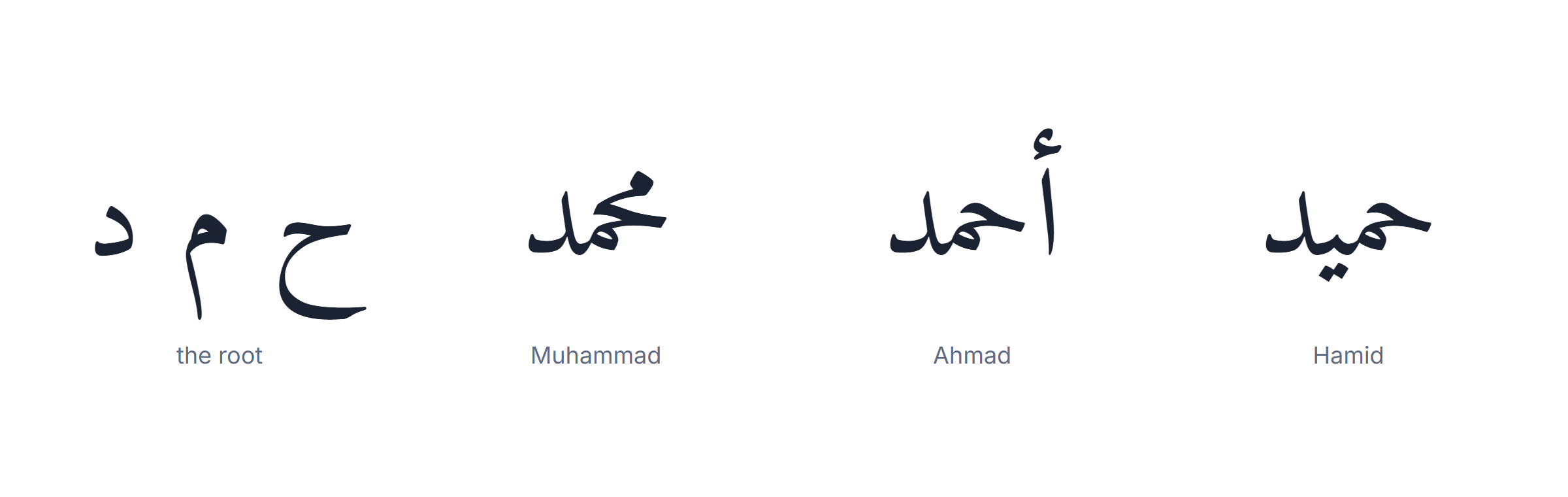
- Muhammad محمد — the one who is praised repeatedly.
- Ahmad أحمد — the most praiseworthy.
- Hamid حامد — the one who praises.
- Mahmoud محمود — the praised one.
This is why searching by meaning works so well in the Arabic name generator above. Type light or strength and you are really searching a root, which is how the Quranic Arabic Corpus indexes classical vocabulary as well. If you want to see how the same roots behave as ordinary words, our list of beautiful Arabic words is the same machinery outside of names.
The five parts of a full Arabic name
A classical Arabic name is not one word, it is a chain. An Arabic name generator gives you the first link — the given name — and the rest is family and biography.
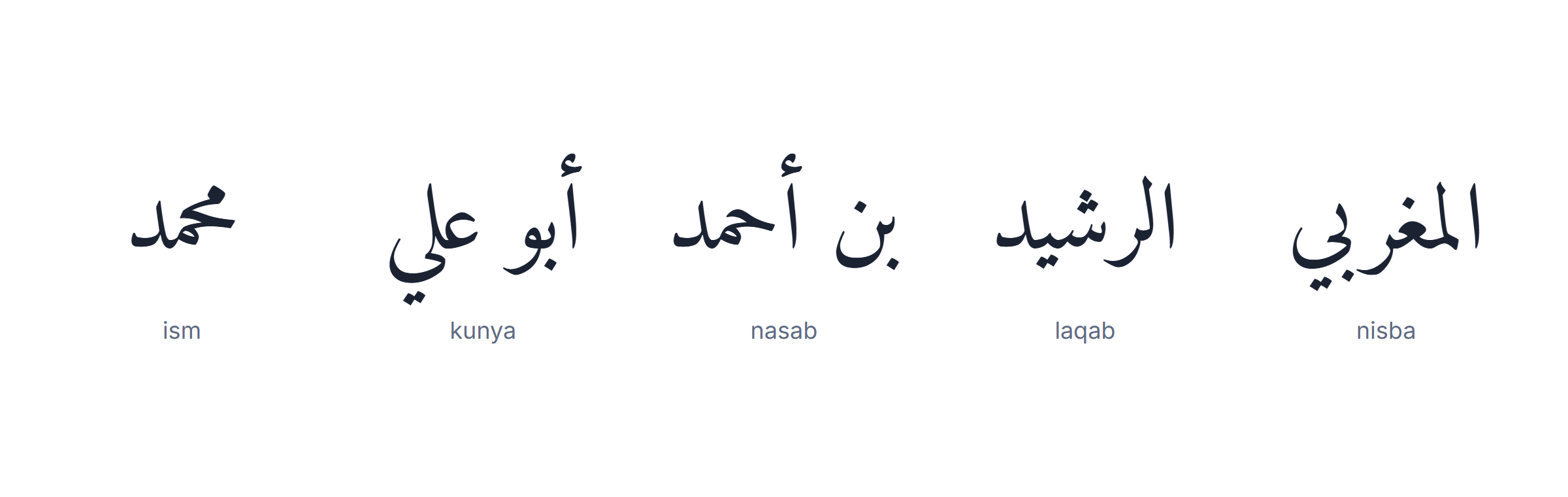
- Ism اسم — the given name, the part you choose.
- Kunya كنية — Abu or Umm plus the eldest child’s name, used as a respectful form of address.
- Nasab نسب — lineage: bin/ibn (son of) or bint (daughter of).
- Laqab لقب — an epithet earned or inherited.
- Nisba نسبة — origin: a town, a tribe, a trade.
Western forms only have room for the ism and one family name, which is why official registries such as the Library of Congress name authority programme keep separate records for the same person under different chains.
Masculine and feminine forms
Most of the names in the Arabic name generator come in a pair. The feminine is usually the masculine plus ة (ta marbuta), which changes the pronunciation of the ending but not the meaning.
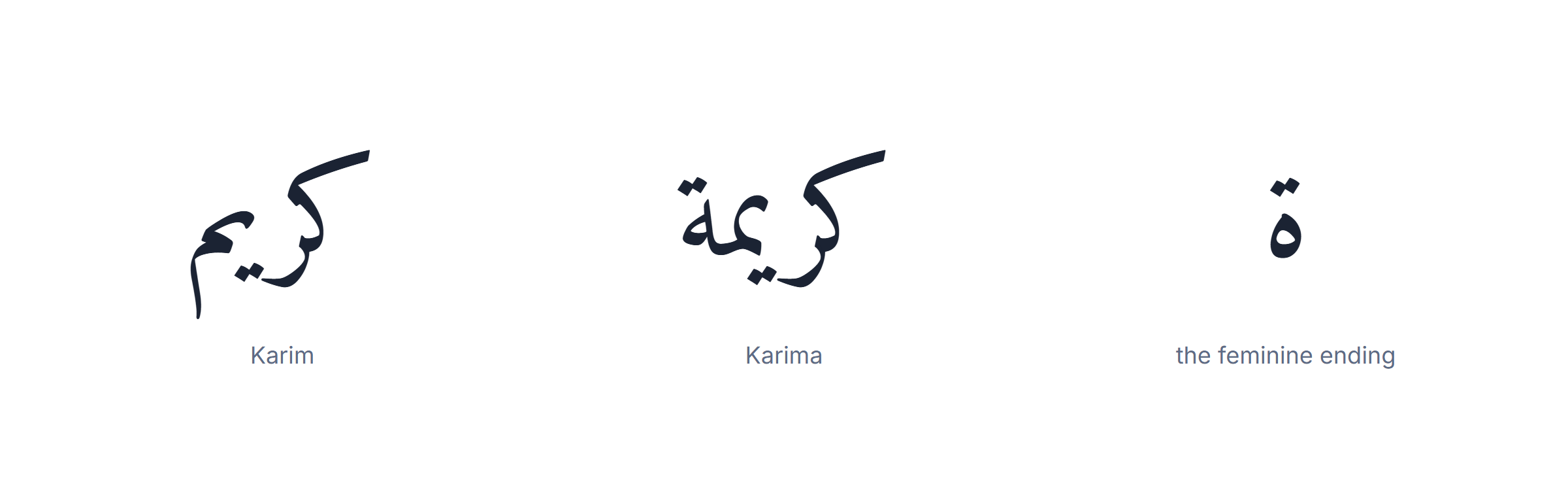
- Karim كريم → Karima كريمة — generous.
- Amin أمين → Amina آمنة — trustworthy.
- Nabil نبيل → Nabila نبيلة — noble.
A handful of names — Noor نور, Zain زين, Sirine — are used for both in different countries. The gender filter in the generator follows the most common usage, not a rule.
Popular Arabic Names for Boys
These sixteen come up in almost every Arabic-speaking country, which is what makes them a good starting point before you open the Arabic name generator above: they travel. The Arabic column is the spelling you should copy — romanization varies by country, the Arabic does not.
| Name | Arabic | Meaning | Origin |
|---|---|---|---|
| Muhammad | محمد | Praiseworthy, worthy of praise | Quranic |
| Ahmad | أحمد | Most praiseworthy | Quranic |
| Ibrahim | إبراهيم | Father of many; the prophet Abraham | Quranic |
| Yusuf | يوسف | The prophet Joseph | Quranic |
| Yasin | ياسين | The opening letters of Surah Ya-Sin | Quranic |
| Bilal | بلال | Moisture, fresh water | Classical |
| Ali | علي | Elevated, lofty | Classical |
| Omar | عمر | Long-lived, flourishing | Classical |
| Khalid | خالد | Eternal, everlasting | Classical |
| Hamza | حمزة | Lion; steadfast | Classical |
| Zayd | زيد | Growth, abundance | Classical |
| Karim | كريم | Generous, noble | Classical |
| Rayan | ريان | Lush, well-watered | Modern |
| Zain | زين | Beauty, grace | Modern |
| Fahd | فهد | Leopard | Gulf |
| Ziyad | زياد | Increase, growth | Levant |
The Arabic name generator marks each of these with its origin. Names that begin with Abd عبد — Abdullah, Abd al-Rahman, Abd al-Karim — are a category of their own and are covered in the mistakes section below. To hear how any of these are pronounced letter by letter, our guide to Arabic alphabet pronunciation takes the 28 letters one at a time.
Popular Arabic Names for Girls
The same principle applies. Note how many of these are ordinary nouns — light, faith, jasmine, a halo around the moon — used directly as names, which is far more common in Arabic than in English, and why the meaning search in the Arabic name generator finds girls’ names so easily.
| Name | Arabic | Meaning | Origin |
|---|---|---|---|
| Maryam | مريم | The mother of Jesus; a Quranic name | Quranic |
| Noor | نور | Light | Quranic |
| Iman | إيمان | Faith, belief | Quranic |
| Sara | سارة | Noble lady | Quranic |
| Fatima | فاطمة | One who weans | Classical |
| Aisha | عائشة | Living, thriving | Classical |
| Khadija | خديجة | Early-born | Classical |
| Layla | ليلى | Night, dark beauty | Classical |
| Amina | آمنة | Trustworthy, safe | Classical |
| Salma | سلمى | Safe, unharmed | Classical |
| Hala | هالة | Halo around the moon | Classical |
| Zahra | زهراء | Radiant, blossoming | Classical |
| Yasmin | ياسمين | Jasmine flower | Persian-Arabic |
| Rania | رانيا | Gazing, contemplating | Modern |
| Lina | لينا | Tender, a young palm tree | Modern |
| Moudhi | موضي | Bright, luminous | Gulf |
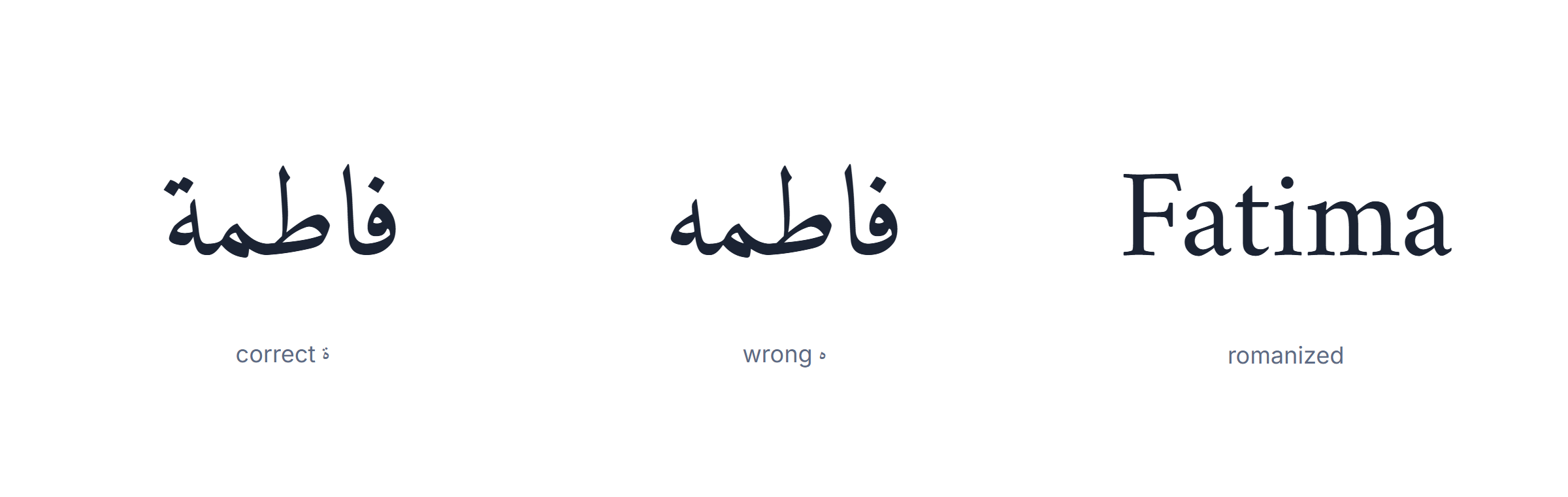
The Arabic name generator writes every one of them for you, which matters more than it sounds: several end in ة and are routinely mis-typed with a plain ه. That single pair of dots is the difference between a correctly spelled name and one that will not match in a search box — see the Arabic letters guide for the full set.
Arabic Names by Meaning
Because the meaning lives in the root, searching by idea is the fastest way to use this Arabic name generator. Four themes cover most of what people actually look for, and each one is a filter the Arabic name generator already understands.
Names that mean light
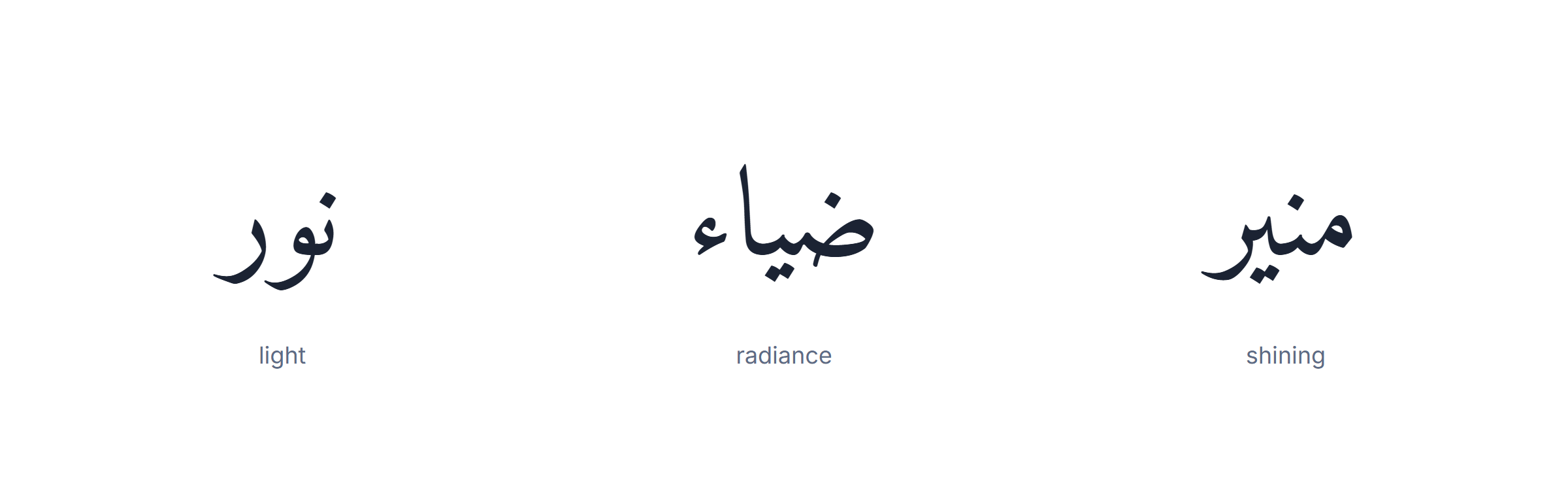
- Noor نور — light. Unisex across most of the Arab world.
- Diya ضياء — radiance, brightness.
- Munir منير / Munira منيرة — shining, giving light.
- Ishraq إشراق — sunrise, first light.
Names that mean strength
- Hamza حمزة — lion, steadfast.
- Usama أسامة — one of the many Arabic words for lion.
- Haydar حيدر — lion; a classical epithet.
- Faris فارس — horseman, knight.
Names that mean beauty and grace
- Jamila جميلة — beautiful.
- Wasim وسيم — handsome, well-featured.
- Razan رزان — dignified, composed.
- Hasan حسن — good, handsome.
Names that mean faith
- Iman إيمان — faith.
- Huda هدى — right guidance.
- Sadiq صادق — truthful.
- Amin أمين — trustworthy.
Arabic Names by Region
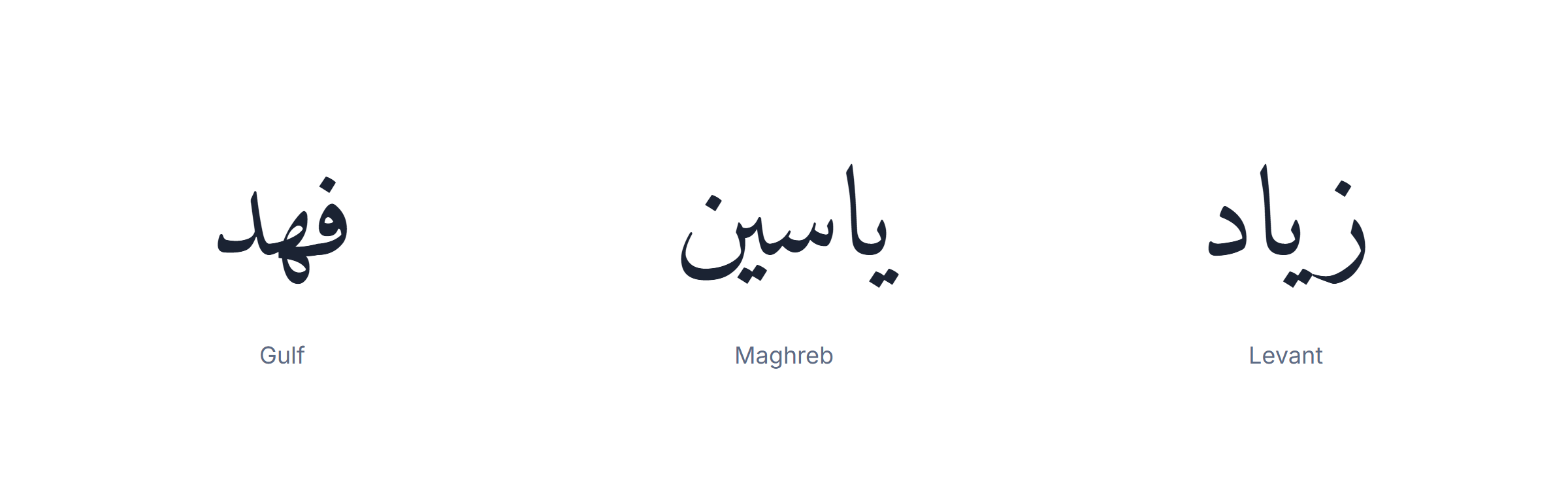
Arabic is one written language and many spoken ones, and naming follows the spoken map. A name that reads as ordinary in Riyadh can read as unusual in Casablanca — both are correct Arabic, which is why the Arabic name generator tags every result with a region. Standard Arabic and Moroccan Arabic are catalogued as separate entries for exactly this reason.
Gulf (Khaliji)
- Fahd فهد, Nayef نايف, Sultan سلطان for boys.
- Moudhi موضي, Latifa لطيفة, Sheikha شيخة for girls.
- Tribal nisba endings — al-Otaibi, al-Qahtani — are part of everyday names here.
Maghreb — Morocco, Algeria, Tunisia
- Yassine ياسين, Ayoub أيوب, Mehdi مهدي for boys.
- Hajar هاجر, Nawal نوال, Imane إيمان for girls.
- French romanization dominates: Yassine, not Yasin. Our Darija keyboard writes the Moroccan forms directly.
Levant and Egypt
- Ziyad زياد, Basel باسل, Tamer تامر for boys.
- Rana رنا, Dana دانة, Farah فرح for girls.
- Short, two-syllable names are strongly preferred here.
If the differences between these varieties interest you beyond names, our guide to Arabic dialects maps them properly, and Arabic vs Persian covers the shared names that are not actually Arabic in origin.
Five Mistakes People Make With Arabic Names
These are the errors that turn a good name into an incorrect one. The Arabic name generator avoids all five for you; the moment you retype the name somewhere else, they are yours to avoid. Every one of them takes about ten seconds to check.
1. Translating instead of transliterating
An Arabic name generator transliterates; a translator does not. A translator turns Rose into وردة — the flower. That is not the name, that is the word. To carry a name across you transliterate the sound: Rose becomes روز. Our Arabic transliteration tool does the sound, and writing your name in Arabic walks through the whole procedure.
2. Dropping the ta marbuta
فاطمة ends in ة. Written فاطمه with a plain ه it still reads as “Fatima” to a human and as a different string to every search box, database and passport reader on earth.
3. Losing the hamza
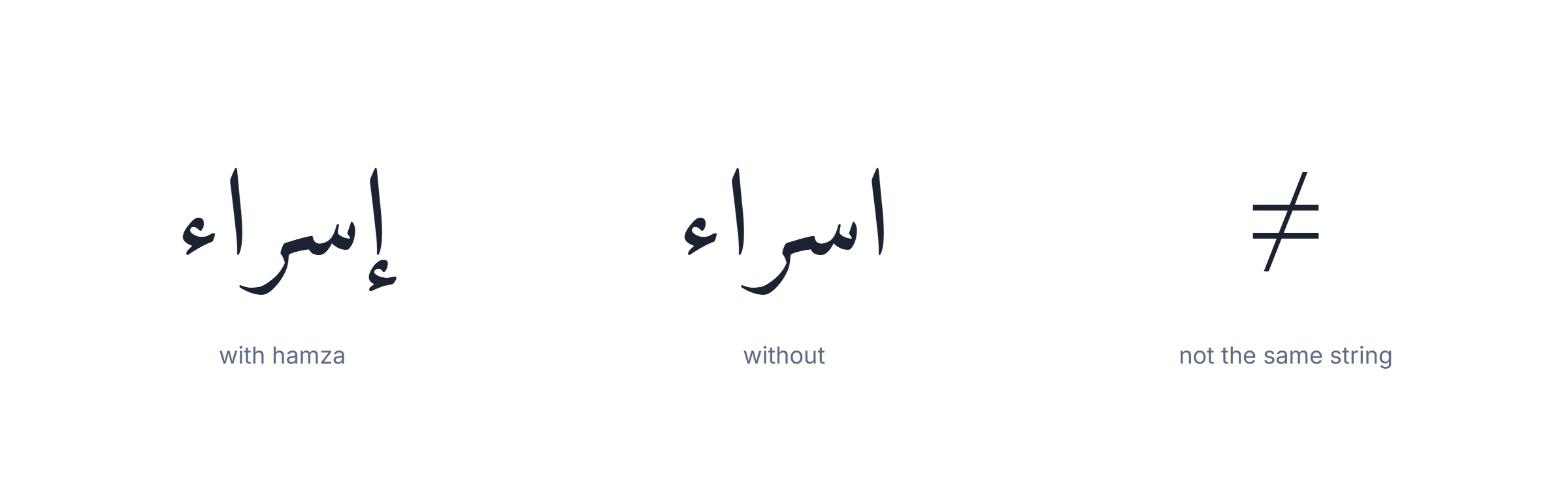
إسراء and اسراء look nearly identical and are different sequences of Unicode characters — the Arabic code chart gives each hamza carrier its own code point. Our guide to typing hamza in Arabic covers all four carriers.
4. Using Abd on its own
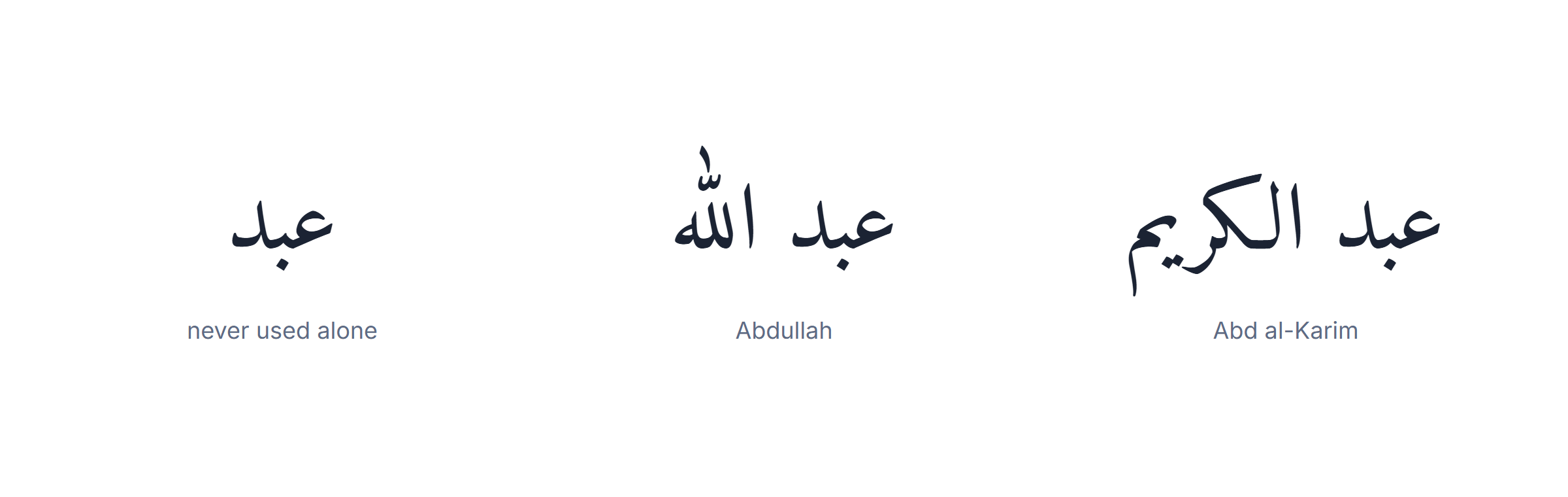
عبد means servant of. It is never a complete name: it must be followed by one of the names of God — Abdullah عبد الله, Abd al-Rahman عبد الرحمن. Splitting the pair across a first-name and last-name field is the most common registration error made with Arabic names abroad.
5. Mixing romanization systems
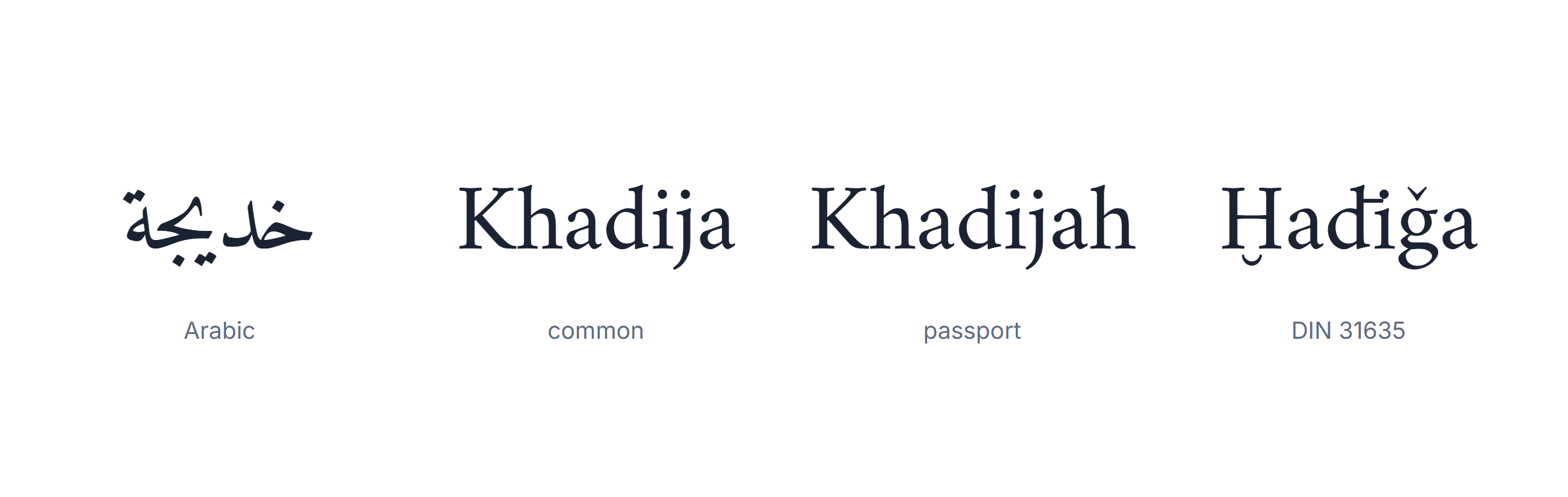
There is no single correct Latin spelling of an Arabic name. Khadija, Khadijah and Ḫadīǧa are the everyday, passport and academic forms of one name. Libraries follow the ALA-LC romanization table. Pick one system per document and stay in it.
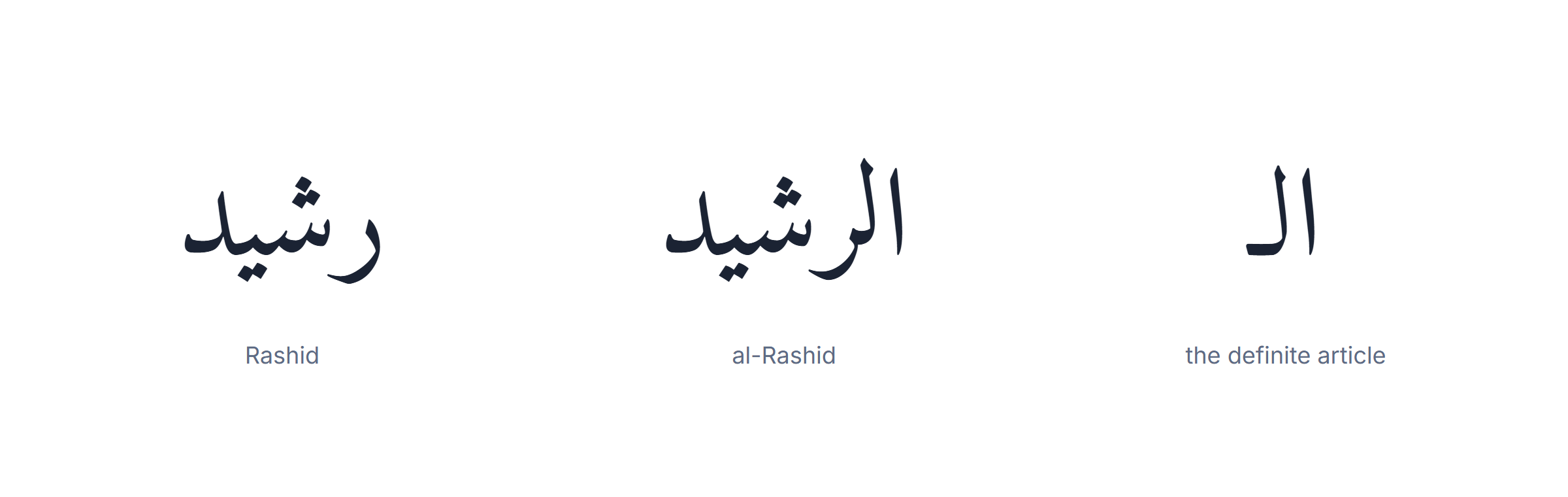
The definite article is part of the same problem: al-, el-, ul- and Al are all the same الـ, and it is not part of the given name.
After the Arabic Name Generator: Writing the Name in Arabic Script
Once the Arabic name generator has given you a name, three tools take it the rest of the way — and all three run in the browser with nothing to install.
- Type it. The online Arabic keyboard writes the letters directly; the keyboard with harakat adds the short vowels if you want the name fully voweled.
- Type it by sound. English to Arabic typing and franco-Arabic typing convert what you hear into Arabic script.
- Make it a design. The Arabic calligraphy generator renders it in classical styles, and Arabic text in Photoshop fixes the broken, disconnected letters design software is famous for.
Type the name on the device you actually use
The Arabic name generator runs in any browser, but writing the name afterwards depends on your operating system. These guides set up the Arabic keyboard once, permanently:
- Arabic keyboard on iPhone and on Android — the two-minute setup.
- Arabic keyboard for Windows, on Mac, on Linux and on Chromebook.
- Typing Arabic in Word, in Google Docs and on WhatsApp — where a name usually has to end up.
If your physical keyboard is not a US one, the Arabic name generator pairs with the layout you already have:
- Clavier arabe AZERTY and clavier arabe phonétique for French keyboards.
- Arabische Tastatur for German keyboards and Arapça klavye for Turkish ones.
- The Arabic keyboard layout maps every key, and the Arabic typing test tells you when you no longer need to look.
Arabic is written right to left and its letters change shape according to position, which is why a name pasted into the wrong tool comes out reversed or disconnected. The Unicode bidirectional algorithm is what decides that, and why Arabic is written right to left explains the practical consequences. Choosing a font matters too — see Arabic fonts and the Arabic presentation forms chart if a name renders as separate letters.
Arabic Names for a Business or Brand
The business filter in this Arabic name generator returns real Arabic words rather than personal names, because a brand is chosen for sound and meaning, not for tradition. Three things separate a word that works as a brand from one that does not:
- Length. Two syllables, three at most. Short words with open vowels travel across Arabic and Latin scripts without losing their shape.
- No emphatic clusters. Words built on ص ض ط ظ are beautiful in Arabic and hard for non-Arabic speakers to say, which costs you word of mouth.
- One clear meaning. A word with a single dominant sense survives translation into a tagline; a word with four does not.
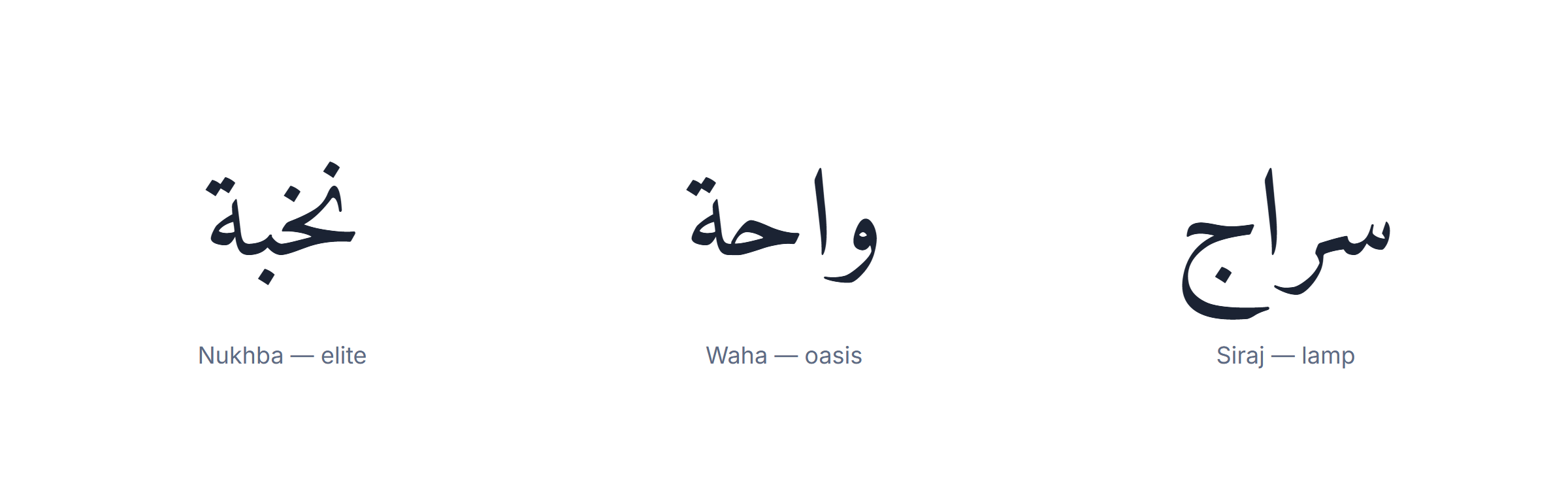
- Nukhba نخبة — the elite, the selection.
- Waha واحة — oasis.
- Siraj سراج — lamp, light source.
- Rouya رؤية — vision.
- Itqan إتقان — mastery, doing something well.
- Wamda ومضة — a flash, a spark.
Two checks before you commit to anything the Arabic name generator gives you:
- Read it aloud to a native speaker of your market’s dialect. A word that is neutral in Standard Arabic can carry an unintended sense locally.
- Search the trademark registers. The WIPO Global Brand Database internationally, and the USPTO trademark search for the United States. A name being authentic Arabic says nothing about whether it is available.
The Arabic calligraphy styles guide is worth a look before you brief a designer: the style you pick changes how a brand name reads far more than the font size does.
More Arabic Guides
The Arabic name generator is one tool in a set, and it works better next to the rest of them. These guides cover the writing system the names in the Arabic name generator are built from:
- The 28 Arabic letters and how each one is pronounced.
- Arabic harakat — the short vowels that decide how a name is read aloud.
- Arabic numbers and Arabic punctuation, for writing a name inside a real sentence.
- Beautiful Arabic words and Arabic quotes and proverbs, if you are naming something rather than someone.
- Common Arabic phrases and Arabic greetings — how to introduce the name you chose.
- How to learn Arabic, is Arabic hard to learn, and Arabic grammar rules.
- Arabic vs Urdu — the other big script that borrows Arabic letters and Arabic names.
- All free Arabic tools and the full guide index.
Frequently Asked Questions
Are these real Arabic names?
Yes. Every name in this database is an authentic Arabic name used across the Arab world. They are drawn from Quranic, classical, and modern Arabic traditions with verified meanings — cross-referenced against established resources on Islamic naming conventions and classical Arabic literature.
What does “Quranic” origin mean for an Arabic name?
A Quranic name is one that appears in or is directly derived from the Quran. These names carry deep spiritual significance and are among the most widely used in Muslim communities worldwide. Choosing a Quranic name is a longstanding tradition in Islamic culture, reflecting values of faith, virtue, and divine connection.
What is the difference between Classical and Modern Arabic names?
Classical Arabic names originate from pre-Islamic and early Islamic poetry, history, and literature — names like Omar (عمر), Khalid (خالد), and Layla (ليلى). Modern Arabic names often blend classical Arabic roots with contemporary phonetics and are more commonly used in urban Arab societies today, such as Rayan (ريان) and Zain (زين). Both traditions produce meaningful, authentic names.
Can I use business names from this Arabic name generator?
The business category contains authentic Arabic words that work well as brand names — concepts like Rouya (رؤية, vision), Itqan (إتقان, mastery), and Wamda (ومضة, spark). These are real Arabic words with strong semantic value, not invented names. Always verify trademark availability in your jurisdiction before using any name commercially. Once you’ve chosen a name, use our Arabic keyboard to write it correctly in Arabic script.
Can I write Arabic names using a keyboard tool?
Yes. Once you find a name you love, you can type it in Arabic script using our free online Arabic keyboard. We also offer a clavier arabe for French speakers, and a Chinese keyboard if you need to write in other scripts as well.
How do I know an Arabic name is spelled correctly?
Compare the Arabic column of the Arabic name generator, not the Latin one. Latin spellings of Arabic names vary by country and by transliteration system, so two people can spell the same name four different ways and all be right. The Arabic script is the stable form: if the Arabic matches, the name matches. The three spelling details that actually change a name are the ة ending, the hamza, and the definite article الـ.
What is the difference between an Arabic name and an Islamic name?
They overlap but are not the same. An Arabic name is any name from the Arabic language — Layla and Ziyad are Arabic and have no religious content. An Islamic name is one carried by a figure in Islamic tradition or built from a divine attribute, and many are not Arabic in origin at all: Ibrahim, Yusuf and Maryam entered Arabic from Hebrew, and Ayesha-style names are used by Muslims in Indonesia, Turkey and Pakistan who speak no Arabic. The origin filter in the Arabic name generator marks the Quranic ones.
Can I use these Arabic names for a character in a novel or a game?
Yes, and it is one of the most common reasons people open an Arabic name generator. Two suggestions that make fiction read as authentic: keep one region consistent for one family, and use the nasab — bin or bint plus the father’s name — instead of inventing a surname. A Gulf character with a Maghrebi given name and a Levantine family name reads to an Arabic-speaking reader the way “Seamus Kowalski-Nakamura” reads in English.
Does this Arabic name generator work on a phone?
Yes. The Arabic name generator, its filters, the search box and the favourites list all work in a phone browser with no app and no account. Nothing you generate or save is sent anywhere — favourites are stored in your own browser. If you want to type Arabic on the same phone, our Arabic keyboard runs in the mobile browser too.