Arabic Alphabet Pronunciation: The Complete Guide to All 28 Letters
Arabic alphabet pronunciation splits cleanly: 21 of the 28 letters have a close English equivalent, and 7 do not. Those seven are where every beginner’s accent is decided. Here is each letter, where it is made in the mouth, and the trick for the hard ones.

All 28 letters at a glance
Read down the table once, then use it as a reference. The closest English sound column is a starting point, not a promise — seven of these have no honest English equivalent and are handled properly further down.
| Letter | Name | Transliteration | Closest English sound |
|---|---|---|---|
| ا | alif | ā | the a in father (long) |
| ب | bāʾ | b | b in book |
| ت | tāʾ | t | t in table |
| ث | thāʾ | th | th in think (unvoiced) |
| ج | jīm | j | j in jam — but g in go in Egypt |
| ح | ḥāʾ | ḥ | 🔴 no English equivalent |
| خ | khāʾ | kh | 🔴 the ch in Scottish loch |
| د | dāl | d | d in door |
| ذ | dhāl | dh | th in this (voiced) |
| ر | rāʾ | r | a rolled r, as in Spanish pero |
| ز | zāy | z | z in zoo |
| س | sīn | s | s in sun |
| ش | shīn | sh | sh in ship |
| ص | ṣād | ṣ | 🔴 emphatic s |
| ض | ḍād | ḍ | 🔴 emphatic d |
| ط | ṭāʾ | ṭ | 🔴 emphatic t |
| ظ | ẓāʾ | ẓ | 🔴 emphatic dh |
| ع | ʿayn | ʿ | 🔴 no English equivalent at all |
| غ | ghayn | gh | 🔴 a French or German r |
| ف | fāʾ | f | f in fish |
| ق | qāf | q | 🔴 a k made far back in the throat |
| ك | kāf | k | k in key |
| ل | lām | l | l in light |
| م | mīm | m | m in moon |
| ن | nūn | n | n in noon |
| ه | hāʾ | h | h in hat |
| و | wāw | w / ū | w in water, or a long oo |
| ي | yāʾ | y / ī | y in yes, or a long ee |

The 21 letters that behave
Most of the alphabet maps onto English closely enough that you can start using it on day one. ب ت د ز س ش ف ك ل م ن ه are effectively free — if you can say b, t, d, z, s, sh, f, k, l, m, n, h, you can say these.
Three need a small adjustment rather than a new skill:
- ث thāʾ and ذ dhāl are the two English th sounds — unvoiced in think, voiced in this. English speakers have both already and simply need to notice they are different letters in Arabic.
- ر rāʾ is tapped or rolled, closer to Spanish or Italian than to the English r. If you can say the Spanish pero, you have it.
- ج jīm is regionally variable and this trips people up: it is j as in jam in most of the Arab world, a hard g as in go in Egypt, and something closer to the French j in parts of the Levant and North Africa. All three are correct in their place.
The 7 sounds English does not have
These are the ones worth real time. Get them approximately right early and you will be understood; get them wrong and never revisit them, and they calcify.
ع — ʿayn
The famous one. It is a voiced pharyngeal — made by tightening the throat well below where any English sound is produced, then voicing through the constriction.
How to find it: start to gag gently, and stop just before the reflex. Freeze your throat at that tension and hum. That tight, slightly strained voiced sound is ʿayn. It is a sound English uses only involuntarily, which is why it feels so odd deliberately.
⚠️ It is not a glottal stop, and it is not silent. Writing it as an apostrophe in transliteration has misled a generation of learners.
ح — ḥāʾ
ʿayn’s unvoiced twin: exactly the same throat position, no voice. How to find it: breathe onto a cold window to fog it, then push the air out harder and from further back. A strong, breathy h made in the throat rather than the mouth.
خ — khāʾ
The easiest of the seven for most Europeans. It is the ch in Scottish loch, German Bach or Spanish jamón — friction at the back of the roof of the mouth.
غ — ghayn
The voiced version of khāʾ, and effectively the standard French or German r. Say khāʾ, then turn your voice on without moving anything else. A gargle with vocal cords engaged.
ق — qāf
A k made much further back — the closure happens at the uvula rather than the soft palate. How to find it: say k, then say it again while trying to swallow. The contact point slides backwards; that is qāf.
📌 Regional note worth knowing before you correct anyone: qāf is a hard g in much of the Gulf and in Bedouin speech, and a glottal stop in Cairo and Beirut — so qahwa (coffee) is heard as gahwa and ahwa. In MSA and in the Qur’an it is the uvular sound described here.
ص ض ط ظ — the emphatics
Treated in their own section below, because what makes them hard is not the consonant.
Emphatic letters and why they matter
Four letters — ص ṣād, ض ḍād, ط ṭāʾ, ظ ẓāʾ — are the “emphatic” or velarised counterparts of س, د, ت and ذ.
The difference is not in the tongue tip. It is in the back of the tongue, which rises toward the soft palate and makes the whole mouth cavity darker. The consonant barely changes; the vowels around it do.
This matters because emphasis is contrastive — it changes meaning, not just accent:
| Plain | Meaning | Emphatic | Meaning |
|---|---|---|---|
| سيف | sayf — sword | صيف | ṣayf — summer |
| تين | tīn — figs | طين | ṭīn — clay, mud |
Arabic is sometimes called لغة الضاد — “the language of the ḍād” — because ض was long held to be unique to it. That is a claim about identity more than phonetics, but it tells you how central these four are.
The look-alikes people confuse
Several letters share one skeleton and differ only in dots. Learn them as families and the confusion disappears in about a week.
| Family | Letters | What separates them |
|---|---|---|
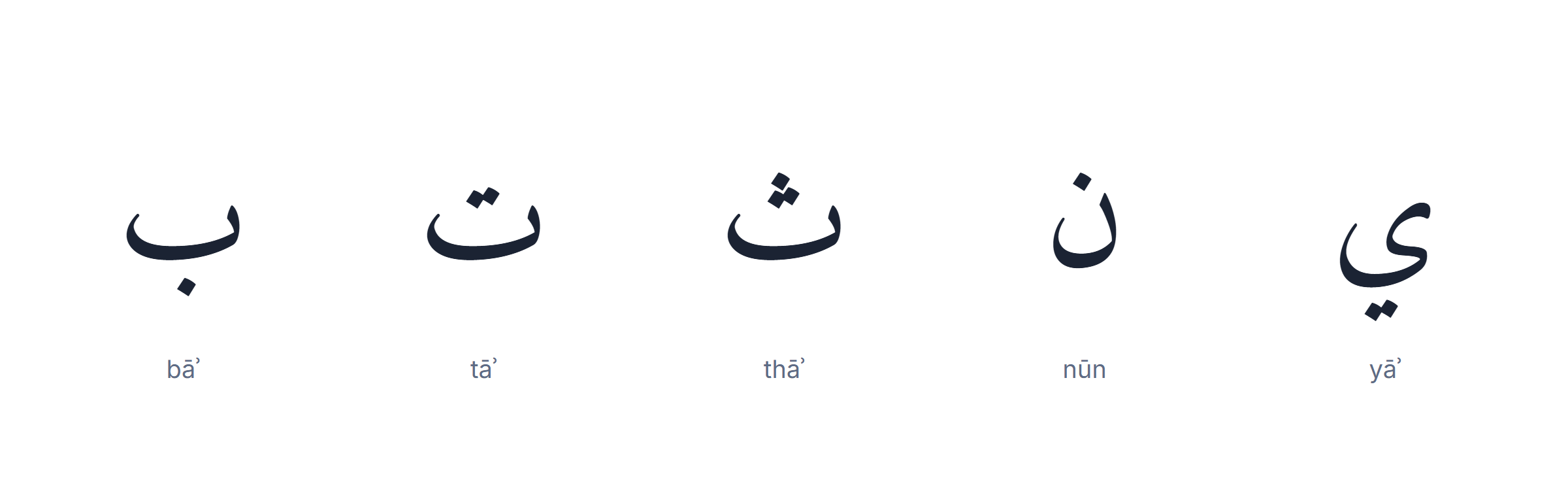
| The bāʾ family | ب ت ث ن ي | dot count and position: 1 below, 2 above, 3 above, 1 above, 2 below |
| The jīm family | ج ح خ | dot inside, no dot, dot above |
| The dāl family | د ذ | one dot above or nothing |
| The rāʾ family | ر ز | one dot above or nothing |
| The sīn family | س ش | three dots above or nothing |
| The ṣād family | ص ض | one dot above or nothing |
| The ṭāʾ family | ط ظ | one dot above or nothing |
| The ʿayn family | ع غ | one dot above or nothing |
🔑 Notice the pattern: in nearly every pair, the dotted one is the “heavier” sound. That is not a rule you can rely on absolutely, but as a memory hook it does a lot of work.
Sun and moon letters
This is pronunciation, not spelling, and it catches everyone once.
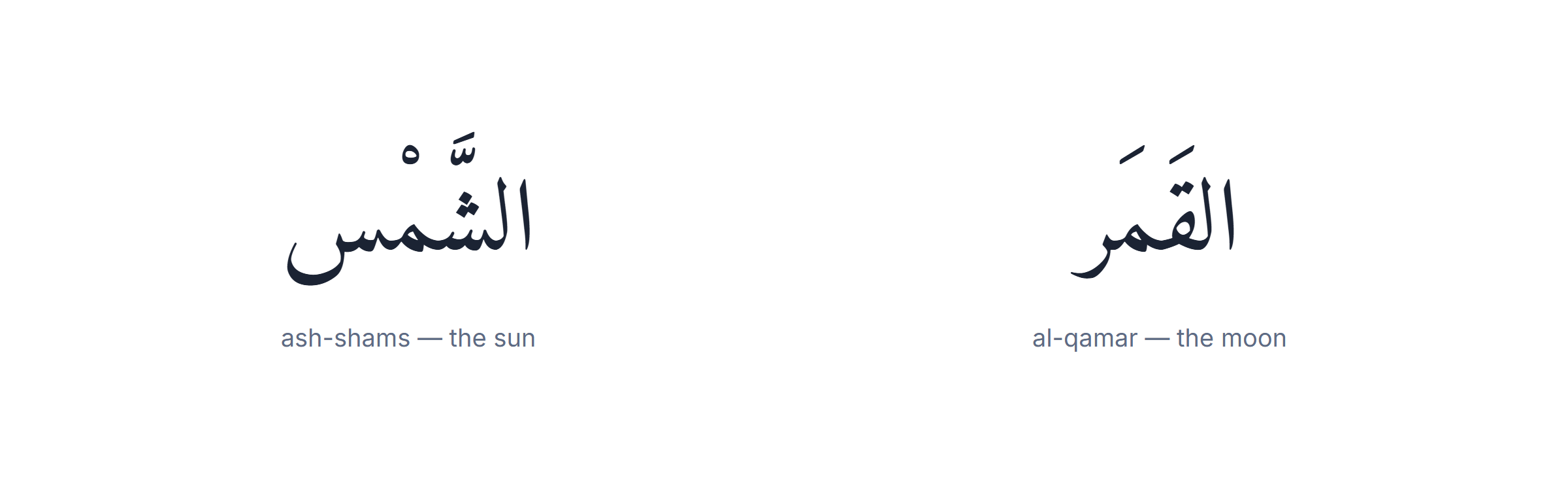
The definite article is ال al-. Before fourteen “sun letters”, the l is written but not pronounced — instead the following consonant doubles:
- الشمس is written al-shams and said ash-shams (the sun) — hence the name.
- القمر is written al-qamar and said al-qamar (the moon), because qāf is a moon letter.
Sun letters: ت ث د ذ ر ز س ش ص ض ط ظ ل ن. Everything else is a moon letter. The shortcut: sun letters are the ones made with the tongue tip near the front of the mouth — the same place l is made, which is exactly why it assimilates.
How to practise so it sticks
- Work in minimal pairs, not lists. sayf / ṣayf, tīn / ṭīn, habb / ḥabb. Your ear learns contrasts; it does not learn isolated sounds.
- Record yourself. Thirty seconds a day. The gap between what you think you said and what you said is the whole lesson, and you cannot hear it live.
- Type and listen, do not just read. Producing a letter and immediately hearing the correct version is the tightest feedback loop available without a tutor.
- Give the seven hard sounds ten minutes a day for two weeks, then stop drilling them and use them. Two weeks of focus beats six months of incidental exposure.
- Do not chase perfection on ʿayn in week one. An approximate ʿayn is understood. A missing one turns عين (eye) into something that is not a word.
The four shapes every letter has
This is the part that makes the alphabet look bigger than 28 letters, and it is the part most charts leave until too late. Arabic letters are cursive always — there is no print version where they stand apart. Each letter therefore has up to four forms depending on where it sits in the word: isolated, initial, medial and final.
Take ʿayn, the letter that scares people most. Isolated it is ع, initial عـ, medial ـعـ, final ـع. Four shapes, one letter, one sound. Nothing about the pronunciation changes — only the join.
The good news is that the four shapes are not four things to memorise. In almost every case the letter keeps one recognisable core and simply grows or loses a connecting tail. Once you have read a hundred words you stop seeing the shapes at all and start seeing the letter, the same way you stopped noticing that a and a look different in handwriting and in print.
The practical consequence for pronunciation is this: never learn a letter from its isolated form alone. Learn it inside a word. A chart that shows you ب and stops has taught you the least common of its four appearances.
The six letters that never connect forward
Six letters break the cursive chain. They join to the letter before them but refuse to join to the letter after, which forces a visible gap in the middle of a word:
ا د ذ ر ز و
That is alif, dāl, dhāl, rāʾ, zāy and wāw. Because of them, a single Arabic word can look like two or three separate pieces. مدرسة (madrasa, school) breaks after the dāl. أوروبا (Ūrūbbā, Europe) breaks three times.
Beginners read those gaps as word boundaries and lose the sentence. It is one of the two most common reading errors, and it is fixed in an afternoon once you know the six letters. Learn them as a set — they are the only exceptions, there is no seventh, and none of them changes sound because of the break.
The related habit worth building early: word boundaries in Arabic are spaces, and they are wider than the gaps. Once you trust the space rather than the shape, the text stops fragmenting.
Arabic alphabet pronunciation in one paragraph
Arabic alphabet pronunciation is 21 easy letters and 7 hard ones. The 21 map onto sounds you already make. The 7 — ʿayn, ḥāʾ, khāʾ, ghayn, qāf and the four emphatics — are made in the throat and the back of the mouth, where English produces nothing. Give those seven ten minutes a day for a fortnight and Arabic alphabet pronunciation stops being the thing holding you back.
Sources and further reading
Everything factual on this page can be checked. These are the sources worth going to directly if you want more depth than an article can give:
- Wikipedia — Arabic alphabet
- Unicode Consortium — the Arabic code chart (PDF)
- Wikipedia — Emphatic consonants