Arabic Numbers: Both Digit Sets, and a Converter
Two different sets of symbols answer to the name Arabic numbers, and the counting words are a third thing again. Convert between them below, then take the tables you need.
Arabic numbers converter
Type any number. It converts both ways as you type — Western digits to Eastern Arabic digits and back — and the copy button puts the result on your clipboard.
Western digits in, Eastern Arabic digits out.
What “arabic numbers” actually means
The phrase Arabic numbers is genuinely ambiguous, and almost every argument about it comes from two people using it for two different things. Both are correct, which is why the argument never ends.
The two things Arabic numbers can mean
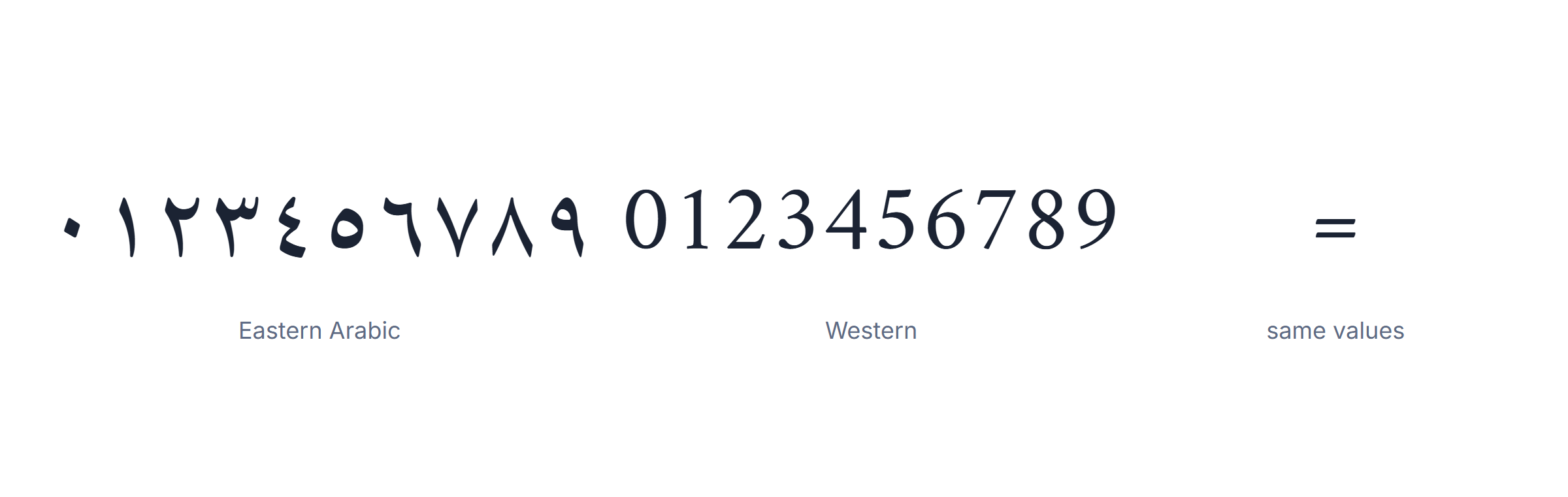
- The digits you are reading right now. 0 1 2 3 4 5 6 7 8 9 are called Arabic numerals in English because Europe learned them from Arabic mathematics. They are the standard digits of almost every country on earth.
- The digits used in much of the Middle East. ٠ ١ ٢ ٣ ٤ ٥ ٦ ٧ ٨ ٩ are what an Egyptian newspaper prints. English usually calls these Eastern Arabic numerals.
- The counting words. Someone asking for Arabic numbers may simply want to know how to say one, two, three out loud in Arabic — a vocabulary question, not a symbol question.
So are 1234 Arabic numbers?
Yes. 1, 2, 3 and 4 are Arabic numerals in the historical sense the word carries in English. They reached Europe through Arabic-speaking mathematicians, and the name stuck. It is a statement about how the symbols travelled, not about which country writes them today.
Why the name Arabic numbers feels wrong to everyone
- An English speaker calls 1 2 3 Arabic numerals and then sees Arabic text using different symbols entirely.
- An Arabic speaker calls ١ ٢ ٣ al-arqam al-hindiyya — Indian numerals — because that is where Arabic mathematics got them.
- Both names are honest credit to whoever passed the system along. Nobody is wrong; the labels just point backwards one step each.
The two sets of Arabic numbers, side by side
This is the table of Arabic numbers most people came for. The value is identical in both columns — only the shape changes, and the shapes are worth knowing because two pairs are easy to confuse.
| Value | Western | Eastern Arabic | Name in Arabic | Roughly |
|---|---|---|---|---|
| zero | 0 | ٠ | صفر | sifr |
| one | 1 | ١ | واحد | wahid |
| two | 2 | ٢ | اثنان | ithnan |
| three | 3 | ٣ | ثلاثة | thalatha |
| four | 4 | ٤ | أربعة | arbaa |
| five | 5 | ٥ | خمسة | khamsa |
| six | 6 | ٦ | ستة | sitta |
| seven | 7 | ٧ | سبعة | sabaa |
| eight | 8 | ٨ | ثمانية | thamaniya |
| nine | 9 | ٩ | تسعة | tisaa |
The two pairs of Arabic numbers that catch everyone
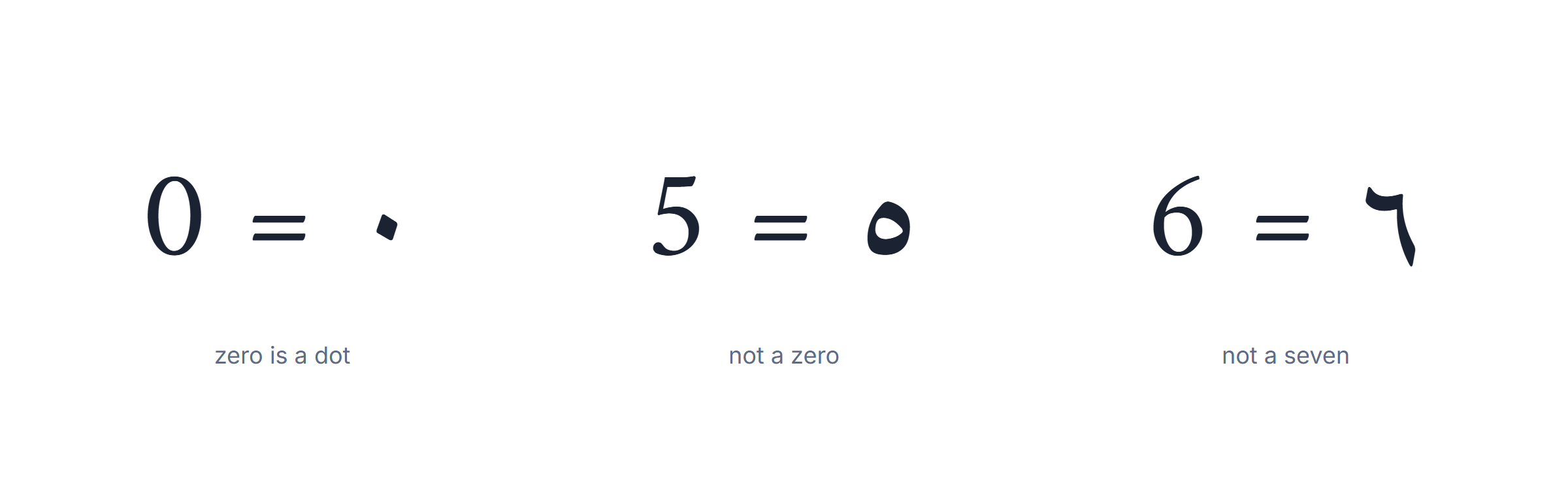
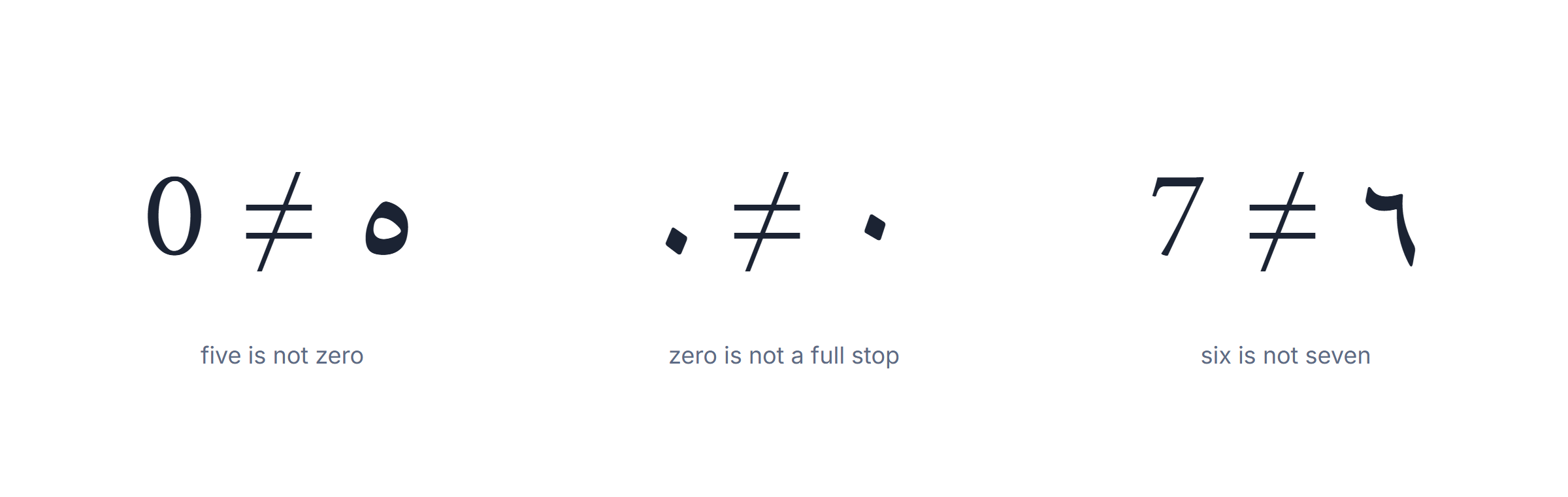
- ٠ is zero, not a full stop. Zero is written as a dot. A number that looks like it ends in a period usually ends in a zero.
- ٥ is five, and it looks like a Western 0. This is the single most common misreading of Arabic numbers, and it turns 50 into 5 or 500.
- ٦ is six, and it looks like a Western 7. The pair with ٧ (seven) is worth ten seconds of attention now rather than a wrong price later.
- ٢ and ٣ are two and three, and they differ only by one more tooth.
A third set of Arabic numbers, in Iran and Pakistan
Persian and Urdu use the same system with four different shapes: ۷ for four, ۹ for six and ۺ for seven look distinctly different, and ۶ is the Persian five. The converter above accepts these too, so a number copied from a Persian page still comes back as plain digits.

Arabic numbers 1 to 10, 1 to 20 and beyond
The counting words for the Arabic numbers matter as much as the symbols. Ten of them carry most of the work, because everything up to a hundred is assembled out of the first ten plus a handful of patterns.
One to ten
| # | Digit | Arabic | Say it |
|---|---|---|---|
| 1 | ١ | واحد | waahid |
| 2 | ٢ | اثنان | ithnaan |
| 3 | ٣ | ثلاثة | thalaatha |
| 4 | ٤ | أربعة | arbaa |
| 5 | ٥ | خمسة | khamsa |
| 6 | ٦ | ستة | sitta |
| 7 | ٧ | سبعة | sabaa |
| 8 | ٨ | ثمانية | thamaanya |
| 9 | ٩ | تسعة | tisaa |
| 10 | ١٠ | عشرة | ashara |
Eleven to twenty
Eleven and twelve are their own words; thirteen through nineteen are simply the unit followed by a fixed ending, so seven of the nine are free once you know one to ten.
| # | Digit | Say it | Built from |
|---|---|---|---|
| 11 | ١١ | ahada ashar | its own word |
| 12 | ١٢ | ithna ashar | its own word |
| 13 | ١٣ | thalaatha ashar | three + teen |
| 14 | ١٤ | arbaa ashar | four + teen |
| 15 | ١٥ | khamsata ashar | five + teen |
| 16 | ١٦ | sittata ashar | six + teen |
| 17 | ١٧ | sabaata ashar | seven + teen |
| 18 | ١٨ | thamaaniyata ashar | eight + teen |
| 19 | ١٩ | tisaata ashar | nine + teen |
| 20 | ٢٠ | ishruun | its own word |
The tens, and why they are the cheapest thing to learn
| # | Digit | Say it |
|---|---|---|
| 20 | ٢٠ | ishruun |
| 30 | ٣٠ | thalaathuun |
| 40 | ٤٠ | arbauun |
| 50 | ٥٠ | khamsuun |
| 60 | ٦٠ | sittuun |
| 70 | ٧٠ | sabauun |
| 80 | ٨٠ | thamaanuun |
| 90 | ٩٠ | tisuun |
| 100 | ١٠٠ | mia |
- Every ten from thirty to ninety is the matching unit plus the same ending. Learn the ending once and you have seven numbers.
- Between the tens, Arabic says the unit first: twenty-one is literally one and twenty. English did this too, a few centuries ago, in four and twenty blackbirds.
- Hundreds and thousands stack the same way, so a hundred and a thousand are the last two words you need before you can read a price tag.
Past a hundred
- مئة — one hundred.
- ألف — one thousand.
- مليون — one million, and it sounds close enough to the English word to be free.

The history of the Arabic numbers, and where the numerals came from
The history of the Arabic numbers explains the naming mess completely, and it takes about a paragraph.
The route
- India, by the 6th century. A base-ten positional system with a symbol for zero is developed and used by Indian mathematicians.
- Baghdad, 8th and 9th centuries. Arabic mathematicians adopt it. Al-Khwarizmi writes it up; his name survives in the word algorithm, and his book title survives in algebra.
- Europe, 12th and 13th centuries. Latin translations carry the system west, where it is called Arabic because that is who Europe got it from. Fibonacci’s 1202 book pushes it into merchant practice.
Why the Arabic numbers won
- Position carries value. The 2 in 20 means something different from the 2 in 2, so ten symbols express any number at all.
- Zero is a number, not a gap. That is the piece Roman numerals never had, and without it long multiplication and division are painful.
- Arithmetic becomes writable. Try multiplying MCMXCIV by XLII and the advantage stops being abstract.
Zero is the piece that mattered most
Of everything the system carried west, the zero is the part that changed what was possible. It is easy to underrate because it looks like nothing, and that is precisely the point: it is a symbol whose job is to say that a place is empty.
- It makes position work. Without a mark for an empty place there is no way to tell 205 from 25, so the whole positional idea collapses.
- It turns arithmetic into a procedure. Columns line up, carrying works, and long division becomes something a clerk can be taught rather than something a mathematician performs.
- It becomes a number in its own right. Treating zero as a quantity you can add and subtract, rather than a placeholder, is the step that opens negative numbers and algebra.
- The name travelled with it. Arabic sifr, meaning empty, became Latin zephirum, then Italian zero — and separately English cipher.
Roman numerals had no zero and no positions, which is why the Roman world did arithmetic on a counting board and wrote down only the results. The Arabic numbers made the writing down and the calculating the same act.
What each language calls it
- English: Arabic numerals — crediting the people it was learned from.
- Arabic: al-arqam al-hindiyya, Indian numerals — crediting the people they learned from.
- Both are one honest step of credit, pointing in opposite directions.
How to type and copy Arabic numbers
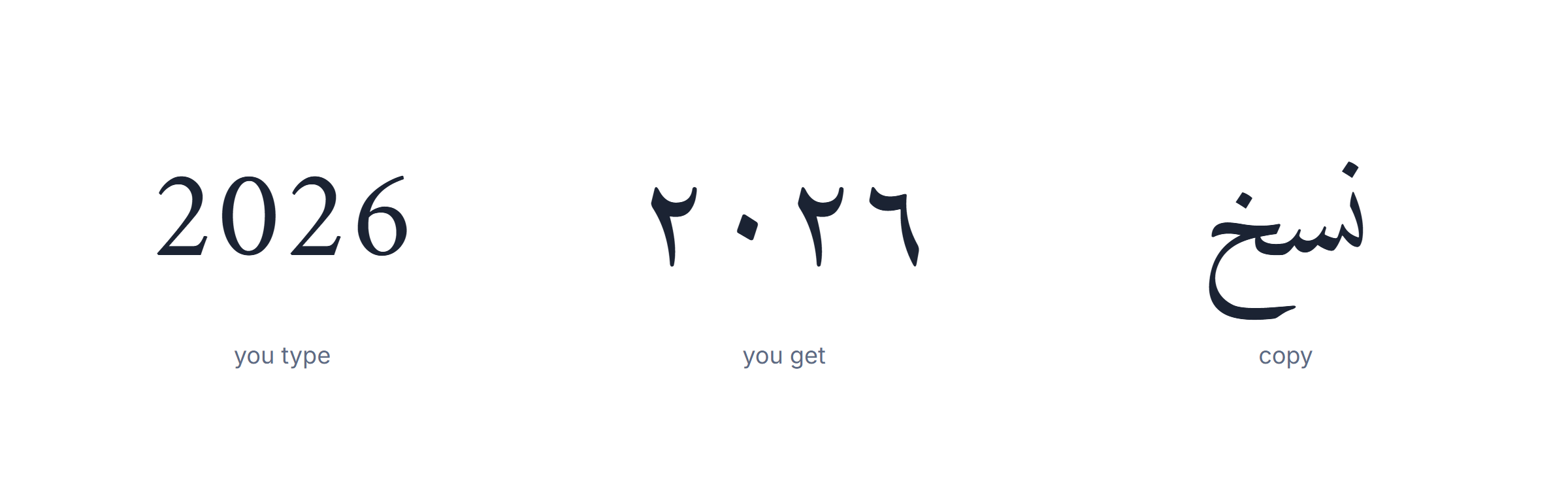
Every table on the internet tells you what the Arabic numbers look like. Far fewer tell you how to produce them, which is the actual problem when you have to fill in a form or label a diagram.
The fastest route
- Use the converter at the top of this page. Type or paste, press Copy. Nothing to install, and it works the same on a phone.
- Use our Arabic keyboard if you are writing whole sentences rather than a single figure.
- Switch your phone keyboard to Arabic if you need them daily — most Arabic layouts produce Eastern digits on the number row automatically.
What decides which Arabic numbers you get
| Situation | What you usually get | Why |
|---|---|---|
| Arabic keyboard on a phone | Eastern ٠١٢ | the layout maps the number row to Eastern digits |
| Arabic keyboard on Windows | Western 012 | most desktop layouts keep the Latin number row |
| A web form | whatever you paste | the field does not convert anything |
| A spreadsheet | Western, usually | Eastern digits often arrive as text, not a number |
The spreadsheet trap with Arabic numbers
- Eastern Arabic digits pasted into a spreadsheet are frequently treated as text, so sums silently return zero.
- Convert to Western digits before any calculation, and keep Eastern digits for display only.
- If a total looks impossibly round, check whether the column is text before you check the formula.
Reading Arabic numbers inside Arabic text
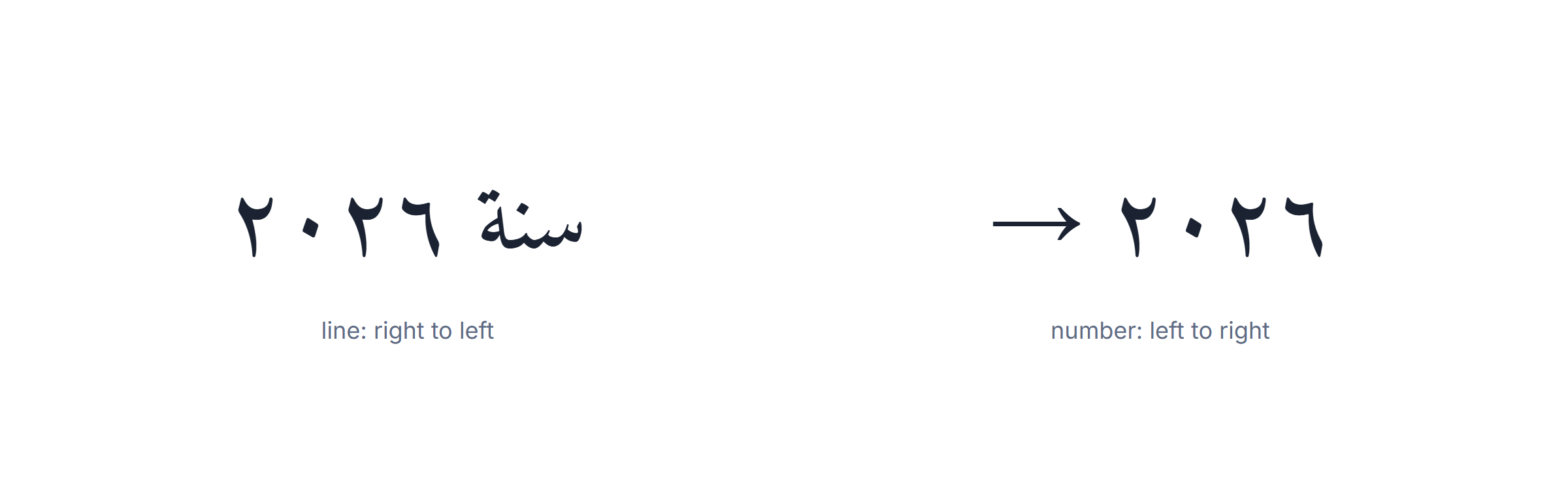
Arabic numbers inside Arabic text look like a bug and are not. Arabic runs right to left; the numbers inside it still run left to right, exactly as they do in English.
Why Arabic numbers in Arabic text are not mirrored
- The most significant digit stays on the left. ٢٠٢٦ is two thousand and twenty-six, read the same way you would read 2026.
- Your browser handles this with the bidirectional algorithm. You are not fighting it; it is already doing the right thing.
- What does flip is the position of the number in the sentence, because the sentence flows the other way.
Dates, phones and prices
- Dates keep their internal order, but the separators sit where the surrounding direction puts them, which is why a pasted date sometimes looks scrambled in a chat app.
- Phone numbers with a leading plus are the classic case — the plus can appear to jump to the wrong end.
- Prices are safest written with the currency spelled out rather than a symbol, because symbols are direction-neutral and drift.
When it really is broken
- Digits separated by spaces mean the text was pasted from a PDF or an image tool.
- A number that reads backwards means the app is not bidi-aware — that is the app, not your text.
- Boxes instead of digits mean a missing font, not a missing character.
Which set of Arabic numbers is used where
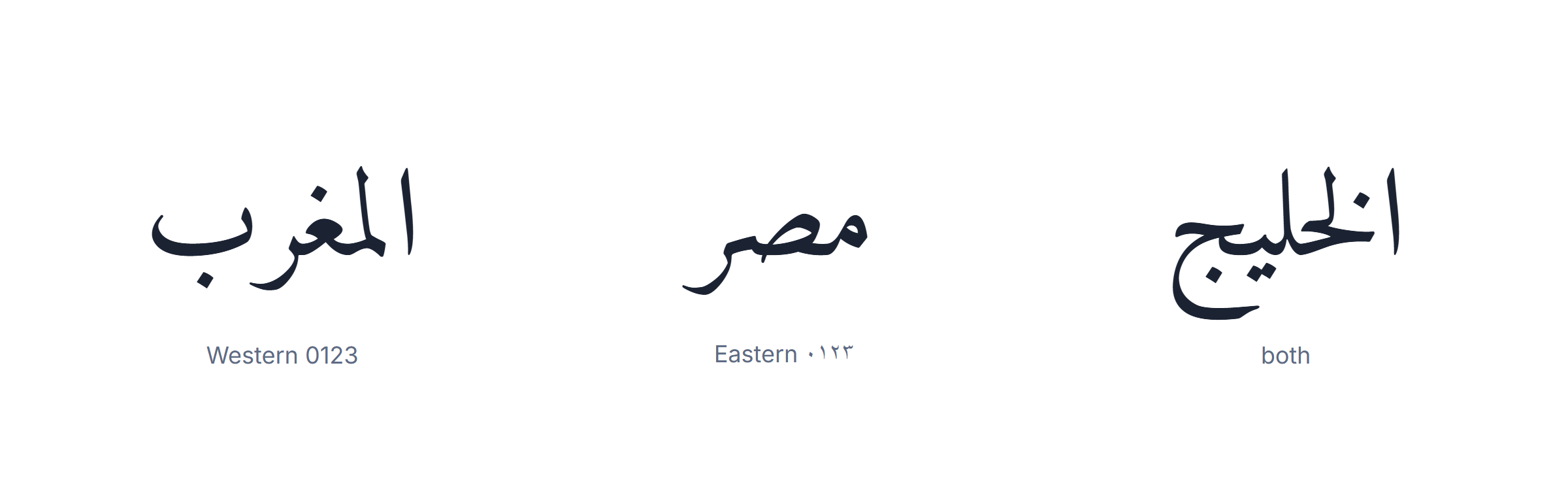
Both sets of Arabic numbers are alive, and the split is geographic rather than formal. Knowing it saves you guessing which one to write.
| Region | Everyday digits | Notes |
|---|---|---|
| Morocco, Algeria, Tunisia | Western 0123 | the Maghreb standardised on them long ago |
| Egypt, Sudan | Eastern ٠١٢ | newspapers, signage, school books |
| Levant and Gulf | both | Eastern in print, Western on screens and packaging |
| Iran, Pakistan, Afghanistan | Persian variants | same system, four different shapes |
| Software everywhere | Western | databases and code assume 0-9 |
The practical rule
- Writing to a person: match what they use. If you do not know, Western digits are understood everywhere.
- Writing for a machine: always Western. Every parser, database and form validator expects 0-9.
- Designing something: Eastern digits carry a visual register that Western ones do not, which is why they persist on signage long after the software moved on.

Ordinals: first, second, third
Counting Arabic numbers and putting them in order use different words, and mixing them is the most audible beginner mistake.
| Order | Arabic | Say it |
|---|---|---|
| first | الأول | al-awwal |
| second | الثاني | ath-thaani |
| third | الثالث | ath-thaalith |
| fourth | الرابع | ar-raabi |
| fifth | الخامس | al-khaamis |
- From third onwards the ordinal is built from the counting word, so the set is cheaper than it looks.
- First is irregular, as it is in most languages.
- Ordinals agree with the noun in gender, which counting numbers handle differently — a grammar topic, not a numbers one.
Learning the Arabic numbers, in order
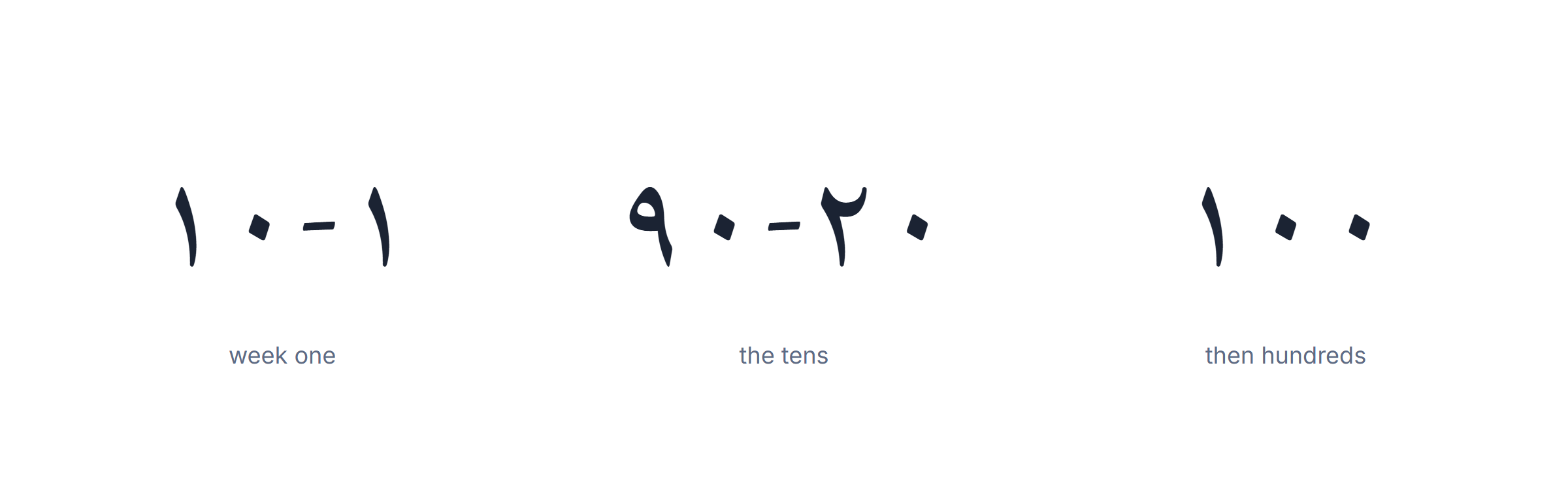
There is a cheap order for learning the Arabic numbers and an expensive one. The expensive one is one to a hundred in sequence; almost nobody finishes it.
The order to learn the Arabic numbers
- One to ten first, out loud, with the digits in front of you. Everything else is assembled from these.
- Then the tens — twenty through ninety. Eight words, one shared ending.
- Then the joining pattern: unit first, then the ten. That single rule unlocks every number from twenty-one to ninety-nine.
- Then a hundred and a thousand. At that point you can read a price, a date and a phone number, which is most of what anyone needs.
Where to practise the Arabic numbers without effort
- Change one device to Arabic and read the clock. You will see the digits several dozen times a day without setting aside a minute.
- Read prices in a photo of a shop sign. Real typography, unlike a clean table.
- Type dates with the converter above rather than looking them up — producing a number sticks better than recognising one.
Pronouncing the Arabic numbers
The written form and the spoken form drift apart faster here than most learners expect, and a table of transliterations hides it. Three things are worth knowing before you say a number out loud to anyone.
- The final vowel usually disappears. Standard Arabic writes thalaathatun; almost nobody says the ending in speech, so what you will hear is thalaatha. Learn the short form first and treat the full one as a reading convention.
- Two and twelve are the pair that trips people. Ithnaan shortens in speech, and in several dialects it barely resembles the written word. If a number sounds like nothing you learned, it is usually this one.
- The dialects diverge most at the low end. One through ten are the numbers people say constantly, so they are the ones that wore down differently in Cairo, Beirut and Casablanca. From twenty upward the region agrees far more than it disagrees.
None of that is a reason to delay. Numbers are one of the few areas where being understood does not require being correct: say the digits clearly and a listener will follow you, because the context — a price, a time, a floor in a building — does most of the work. The precision matters later, and it arrives from listening rather than from a table.
Counting words against digits: which to learn first
- Digits, if you are reading. Prices, signs, page numbers and forms are all symbols, and the ten shapes take an afternoon.
- Words, if you are speaking. A shopkeeper says a price out loud before writing it, and the written figure may never appear.
- Both, eventually — but the order should follow what you actually do this month, not what a course puts first.
How long the Arabic numbers take
- The ten digits: an afternoon, and most of that is separating ٥ from 0 and ٦ from 7.
- Counting to a hundred: a week of light practice, because it is ten words plus two rules.
- Reading numbers fluently inside real text: a month, and it arrives without you noticing.
Five mistakes with Arabic numbers
| Mistake | What goes wrong | Fix |
|---|---|---|
| Reading ٥ as zero | 50 becomes 5, or 500 | five is the round one; zero is the dot |
| Reading ٠ as a full stop | a price loses a digit | a dot inside a number is a zero |
| Mirroring the number | 2026 read as 6202 | digits always run left to right |
| Summing Eastern digits in a spreadsheet | the total comes out zero | convert to Western first |
| Using ordinals to count | first, first, first | counting and ordering are different words |
The two that cost real money
- ٥ versus 0 on a price tag. This is the reason to spend ten seconds on the pair rather than trusting context.
- Text-typed digits in a spreadsheet. The error is silent: no warning, just a total that is quietly wrong.
The one that costs credibility
- Writing Eastern digits to someone in Morocco or Tunisia, where everyday writing uses Western ones. It is not wrong, it just reads as though you did not check.
Arabic numbers in dates, prices and phone numbers
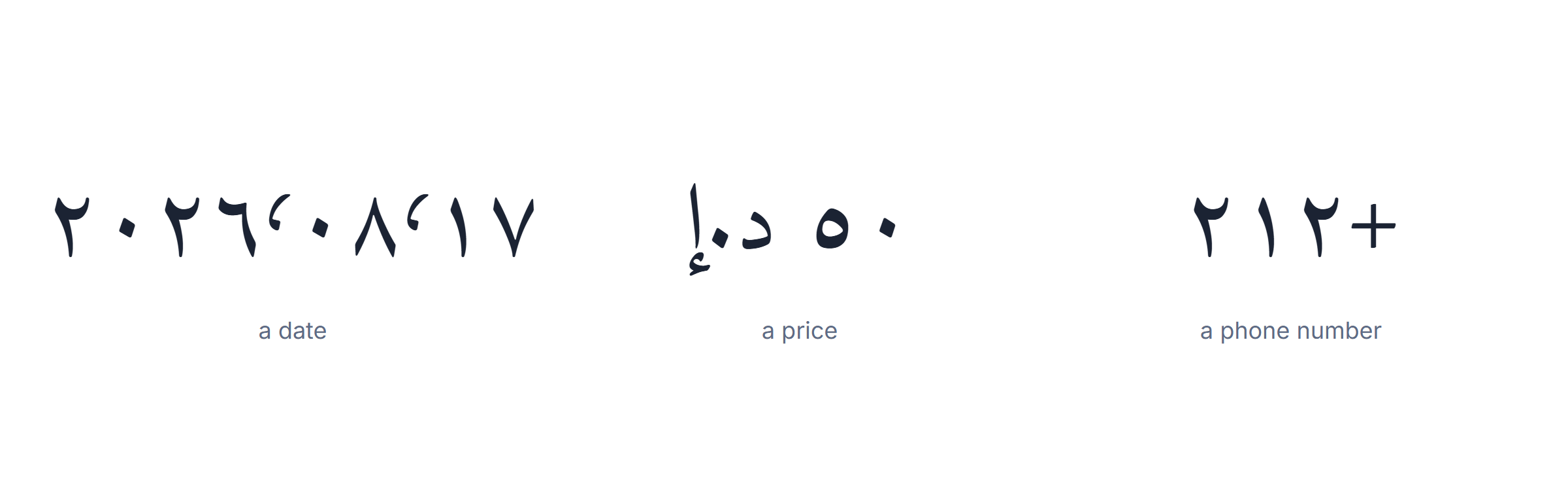
Almost nobody meets Arabic numbers in a table. They meet them on a receipt, a passport stamp or a WhatsApp message, and each of those has its own small trap.
| Where | What you see | What to watch |
|---|---|---|
| Dates | ٢٠٢٦ֿ٠٨ֿ١٧ | day-month-year in most of the region, not month-day |
| Hijri dates | ١٤٤٨ | a four-digit year in the 1400s is Hijri, not a typo |
| Prices | ٥٠ د.إ | ٥ is five, so this is fifty and not five |
| Phone numbers | +٢١٢ | the plus can appear to jump ends in chat apps |
| Page numbers | ١٢٣ | books often number pages from the other cover |
Hijri years are the one that surprises people
- An Arabic date showing a year in the 1400s is almost certainly a Hijri year, not an error and not the 15th century.
- Official documents across the Gulf print both calendars, so the same page can carry two plausible-looking years.
- Converting between them is arithmetic, not digit conversion — the Arabic numbers themselves mean the same thing in either calendar.
Reading a receipt without doing the maths twice
- Find the decimal separator first. In much of the region it is a comma-shaped mark, and the thousands separator is the one that looks like an apostrophe.
- Convert the total with the tool above before you argue about it — misreading Arabic numbers on a bill is the single most expensive version of the ٥-versus-0 mistake.
- If the currency is written as a symbol rather than a word, expect it to sit on whichever side the surrounding direction puts it.
The one-page reference
If you keep one thing about the Arabic numbers from this page, keep this. Everything above is the explanation; this is the part you will come back for.
- Ten digits, two shapes each: 0-9 and ٠-٩, identical in value.
- Zero is a dot — ٠ — and five is the round one, ٥.
- Numbers run left to right even inside right-to-left text.
- Machines want Western digits. People want whatever their region uses.
- The counting words are one to ten, the tens, then unit-before-ten.
Copy the Arabic numbers
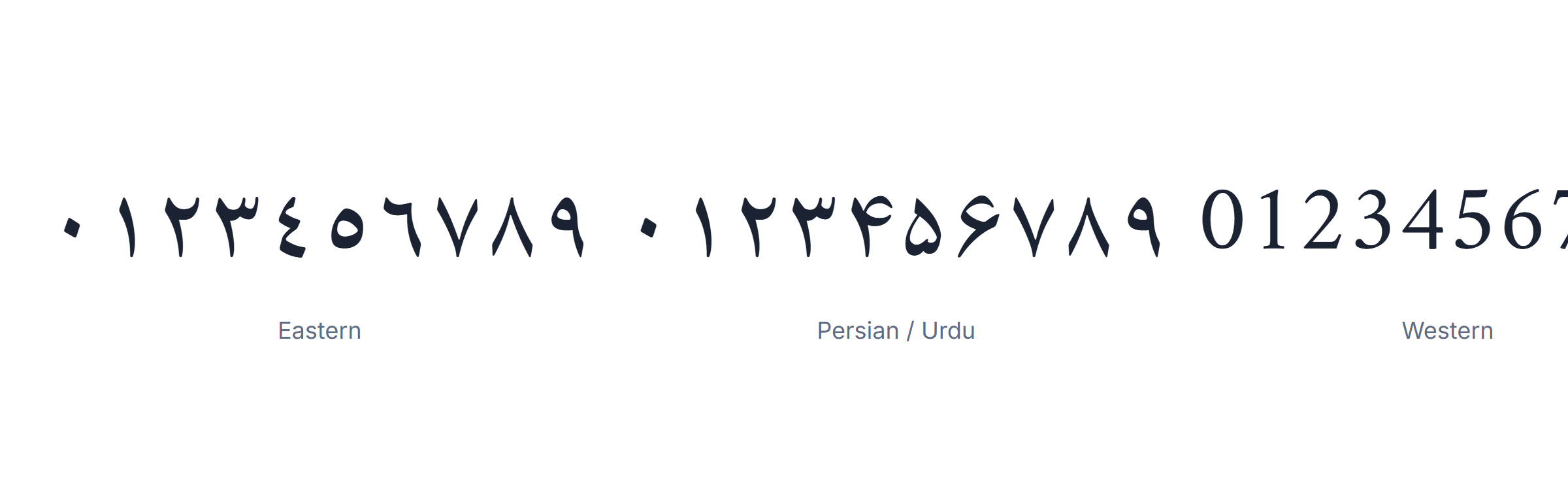
- Eastern set: ٠ ١ ٢ ٣ ٤ ٥ ٦ ٧ ٨ ٩
- Persian and Urdu set: ۰ ۱ ۲ ۳ ۴ ۵ ۶ ۷ ۸ ۹
- Or use the converter at the top, which copies for you.
Why this page exists at all
Every reference on the Arabic numbers prints the same ten digits and stops there, which is useful exactly once. What people actually need, over and over, is to turn a specific number into the other set — a year on a form, a price from a photograph, a passport number, a date on an official document that has to be retyped somewhere else. That is a conversion, not a lookup, and a static chart cannot do it.
A page that prints ten symbols answers the question you had the first time. A page that converts answers the one you have every time after that. The tables below are worth reading once; the tool at the top is why you will come back.
What the converter does, and what it deliberately does not
- It converts digits, in both directions, including the Persian and Urdu variants. It does not translate a number into the Arabic counting words — those are in the tables above, because a spoken form depends on grammar the digits do not carry.
- It leaves everything that is not a digit exactly as you typed it, so dates, decimal points and phone numbers keep their punctuation.
- It runs entirely in your browser. Nothing you type is sent anywhere, which matters more than it sounds when the thing you are converting is an account number.