Arabic Transliteration: Convert Both Ways, in 5 Named Schemes
Convert Arabic to Latin letters in five named schemes — ALA-LC, DIN 31635, ISO 233, simplified or Arabizi — and Latin back to Arabic. Every scheme is labelled, because “the transliteration” of an Arabic word does not exist: there are several, and which one is right depends on what you are writing.
What Arabic transliteration is, and what it is not
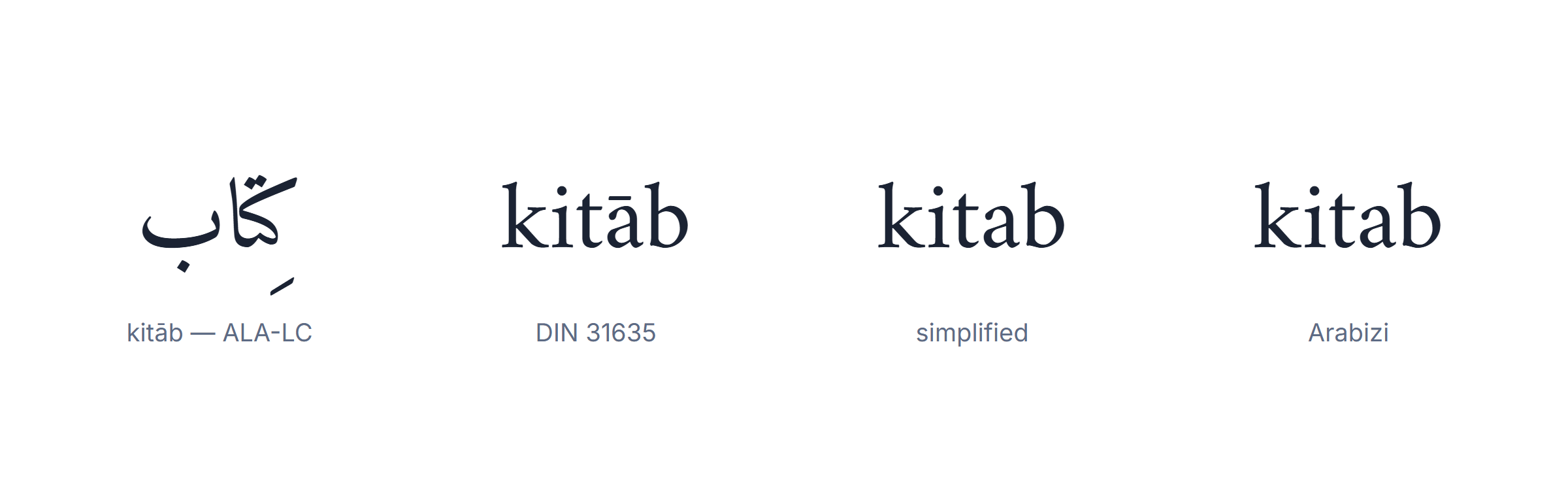
Arabic transliteration is writing Arabic in Latin letters. It carries the letters and the sounds across; it does not carry the meaning. كتاب transliterates as kitāb and translates as “book”. Those are two different operations, and confusing them is the single most common reason people end up with the wrong output.
You need transliteration when Arabic has to survive inside a Latin-only system: a library catalogue, a bibliography, a passport, a database field, a URL, a citation. You need translation when you want to know what it says. This page does the first.
There is a third thing that gets called transliteration and is not: phonetic typing, where you type marhaba and get مرحبا. That is transliteration running backwards, and it is genuinely harder, because Latin spelling throws away information Arabic needs. The Latin → Arabic direction above does it, and the section on what Latin cannot recover explains why no tool can do it perfectly.
The five schemes, and which one you need
There is no single correct romanisation of Arabic. There are several standards, each built for a different job, and the first question is always which one your context requires — not which one looks nicest.
| Scheme | Use it for | Looks like | Typeable? |
|---|---|---|---|
| ALA-LC | Library catalogues, bibliographies, English-language academic writing | al-shams, kitāb, ḥadīth | Needs diacritics |
| DIN 31635 | Arabic and Islamic studies journals, European scholarship | aš-šams, kitāb, ḥadīṯ | Needs diacritics |
| ISO 233 | Anything that must convert back to Arabic without loss | ʾAlšams, kitāb, ḥadīṯ | Awkward, by design |
| Simplified | Search boxes, filenames, URLs, ordinary writing | al-shams, kitab, hadith | Any keyboard |
| Arabizi | Chat, social media, messaging between Arabic speakers | el shams, kitab, 7adith | Any keyboard |
The short decision rule. If someone told you which scheme to use, use that one. If a library or catalogue is involved, ALA-LC. If a journal is involved, its style sheet will usually name DIN 31635 or a house variant. If nobody specified and it only has to be readable, use simplified — the diacritics in the academic schemes carry real information, and an audience that cannot read them gains nothing from their presence.
What you should not do is mix them. Half a bibliography in ALA-LC and half in DIN is the mistake a reviewer notices first, which is why the tool is built so you choose a scheme once and everything comes out consistent.
The full letter chart
Every Arabic letter in all five schemes. This is the table the converter is built from, so anything it outputs can be checked against it by hand.
| Letter | Name | ALA-LC | DIN 31635 | ISO 233 | Simplified | Arabizi |
|---|---|---|---|---|---|---|
| ء | hamza | ʾ | ʾ | ʾ | ‘ | 2 |
| ا | alif | ā | ā | ʾA | aa | a |
| ب | bāʾ | b | b | b | b | b |
| ت | tāʾ | t | t | t | t | t |
| ث | thāʾ | th | ṯ | ṯ | th | th |
| ج | jīm | j | ǧ | ǧ | j | j |
| ح | ḥāʾ | ḥ | ḥ | ḥ | h | 7 |
| خ | khāʾ | kh | ḫ | ḫ | kh | 5 |
| د | dāl | d | d | d | d | d |
| ذ | dhāl | dh | ḏ | ḏ | dh | dh |
| ر | rāʾ | r | r | r | r | r |
| ز | zāy | z | z | z | z | z |
| س | sīn | s | s | s | s | s |
| ش | shīn | sh | š | š | sh | sh |
| ص | ṣād | ṣ | ṣ | ṣ | s | 9 |
| ض | ḍād | ḍ | ḍ | ḍ | d | 9′ |
| ط | ṭāʾ | ṭ | ṭ | ṭ | t | 6 |
| ظ | ẓāʾ | ẓ | ẓ | ẓ | z | 6′ |
| ع | ʿayn | ʿ | ʿ | ʿ | ‘ | 3 |
| غ | ghayn | gh | ġ | ġ | gh | 3′ |
| ف | fāʾ | f | f | f | f | f |
| ق | qāf | q | q | q | q | 8 |
| ك | kāf | k | k | k | k | k |
| ل | lām | l | l | l | l | l |
| م | mīm | m | m | m | m | m |
| ن | nūn | n | n | n | n | n |
| ه | hāʾ | h | h | h | h | h |
| و | wāw | w / ū | w / ū | w | w / uu | w / ou |
| ي | yāʾ | y / ī | y / ī | y | y / ii | y / ee |
| ة | tāʾ marbūṭa | ah / at | a / at | ẗ | a | a |
| ى | alif maqṣūra | á | ā | ỳ | a | a |
Two rows deserve a note. Wāw and yāʾ do double duty — they are the consonants w and y and also the long vowels ū and ī. Which one they are depends on the vowel before them, which is why the tool looks at the preceding character instead of mapping them blindly. And tāʾ marbūṭa ة changes with grammar: ALA-LC writes it ah standing alone and at when the word is possessed, so madrasah but madrasat al-banāt.
Vowels — where it all breaks
Arabic writes long vowels as letters and short vowels as optional marks above and below the line. Almost all real Arabic text omits the marks. This is the root of nearly every transliteration problem there is.
كتب is three consonants — k, t, b. Depending on short vowels nobody wrote, it is kataba (he wrote), kutiba (it was written) or kutub (books). A tool reading unvowelled text has to guess, and no tool can guess reliably, because the answer lives in the grammar of the sentence rather than in the letters.
So add the harakat before you transliterate. Type كَتَبَ rather than كتب and the output above is exact instead of approximate. Our Arabic keyboard with harakat puts every mark on its own key, and the guide to the harakat explains what each one does.
Long vowels are easier and still not automatic. ا, و and ي become ā, ū and ī — a macron, not a doubled letter, in every academic scheme. Writing kitaab instead of kitāb is the tell of a simplified scheme, which is fine if simplified is what you chose.

al-, and why two spellings are both right
الشمس is the sun. Is it al-shams or ash-shams? Both — and the difference is the scheme, not an error.
Arabic has fourteen “sun letters”. When the definite article ال comes before one, the l is not pronounced and the following consonant doubles instead. The word is therefore spelled al-shams and said ash-shams.
- ALA-LC and DIN 31635 write what is spelled: al-shams. The article is always al-, because a catalogue needs every entry to sort in one place.
- Phonetic and simplified schemes write what is said: ash-shams, ar-rajul, an-nūr.
The tool follows that split: choose ALA-LC or DIN and you get al- throughout; choose simplified or Arabizi and the sun letters assimilate. Neither is a bug, and knowing which you are looking at tells you which scheme a document was written in.
The fourteen sun letters, for reference: ت ث د ذ ر ز س ش ص ض ط ظ ل ن. Everything else is a moon letter and keeps its l. The alphabet pronunciation guide covers why the split falls where it does.

Four things Latin cannot recover
Going Arabic → Latin loses information. Going back, that information cannot be reconstructed, which is why the Latin → Arabic direction of any tool — including this one — is a best guess rather than a conversion.
- Which h. Arabic has ه and ح, two clearly different sounds. Simplified writes both as h. From Hassan alone, nothing can tell you which was meant.
- Which s, d, t or z. Arabic has plain and emphatic pairs — س/ص, د/ض, ت/ط, ز/ظ. Simplified collapses each pair into one Latin letter.
- ʿayn and hamza. Both are consonants, and both usually vanish in casual Latin spelling. ع has no Latin equivalent at all, so Ali and ʿAlī look like one name and are not written the same way in Arabic.
- Vowel length. Salam could be سلام with a long ā, or a shorter form. Latin without macrons does not say.
This is why the converter keeps a list of common words and names and matches those first: a dictionary lookup is exact, a rule is a guess. For anything permanent — a document, an engraving, a tattoo — treat the output as a draft and have a native speaker confirm it.
Which schemes round-trip
“Reversible” means you can convert Arabic to Latin and back and recover the original characters. It matters more than people expect, because databases, citation managers and archival systems often store only the Latin form.
| Scheme | Round-trips? | What is lost |
|---|---|---|
| ISO 233 | Yes, fully | Nothing — that is its entire purpose, and the reason it is unpleasant to read |
| DIN 31635 | Almost always | Unwritten short vowels; the two alif forms in some positions |
| ALA-LC | Usually | Short vowels; tāʾ marbūṭa versus hāʾ in some endings |
| Simplified | No | Every emphatic distinction, ʿayn, hamza, vowel length |
| Arabizi | No | It is not standardised, so the same word is written several ways by different people |
If you are choosing a scheme for a system rather than a document, that table is the whole decision: store ISO 233 or store the Arabic itself, and display whatever is readable.
Names on passports and official documents
This is the most common real-world use of Arabic transliteration and the one with actual consequences, so it gets a plain answer.
Keep the spelling already on your documents. If your passport says Mohammed, everything else you file should say Mohammed. A visa application spelling your name differently from your passport is a mismatch, and mismatches cause delays regardless of which spelling is more “correct”.
There is no single official romanisation for Arabic names. محمد is four letters — m, ḥ, m, d — and appears as Mohammed, Muhammad, Mohamad, Mohamed and Muhammed, each a reasonable reading of the same word. Which one you have usually depends on which administration recorded it: French-influenced countries produced Mohamed and Youssef, English-influenced ones Muhammad and Yusuf.
Two practical notes. The machine-readable zone at the bottom of a passport uses ICAO Doc 9303, a stripped scheme with no diacritics at all, which is why it can differ from the printed name above it — that is normal, not an error. And if you are writing your name into Arabic rather than out of it, our write your name in Arabic page works from a curated database of real name spellings rather than a rule, which is more reliable for exactly the reasons in the previous section.
Arabizi, the chat alphabet
Arabizi — also called Franco-Arabic, Arabish or the Arabic chat alphabet — is what Arabic speakers actually type when an Arabic keyboard is not to hand. It is not a standard, it was never designed, and tens of millions of people use it daily.
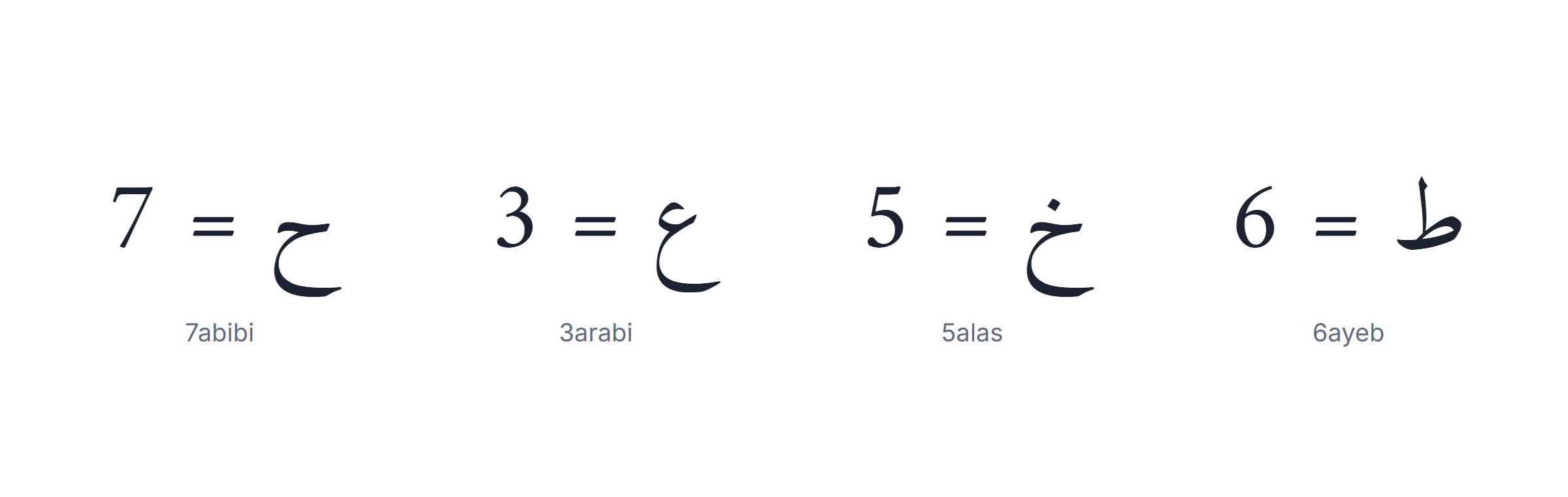
Its distinctive feature is using digits for the sounds Latin has no letter for, chosen because the digit resembles the Arabic letter:
| Digit | Letter | Sound | Example |
|---|---|---|---|
| 2 | ء | hamza, glottal stop | 2ana — I |
| 3 | ع | ʿayn | 3arabi — Arabic |
| 5 | خ | kh | 5alas — enough |
| 6 | ط | emphatic t | 6ayeb — okay |
| 7 | ح | ḥ | 7abibi — my dear |
| 9 | ص | emphatic s | 9abah — morning |
It varies by region. North African Arabizi leans on French conventions — ch for the sh sound, ou for u — while Gulf and Levantine Arabizi lean on English. The same word from a Moroccan and a Kuwaiti can look quite different, and both are correct within their own usage.
Arabizi is fine in chat and wrong everywhere formal. To turn it into real Arabic script, our Franco-Arabic keyboard is built for exactly that, and English to Arabic typing does the phonetic version without the digits.
How accurate is this converter?
A fair question to ask of any free tool, and the honest answer has two halves.
Arabic to Latin is close to exact when the text carries harakat. The mapping is a published table, the sun letters assimilate where the scheme says they should, shadda doubles the consonant, and the silent alif after fathatan is dropped. Feed it vowelled text and the output is what the standard prescribes. Feed it unvowelled text and the short vowels are simply absent, because they are absent from the input — no tool can invent them.
Latin to Arabic is a best guess, and is labelled as one in the tool. Common words and names are matched from a built-in list, which is exact. Everything else is reconstructed by rule, and the rule cannot know which of two h sounds or which of four s-like letters you meant. Treat that direction as a first draft.
Where the tool is deliberately conservative: it will not silently normalise your text, it does not strip harakat you typed, and it never guesses at meaning. It transliterates, which is the job.
Questions
What is Arabic transliteration?
Which transliteration scheme should I use?
Is Arabic transliteration reversible?
Why do Arabic names have so many English spellings?
What do the numbers in Arabizi mean?
Can I use this for a tattoo?
Sources
The romanisation tables here follow the published standards rather than a house style. These are the primary references: