Arabic vs Urdu: The 11 Extra Letters, A Complete Guide
Urdu is written in Arabic letters, borrows thousands of Arabic words, and is a South Asian language closely related to Hindi. It also adds around eleven letters that Arabic has no use for — and those letters are the whole story.

Two unrelated languages sharing an alphabet
| Arabic | Urdu | |
|---|---|---|
| Language family | Semitic (Afro-Asiatic) | Indo-Aryan (Indo-European) |
| Closest relatives | Hebrew, Amharic, Aramaic | Hindi, Punjabi, Bengali — and distantly Persian, English |
| Letters | 28 | around 39, depending how digraphs are counted |
| Usual style | Naskh — flat on the line | Nastaliq — sloping and cascading |
| Where | 22 countries | Pakistan (national language), northern India |
Urdu’s script came to it through Persian, which had already adapted the Arabic alphabet. So Urdu inherited Arabic’s 28 letters plus Persian’s four additions, and then added several more of its own for sounds neither language has.
The letters Urdu added
From Persian (4)
| Letter | Sound |
|---|---|
| پ | p as in pen |
| چ | ch as in chair |
| ژ | zh, the s in measure |
| گ | g as in go |
Urdu’s own retroflex letters (3)
These are the distinctively South Asian sounds — made with the tongue curled back against the roof of the mouth. They do not exist in Arabic, Persian or English, and they are marked with a small ط written above the plain letter.
| Letter | Sound | Plain counterpart |
|---|---|---|
| ٹ | retroflex ṭ | ت |
| ڈ | retroflex ḍ | د |
| ڑ | retroflex ṛ (a flapped r) | ر |
Urdu-specific vowel and nasal letters (4)
| Letter | Name | What it does |
|---|---|---|
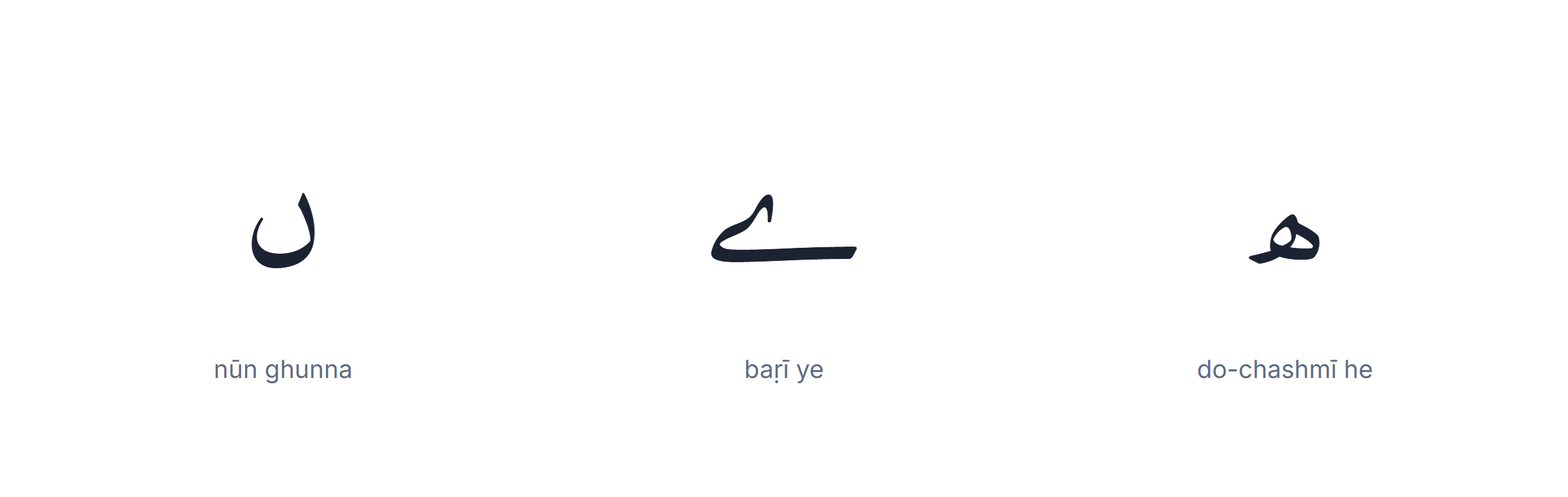
| ے | baṛī ye | a “big ye” used at the end of words for a particular vowel |
| ں | nūn ghunna | nasalises the preceding vowel — a dotless n |
| ۂ / ۃ | he with hamza | grammatical linking forms |
| ھ | do-chashmī he | aspiration — see below, it is the important one |

The two-eyed h — Urdu’s biggest structural addition
ھ is called do-chashmī he, “two-eyed h”, from its shape. It is never a standalone sound. Its only job is to aspirate the letter before it — to add the puff of air that distinguishes English pin from spin.
In Urdu, aspiration is contrastive: it changes the meaning of the word. That gives Urdu a whole parallel series that Arabic simply does not have:
| Plain | Aspirated | Plain | Aspirated |
|---|---|---|---|
| ب | بھ | پ | پھ |
| ت | تھ | ٹ | ٹھ |
| ج | جھ | چ | چھ |
| د | دھ | ڈ | ڈھ |
| ک | کھ | گ | گھ |
🔑 This is why counting Urdu’s letters is awkward. Are the aspirated digraphs separate letters or two letters written together? Different sources answer differently, which is why you will see the alphabet given as anything from 38 to 58.
Note also that Urdu keeps ہ (gol he, round h) as the ordinary h sound, distinct from ھ. Two shapes, two entirely different jobs.
Nastaliq — why Urdu looks so different
Even before you notice a single extra letter, Urdu looks different, and that is a matter of calligraphic style rather than alphabet.
- Arabic is normally set in Naskh: upright, evenly spaced, sitting flat on the baseline.
- Urdu is normally set in Nastaliq: each word starts high on the right and cascades down to the left, so the baseline is a series of diagonal steps rather than a straight line.
Nastaliq is beautiful and genuinely harder — harder to typeset, harder to render on screens, and harder to read quickly if you learned on Naskh. It is why Urdu text on the web lagged behind for years, and why some Urdu sites still fall back to Naskh, which Urdu readers find serviceable but plain.
You can compare the two directly: our Arabic calligraphy generator ships Noto Nastaliq Urdu alongside the Naskh faces, so you can type the same text and switch between them.

Telling them apart at a glance
- Does the line slope? If words cascade downward to the left, it is Nastaliq, which means Urdu or Persian poetry — not standard Arabic.
- Look for ٹ ڈ ڑ — a small ط floating above a letter. Those are Urdu retroflexes and appear in no Arabic text.
- Look for ھ after a consonant. Aspiration digraphs are an instant giveaway.
- Look for ے and ں at the ends of words. Neither exists in Arabic.
- Look for ة. If the Arabic feminine ending is everywhere, you are reading Arabic — Urdu has no grammatical gender marked that way.
The grammar has nothing in common
| Feature | Arabic | Urdu |
|---|---|---|
| Word order | verb–subject–object, or SVO | subject–object–verb |
| Word formation | three-consonant roots and patterns | prefixes, suffixes, compounds |
| Adpositions | prepositions, before the noun | postpositions, after the noun |
| Gender | masculine / feminine | masculine / feminine — but assigned differently |
| Number | singular, dual, plural | singular, plural |
| Definite article | ال | none |
| Verb agreement | with the subject | can agree with the object in past tenses |
“I read the book” is verb, then I, then the book in Arabic, and I, the book, read in Urdu. There is no shared sentence architecture to transfer.
Urdu and Hindi are the same spoken language
This is the fact that reframes the whole comparison, and it is the one most often left out.
Spoken Urdu and spoken Hindi are, at the everyday level, the same language. Same grammar, same core vocabulary, mutually intelligible without effort. Linguists often refer to the pair as Hindustani. They diverge in two places:
- Script. Urdu uses Perso-Arabic, right to left. Hindi uses Devanagari, left to right. Two completely unrelated writing systems for one spoken language.
- Formal vocabulary. Where a register turns literary, Urdu reaches for Persian and Arabic words and Hindi reaches for Sanskrit ones. In a market both are identical; in a courtroom or a poem they part company.
🔑 So an Urdu speaker’s Arabic advantage is vocabulary and script, not structure — while their Hindi “advantage” is that it is already the same language in a different alphabet.
What this means if you are learning
If you read Urdu and want Arabic: you have a real head start and it is narrower than it feels. The script is nearly free — you are dropping letters rather than learning them, and adjusting a few pronunciations. Thousands of Arabic loanwords are already familiar, though often with shifted meanings. But the grammar is entirely new: roots and patterns, the dual, case endings, VSO order and the definite article are all things Urdu never prepared you for.
If you read Arabic and want Urdu: add about eleven letters, learn to read Nastaliq at speed, and accept that the language itself is unrelated. You will recognise a great deal of formal vocabulary immediately.
If you are starting both from zero: learn the Arabic alphabet first. It is the smaller, flatter, more regular set, and everything else — Persian, Urdu, Pashto, Kurdish — is built on top of it. Our letter-by-letter pronunciation guide is the place to start, and how to learn Arabic lays out the timeline.
The numerals: three different sets in play
Numbers are the fastest visual tell between an Arabic page and an Urdu one, and almost no comparison mentions them.
| Value | Arabic (Eastern) | Urdu | What we use |
|---|---|---|---|
| 4 | ٤ | ۴ | 4 |
| 5 | ٥ | ۵ | 5 |
| 6 | ٦ | ۶ | 6 |
| 7 | ٧ | ۷ | 7 |
Arabic and Urdu use the same digit system for 0–3 and 8–9 and then diverge on four, five, six and seven, where Urdu keeps the Persian forms. If you see ۵ rather than ٥, you are looking at Urdu or Persian, not Arabic.
There is a naming irony worth knowing. The digits 1 2 3 that English calls “Arabic numerals” are indeed the ones Europe took from Arabic mathematicians, who had taken them from India. The ones Arabic itself writes, ١٢٣, are called Eastern Arabic numerals. Both names are correct and they point at different digits.
And in all three systems the digits run left to right inside a right-to-left line. A date or a price is read in the opposite direction to the words around it.
How much Arabic is actually in Urdu
Estimates put the Arabic-derived share of formal Urdu vocabulary at roughly a quarter, with another large slice from Persian — and Persian itself carries Arabic loans, so some words arrived twice by different routes.
Everyday examples an Arabic speaker recognises instantly: kitāb (book), qalam (pen), waqt (time), mushkil (difficult), ʿilm (knowledge), duniyā (world), sabab (reason).
But the borrowing is vocabulary only, and it is one-directional. Urdu took words from Arabic; Arabic took essentially nothing from Urdu. And the grammar those words sit in is entirely Indic — Urdu puts the verb at the end, has postpositions where Arabic has prepositions, and marks its nouns in ways Arabic has no equivalent for.
The practical result is the thing that surprises everybody: shared vocabulary buys you far less comprehension than it feels like it should. An Arabic speaker reading Urdu catches perhaps one content word in four and misses every sentence, because the words that carry the structure — the verbs, the postpositions, the auxiliaries — are the ones that were never borrowed.
Why many Urdu speakers can read the Quran but not understand it
Tens of millions of people in Pakistan and India read Arabic script fluently and understand almost none of the Arabic they are reading. To anyone who assumes script equals language this looks impossible; it follows directly from everything above.
Quranic recitation is taught as decoding: the letters, the harakat, and the rules of tajwīd that govern length and nasalisation. That skill is complete and genuine — pronunciation is often more precise than a casual Arabic speaker’s, because tajwīd is stricter than everyday speech. What is not taught alongside it is Arabic grammar or vocabulary.
Add the script difference and the gap widens. Urdu is set in nastaʿlīq, which slopes down the line; the Quran is set in naskh, which sits flat. A reader trained on both switches between two visually distinct systems without difficulty, which is a real skill and still not comprehension.
If you are an Urdu speaker starting Arabic, this is your actual position: you have already done the alphabet, which is the part that stops most beginners, and you can skip straight to grammar and vocabulary. Your head start is real. It is just not the head start people assume.
Where each is spoken, and by how many
| Arabic | Urdu | |
|---|---|---|
| Family | Semitic (Afro-Asiatic) | Indo-Aryan (Indo-European) |
| Speakers | Roughly 400 million | Roughly 230 million with Hindi counted together |
| Where | Over 20 countries, North Africa to the Gulf | Pakistan, northern India, and a large diaspora |
| Letters | 28 | Around 39–40 |
| Usual style | Naskh — sits flat on the line | Nastaʿlīq — slopes down to the left |
| Word order | Verb early | Verb last |
The speaker figure for Urdu depends entirely on a political question rather than a linguistic one: counted apart from Hindi it is around 70 million native speakers, counted together as Hindustani it is among the largest languages on earth. Both numbers get quoted as fact, which is why they look irreconcilable.
Arabic has the opposite problem. Its 400 million share a written standard almost nobody speaks at home, and the spoken varieties underneath are far enough apart that a Moroccan and an Iraqi may not understand each other. One number, many languages.
Arabic vs Urdu: the summary
Arabic vs Urdu is the same script carrying two unrelated languages. Urdu is Indo-Aryan and effectively the same spoken language as Hindi in a different alphabet. It adds Persian’s four letters, three retroflexes, the aspirating two-eyed he and a few vowel signs, and it is normally set in Nastaliq rather than Naskh — which is why Arabic vs Urdu looks so different before you have read a single word.
Sources and further reading
Everything factual on this page can be checked. These are the sources worth going to directly if you want more depth than an article can give: