Franco Arabic Keyboard (Arabizi to Arabic)
Type in Franco Arabic (Arabizi) below — use 7 for ح, 3 for ع, 2 for ء — and our converter turns it into real Arabic script instantly. Then tap Copy and paste into WhatsApp, Instagram or anywhere. Full number chart and examples are below.
Last updated: June 2026
Quick answer: Franco Arabic (also called Arabizi or the Arabic chat alphabet) writes Arabic with Latin letters and numbers, where numbers replace Arabic letters that have no Latin equivalent: 2=ء, 3=ع, 5=خ, 6=ط, 7=ح, 8=ق, 9=ص. Type franco in the tool above and it converts to Arabic — e.g. 7abibi → حبيبي.
What is Franco Arabic (Arabizi)?
Franco Arabic is Arabic written in Latin letters and numbers. It’s also known as Arabizi, Arabish, 3arabizi or the Arabic chat alphabet. It appeared in the 1990s on pagers and SMS that couldn’t display Arabic script, and it’s still everywhere on chat and social media — especially among young people in the Maghreb and the Gulf.
Why does franco use numbers?
Several Arabic letters have no Latin equivalent, so writers borrow numbers whose shape looks like the letter — 3 mirrors ع (ain) and 7 mirrors ح (haa). Franco is different from plain phonetic typing: for that, see our English to Arabic typing tool.
The Franco Arabic number code — full chart
| Franco | Arabic | Name | Example → Arabic |
|---|---|---|---|
| 2 | ء / أ | hamza | su2al → سؤال (question) |
| 3 | ع | ain | 3ain → عين (eye) |
| 3′ / gh | غ | ghayn | 3’ali → غالي (expensive) |
| 5 / kh | خ | kha | 5aled → خالد (Khaled) |
| 6 | ط | taa | 6areeq → طريق (road) |
| 6′ | ظ | zaa | 6’arf → ظرف (envelope) |
| 7 | ح | haa | 7abibi → حبيبي (my darling) |
| 7′ | خ | kha (Gulf) | 7’obz → خبز (bread) |
| 8 | ق | qaf | 8alb → قلب (heart) |
| 9 | ص | sad | 9aba7 → صباح (morning) |
| 9′ | ض | dad | 9’aw2 → ضوء (light) |
Tricky cases: 4 is rare and non-standard (occasionally أ in the Gulf, mirroring ٤) — best avoided. 8 is usually ق but a few writers use it for غ. kha is written 5 in most regions and 7′ in the Gulf. Regular Latin letters keep their sound: b, t, s, sh/ch=ش, ou=و, ee=ي.
Common franco words & example sentences
| Franco | Arabic | Meaning |
|---|---|---|
| salam | سلام | hi / peace |
| 7abibi | حبيبي | my love |
| kif 7alak | كيف حالك | how are you |
| ana 3arabi | أنا عربي | I’m Arab |
| 3lash | علاش | why (Maghreb) |
| 5alas | خلاص | enough / done |
Same word, different spellings: the word خبز (bread) can be written 5obz (most regions), 7’obz (Gulf) or khobz (with letters). Our converter accepts all of them.
How to convert franco to Arabic (step by step)
- Type your franco/Arabizi in the tool at the top — e.g. kif 7alak ya 3ammi.
- Press space after each word and it becomes Arabic script.
- Copy the Arabic and paste it into WhatsApp, Instagram, TikTok or any app.
No download, no sign-up. Want the reverse (typing by sound without numbers)? Use English to Arabic typing.
Franco in the Maghreb (Darija) vs the Gulf
The number core (2, 3, 5, 6, 7, 8, 9) is shared everywhere, but spelling habits differ. Maghreb (Morocco, Algeria, Tunisia) borrows from French — ch=ش, ou=و, 9=ق, and words like 3lash, labas, bzaf. The Gulf often uses 8 or g for qaf and 7′ for kha. Writing Moroccan? See our Clavier Darija; in French, the Clavier Arabe.
More about Franco Arabic (Arabizi)
Franco Arabic is documented as the Arabic chat alphabet:
- Arabic chat alphabet
- For sound-based (no numbers) typing, see English to Arabic typing; for Moroccan, Clavier Darija.
- Part of the Arabic Keyboard hub.
Related in this cluster
- Écrire son nom en arabe — write a Latin first name in Arabic letters
- Clavier arabe — the French keyboard page
Where the franco arabic keyboard code came from
Nobody designed it. The franco arabic keyboard code was invented by teenagers with broken phones, and that history explains every one of its quirks.
In the late 1990s and early 2000s, SMS was the way young people in the Arab world talked, and most handsets sold there could not display Arabic at all. The only alphabet available was Latin. Arabic has sounds Latin has no letter for — ع, ح, ص, ط — so people reached for the digits sitting on the same keypad.
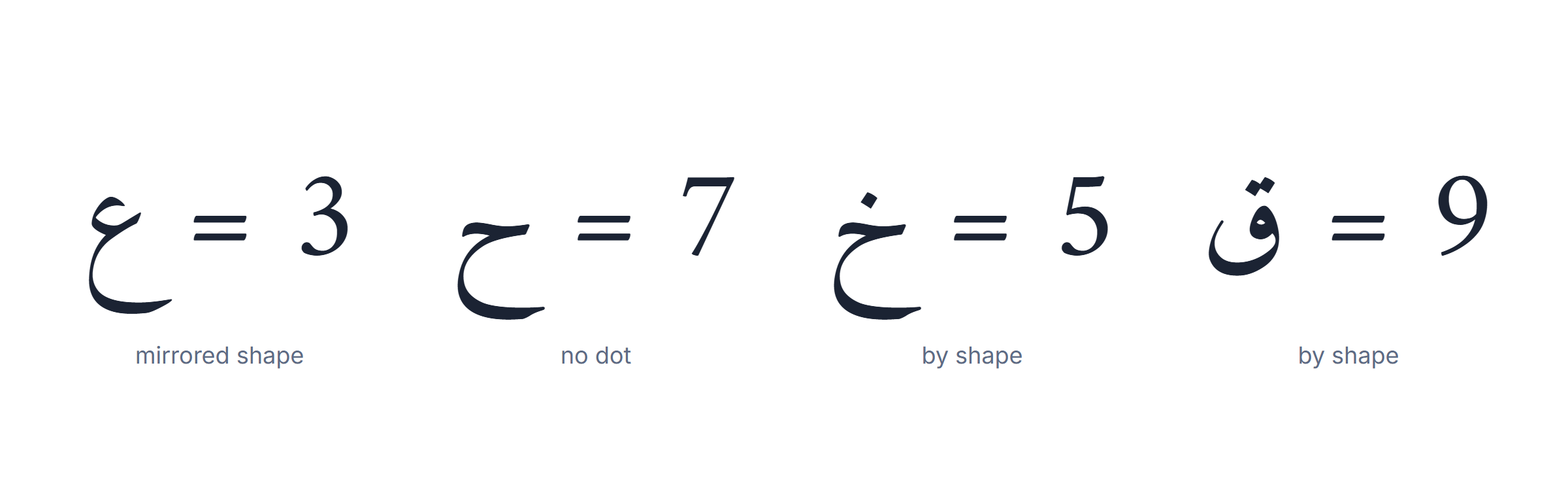
The choice was visual, not phonetic. 3 is a mirrored ع. 7 is ح without its dot. 9 resembles ق, 5 stands in for خ, and 2 carries the hamza. That is the whole system, and it is why a franco arabic keyboard uses numbers where you might have expected letter combinations.
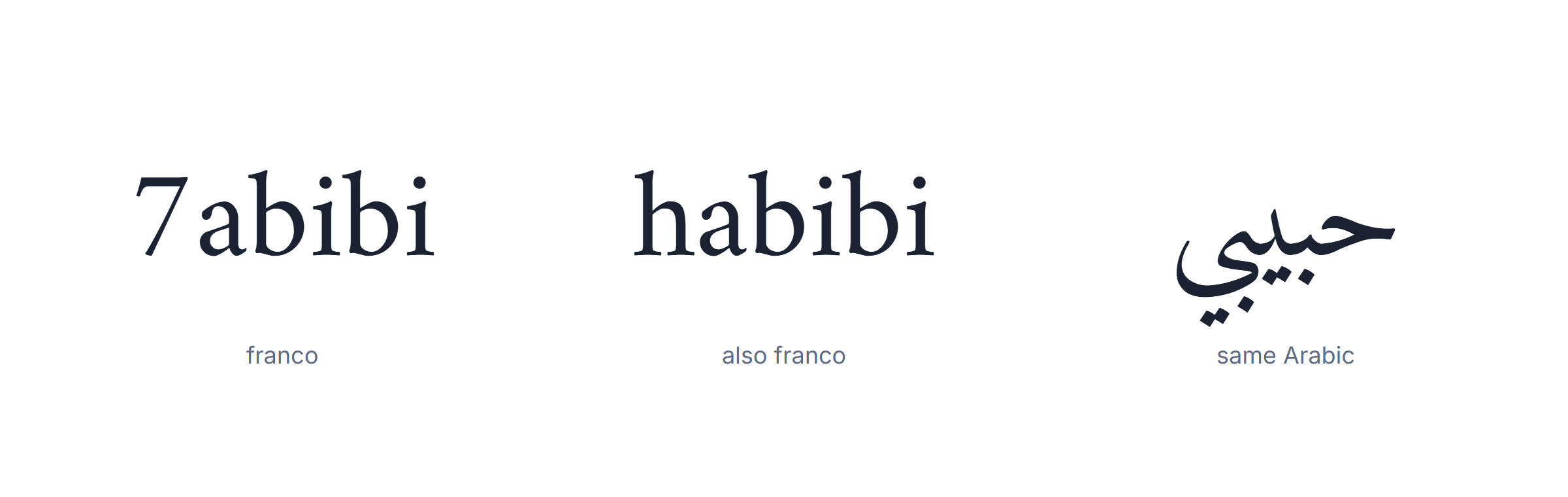
Two things followed from its origin. It spread without any authority behind it, so there is no official spelling — 7abibi and habibi are both in daily use. And it survived long after phones learned to render Arabic, because by then a generation could type it faster than the Arabic layout. That is still the main reason a franco arabic keyboard is worth having: it matches how people already write.
The one thing it never became is a standard for anything formal. No newspaper, no textbook and no government form uses it. It is a fast, informal, entirely popular invention — which is exactly what makes it useful for messages and useless for documents.
Five mistakes to avoid with a franco arabic keyboard
These five come up constantly, and none of them means the conversion failed.
1. Using 3 as the digit three. Write 3 kutub meaning “three books” and a franco arabic keyboard reads the 3 as ع. Inside franco text, the digits are letters. If you need a real number, write it out or type it after the conversion.
2. Expecting one correct spelling. There is none. 7abibi, habibi and 7abiby all reach the same Arabic word. A franco arabic keyboard is tolerant by design, because the code it implements was never standardised.
3. Confusing it with translation. Typing hello into a franco arabic keyboard gives you hello in Arabic letters, not مرحبا. The script changes; the language does not. This is the single most common misunderstanding, and it is worth being clear about before you paste the result somewhere.
4. Mixing dialect and standard Arabic in one sentence. Franco is written by ear, so people write the dialect they speak. That is fine in a message and wrong in anything meant to read as formal Arabic. Decide which one you are writing before you start.
5. Assuming everyone reads it. Franco is generational and regional. Someone over fifty, or someone from a different country, may find your franco harder to read than plain Arabic. When in doubt, convert with the franco arabic keyboard and send the Arabic.
When a franco arabic keyboard is the right tool — and when it is not
The honest answer is that it is excellent for some things and a poor choice for others, and the line between them is easy to draw.
Use it when you cannot type Arabic. On a borrowed computer, on a work laptop where you cannot install a layout, or in a hurry — a franco arabic keyboard needs nothing but a browser. This is its strongest case and the reason most people arrive here.
Use it when you think in sounds, not letters. Learners who can speak some Arabic but cannot yet find the letters benefit enormously: you write what you hear and see the Arabic appear, which teaches the mapping as a side effect. It is a better way in than memorising a keyboard chart.
Use it for dialect. Darija, Egyptian and Levantine have sounds and words that the standard layout was never arranged around. Franco handles them naturally because it was invented by the people who speak them.
Do not use it for anything official. Names on forms, legal documents, printed material, engraving. Not because a franco arabic keyboard is inaccurate, but because these are exactly the cases where a single wrong consonant matters and where you should copy an existing Arabic spelling rather than generate a new one.
Do not use it as a substitute for learning the layout if you write Arabic every day. Franco is faster on day one and slower by month three. The people who type Arabic fastest all use the Arabic layout; they keep a franco arabic keyboard around for the sounds they are unsure how to spell.
A reasonable middle path: convert here, read the Arabic output, and over time you will stop needing the conversion for the words you write most.
Is a franco arabic keyboard private?
People type names, phone numbers and personal messages into converters, so the question is a fair one. The answer depends entirely on how the tool is built, and you cannot tell by looking at it.
Server-side tools send every keystroke to the provider and send the Arabic back. Translation services work this way because they have to — the model lives on the server. Your text leaves your device.
Browser-side tools do the mapping in JavaScript on your own machine. Nothing is transmitted, because a franco arabic keyboard is a lookup table, not a service. There is no server to send anything to.
This page is the second kind. Your text is not sent to a server and is not stored, there is no sign-in, and the conversion keeps working if your connection drops. You can test that in ten seconds: load the page, turn off your Wi-Fi, and keep typing. Any franco arabic keyboard that quietly calls a server stops working the moment the connection does.
The remaining caveat is not about this page. Once you copy the Arabic out, it sits in your clipboard and then in whichever app you paste it into, and that app decides what happens next. On a shared computer, close the tab rather than just navigating away.
Using a franco arabic keyboard to learn to read Arabic
This is the use nobody advertises and the one with the most value in it. A franco arabic keyboard shows you the Latin input and the Arabic output at the same time, which is a flashcard you did not have to make.
Reading Arabic is hard for beginners for one specific reason: the letters change shape depending on position, so the ع you learned in a chart looks nothing like the ـعـ in the middle of a word. Charts teach isolated forms. Real text is joined.
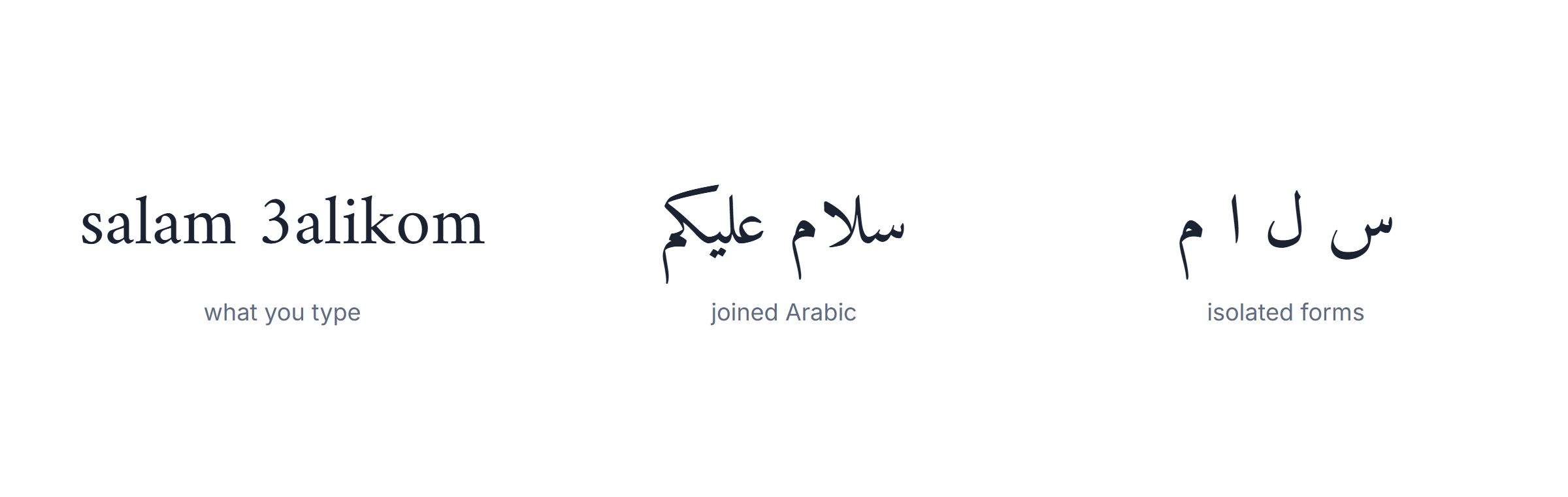
Typing solves this the way charts cannot, because you produce joined words from the first minute. Here is a routine that works in about ten minutes a day.
Week one — your own words. Type the twenty words you actually say most: greetings, family, food, the town you live in. Read the Arabic output aloud each time. Do not add new words; repeat these until you recognise them without the franco line above.
Week two — cover the input. Type a word, then look only at the Arabic and try to say it before you check. This is the step that converts recognition into reading. Expect to be wrong on the emphatic letters first; everyone is.
Week three — go backwards. Find short Arabic text — a caption, a comment, a headline — and type what you think it says into the franco arabic keyboard. If your output matches the original, you read it correctly. If it does not, the difference shows you exactly which letter you misread.
Three weeks of that will not make you fluent, and nothing does. What it does reliably is get you past the stage where Arabic looks like decoration. After that, a franco arabic keyboard stops being a crutch and becomes what it should be — a fast way to type, on the days you do not feel like hunting for letters.
One warning about this method, because it has a real failure mode. If you stay in week one for months, franco becomes the language you read and Arabic stays decoration. The point of covering the input in week two is precisely to stop that happening. Learners who skip it can type Arabic for years and still not read a street sign.
And if you already read Arabic comfortably, none of this applies — use the franco arabic keyboard purely for speed, and ignore the learning angle entirely. Speed is a perfectly good reason on its own, and it is why most people who can read Arabic perfectly well still keep a converter open in a tab.
Whichever camp you are in, the test of a good franco arabic keyboard is the same: does the Arabic it produces read correctly to someone who never saw your input? Everything else is preference.
Frequently Asked Questions
What is franco arabic?
Writing Arabic with Latin letters and numbers (e.g. 7abibi = حبيبي). Also called Arabizi or the Arabic chat alphabet.
What does 7 mean in franco?
The letter ح (haa), a deep “h” — e.g. 7abibi → حبيبي.
What does 3 mean?
The letter ع (ain), a throaty sound; the 3 mirrors the letter — 3ain → عين.
What do 5 and 7′ mean?
Both write خ (kha), the “ch” in “loch” — 5alas / 7’alas → خلاص.
What does 8 mean?
Usually ق (qaf) — 8alb → قلب. A few writers use it for غ.
What do 9 and 2 mean?
9 = ص (sad); 2 = the hamza ء — su2al → سؤال.
How do I convert franco to arabic?
Type it in the converter above and copy the Arabic — no download or account.
Is franco the same in Morocco and the Gulf?
No — Maghreb uses French-influenced spelling (ch, ou, 9), the Gulf uses 8/g for qaf; the number core is shared.