Is Arabic Hard to Learn? The Honest 2,200-Hour Answer
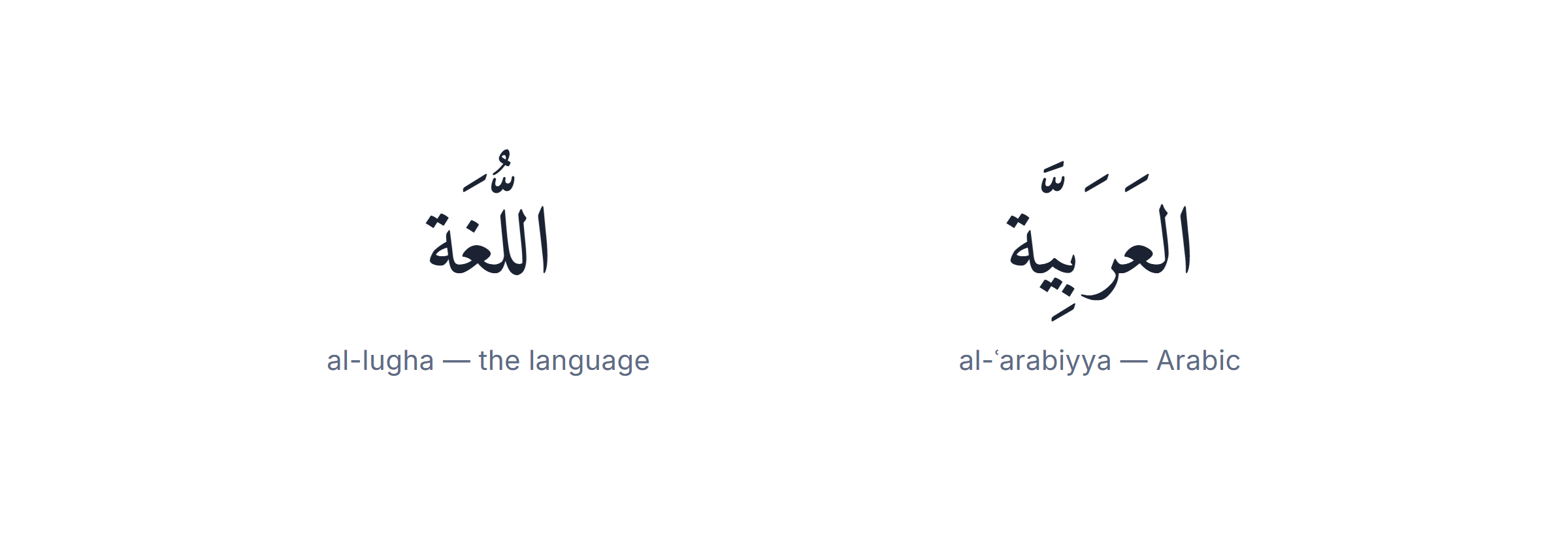
Arabic is hard, and the honest version is more useful than either the discouraging one or the reassuring one. Here is exactly where the difficulty sits, what is easier than you have been told, and what actually makes people quit.
The number, and what it means
The most-cited figure comes from the US Foreign Service Institute, which has been putting diplomats through intensive language training for decades and grouping languages by how long that takes.
| Category | Examples | Hours to professional working proficiency |
|---|---|---|
| I | Spanish, French, Italian, Dutch | ~600–750 |
| II | German | ~900 |
| III | Russian, Hebrew, Hindi, Turkish, Greek | ~1,100 |
| IV | Arabic, Mandarin, Japanese, Korean, Cantonese | ~2,200 |
So: roughly three times Spanish, and in the hardest group there is.
① It measures professional proficiency — negotiating, reading a contract, following a political broadcast. Ordering food, reading signs and holding a conversation arrive far earlier.
② It measures classroom hours with a teacher and a cohort, not self-study, which is usually less efficient per hour.
③ It is calibrated on English speakers with an aptitude for languages, selected by the State Department. It is a benchmark, not a prophecy.
The useful way to read it: Arabic is not harder in some mysterious way. It is bigger. There is more to learn before the pieces connect, and the payoff curve is back-loaded.
The four genuinely hard parts
1. The missing short vowels
This is the one that surprises people, and in our view it is the single hardest thing about Arabic — harder than the script, harder than the grammar.
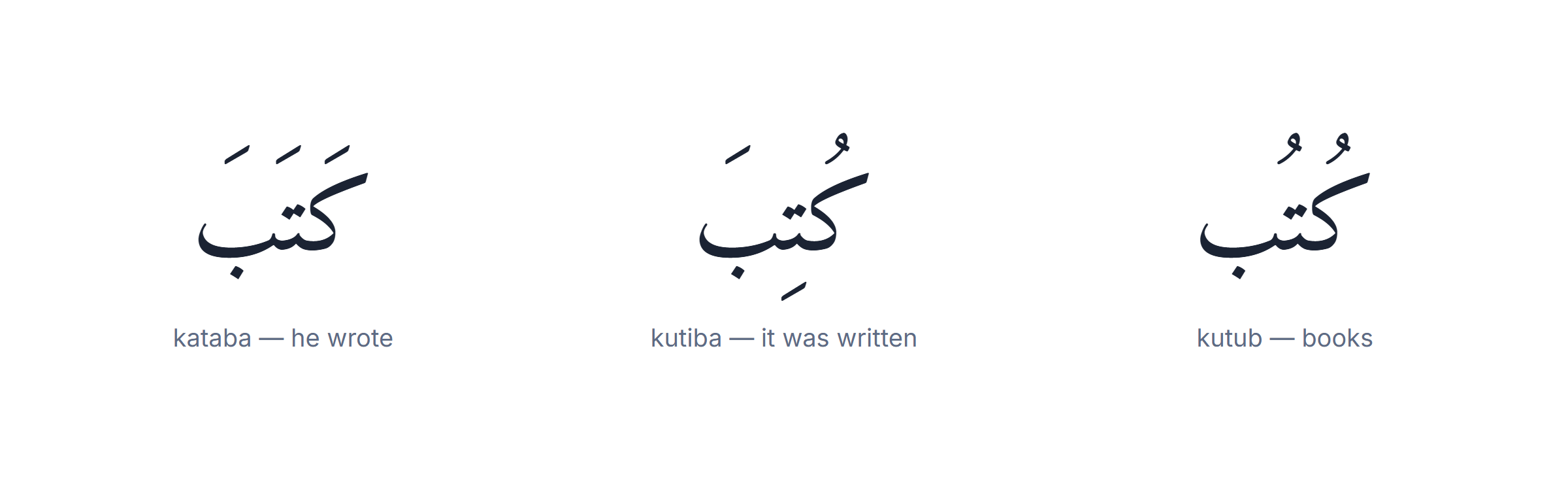
Written Arabic normally records consonants and long vowels only. The short vowels — the harakat — exist as marks above and below the letters, and outside the Qur’an, poetry and children’s books, they are simply not written.
So the three letters ك ت ب could be kataba (he wrote), kutiba (it was written), kutub (books) or kutiba — and the reader is expected to know which from context, vocabulary and grammar.
Why it is hard: it means you cannot fully read a word you have not already learned. In Spanish you can pronounce an unknown word correctly on sight. In Arabic you often cannot, which breaks the normal beginner strategy of reading your way into a language.
Why it is survivable: the ambiguity collapses fast as vocabulary grows, because the patterns are regular. It feels impossible in month three and unremarkable in year two.
2. Root-and-pattern morphology
Arabic builds words by pouring a three-consonant root into a pattern. From ك-ت-ب (writing) you get kataba (he wrote), kitāb (book), kātib (writer), maktab (office), maktaba (library), maktūb (written).
This is genuinely hard at first because it is a system with no European equivalent — and it is the thing that makes Arabic faster than European languages later, once it clicks. It is front-loaded difficulty that converts into compounding returns.
3. Diglossia — the two-Arabics problem
This is the difficulty that is unique to Arabic and that most “how hard is X” comparisons ignore entirely.
Modern Standard Arabic is the written and formal language. It is nobody’s native speech. What people actually speak at home is a regional dialect, and the distance between Moroccan Darija and Gulf Arabic is comparable to the distance between Portuguese and Italian.
The practical effect: learning MSA to a high level and then arriving in Cairo, you will be able to read every sign and understand the news, and you will struggle in a taxi. Learners of Spanish never face this. It is not extra grammar — it is a second learning project hidden inside the first.
4. Seven sounds that do not exist in English
ʿayn ع, ḥāʾ ح, khāʾ خ, ghayn غ, qāf ق and the emphatic ص ض ط ظ. Several are made in the throat, where English produces no consonants at all, so there is no muscle memory to borrow.
These are hard for a few weeks and then done — which puts them well below the other three on this list. We cover each one in Arabic alphabet pronunciation.
Four things that are easier than feared
The alphabet
The thing beginners dread most is the thing that takes the least time. 28 letters, learnable in two to four weeks, and it is phonetic — no English-style spelling chaos where through, though and tough rhyme with nothing.
The four positional forms sound alarming and are not: they are one skeleton with joining strokes, and you stop noticing them in a fortnight.
Only three vowels
Arabic has three vowel qualities — a, i, u — each short or long. That is it. English has somewhere around a dozen depending on how you count and which accent you use. For once the direction of difficulty runs the other way.
No verb “to be” in the present
“The book is big” is الكتاب كبير — literally the-book big. A whole category of English error simply does not exist.
Spelling is regular
Once you know the letters, you can spell almost any word you can hear correctly, and pronounce almost any vowelled word you can see. The exceptions are few and systematic.
Why people actually quit
Very few people quit Arabic because ʿayn defeated them. The real reasons are structural, and all four are avoidable:
- They never chose between MSA and a dialect, studied MSA by default because that is what the textbooks teach, and eighteen months later could not talk to their partner’s family. This is the big one.
- They hit the unvowelled wall in month three with no warning, concluded their reading had got worse, and read it as failure rather than as the expected next stage.
- They stayed on transliteration too long. Reading marhaban instead of مرحبا feels fast for a month and then caps everything, because almost all real material becomes unavailable.
- They expected a Category I payoff curve. In Spanish, month three feels great. In Arabic, month three feels like a plateau — and it is the point where the compounding is about to start.

Compared with the other hard languages
| Arabic | Mandarin | Japanese | |
|---|---|---|---|
| Writing system | 🟢 28 letters, phonetic, ~3 weeks | 🔴 thousands of characters, years | 🔴 three systems at once |
| Tones | 🟢 none | 🔴 four plus neutral | 🟢 pitch accent only |
| Grammar | 🔴 case, dual number, broken plurals | 🟢 comparatively simple | 🔴 politeness levels, particles |
| Spoken vs written | 🔴 diglossia — effectively two languages | 🟢 aligned | 🟡 formal registers differ |
| Reading unknown words | 🔴 vowels omitted | 🔴 character must be known | 🟡 furigana sometimes helps |
All three land near 2,200 hours, but they get there differently. Arabic gives you the easiest writing system in Category IV and the hardest spoken-written gap. If your goal is reading, Arabic is the most accessible of the four. If your goal is conversation in a specific country, the diglossia makes it arguably the most awkward.
Who finds Arabic easier
- Speakers of Persian, Urdu, Turkish or Malay — a large shared vocabulary of Arabic loanwords, and for Persian and Urdu, the same script.
- Hebrew speakers — the same root-and-pattern system and a related alphabet. The single biggest head start available.
- Anyone who already reads the Qur’an phonetically — the alphabet stage is already done, and that is four weeks saved.
- Spanish speakers, slightly — rolled r, similar vowels, and roughly a thousand Arabic-derived words already in Spanish.

How to make it measurably faster
- Choose MSA or a dialect in week one and write the choice down. This one decision saves more time than any app.
- Finish the alphabet in four weeks. It is the cheapest large win in the whole language and everything else is gated behind it.
- Learn roots, not words. One afternoon on ك-ت-ب gives you six words. Word-by-word memorisation gives you one.
- Move to unvowelled text on purpose in month three, starting with headlines. Do not wait until it happens to you.
- Type Arabic from week one. Producing letters is a different skill from recognising them, and it turns the language into something you use rather than study.
The verdict
Yes, Arabic is hard — about three times the hours of Spanish, and in the hardest tier the FSI recognises. But the difficulty is not spread evenly, and knowing where it sits is most of the battle.
The script, the vowel inventory and the spelling are all easier than the European-language average. What is hard is the missing short vowels, the root system, and above all the gap between the Arabic that is written and the Arabic that is spoken. Nothing on that list is beyond an ordinary person with an ordinary hour a day. It simply takes longer than the brochures suggest, and it rewards patience more than talent.
What each stage actually feels like
The difficulty is not spread evenly. It arrives in a specific order, and knowing the order is most of what stops people quitting.
| Stage | What it feels like | What is really happening |
|---|---|---|
| Weeks 1–4 | Surprisingly fine | The alphabet is 28 letters and mostly phonetic. Easier than its reputation. |
| Months 2–3 | Fast, visible progress | Vowelled text, simple sentences. Every hour shows a return. This is the good stretch. |
| Month 3–4 | Like going backwards | The plateau. The vowel marks vanish from real text and reading collapses. Nothing has been lost — the support was removed. Most quitting happens here. |
| Months 5–9 | Slow, invisible | Root patterns are installing. Progress is real and not measurable week to week, which is a motivation problem rather than a learning one. |
| Month 9+ | Sudden clicks | Unfamiliar words start decoding from their roots. This is the payoff for the whole system, and it does not arrive early. |
The shape to expect is therefore easy, good, awful, flat, then compounding. If you know the third stage is coming and know it is structural, it stops reading as failure.
The cost nobody prices in: the second variety
Every difficulty estimate for Arabic, including the FSI’s 2,200 hours, prices one variety. In practice most learners end up needing two.
Learn Modern Standard Arabic and you can read a newspaper, follow the news, and write formally — and you will sound noticeably stiff ordering coffee, because nobody speaks MSA at home. Learn Egyptian or Levantine and you can hold a conversation from month three — and you cannot read the newspaper.
The second variety is much cheaper than the first: the script is done, the roots are shared, and the gap is mostly vocabulary swaps and a smaller verb system. Budget somewhere around a quarter to a third of the original effort, not another full course.
Which order? If your goal is reading, research, or work with written Arabic, start with MSA. If your goal is talking to people in one country, start with that dialect and add MSA later — you will be speaking a year sooner. The expensive mistake is not the order; it is choosing neither and drifting between them, which is what a lot of first-year study actually is.
So, is Arabic hard to learn? The short version
Is Arabic hard to learn — yes, about three times the hours of Spanish. But the difficulty is not where beginners expect it. The alphabet is easy, the vowel system is simpler than English, and the spelling is regular. What is genuinely hard is the missing short vowels, the root-and-pattern system, and the gap between written and spoken Arabic.
Sources and further reading
Everything factual on this page can be checked. These are the sources worth going to directly if you want more depth than an article can give:
- US Department of State — FSI language difficulty categories
- Wikipedia — Diglossia
- Wikipedia — Semitic root
- Trans4mind — Learning a New Alphabet as an Adult, on why adult learners stall at the keyboard rather than at the grammar