Arabic Greetings and Replies: 20 Essential Pairs
Arabic greetings are paired. Almost every one has a fixed answer, and the answer is usually not a repetition of the greeting. Learning Arabic greetings without their replies is why beginners freeze two seconds into the exchange.
Why Arabic greetings come in pairs
In English, “hi” is answered with “hi”. Arabic mostly does not work that way. The great majority of greetings have a specific, fixed, different response, and using the right one is the difference between sounding like a learner and sounding like someone who has been around.
Several of these pairs also follow a nice rule: the reply raises the greeting. Say “morning of goodness” and you get back “morning of light”. Say “peace be upon you” and the reply adds mercy and blessing. The convention is to give back a little more than you received.
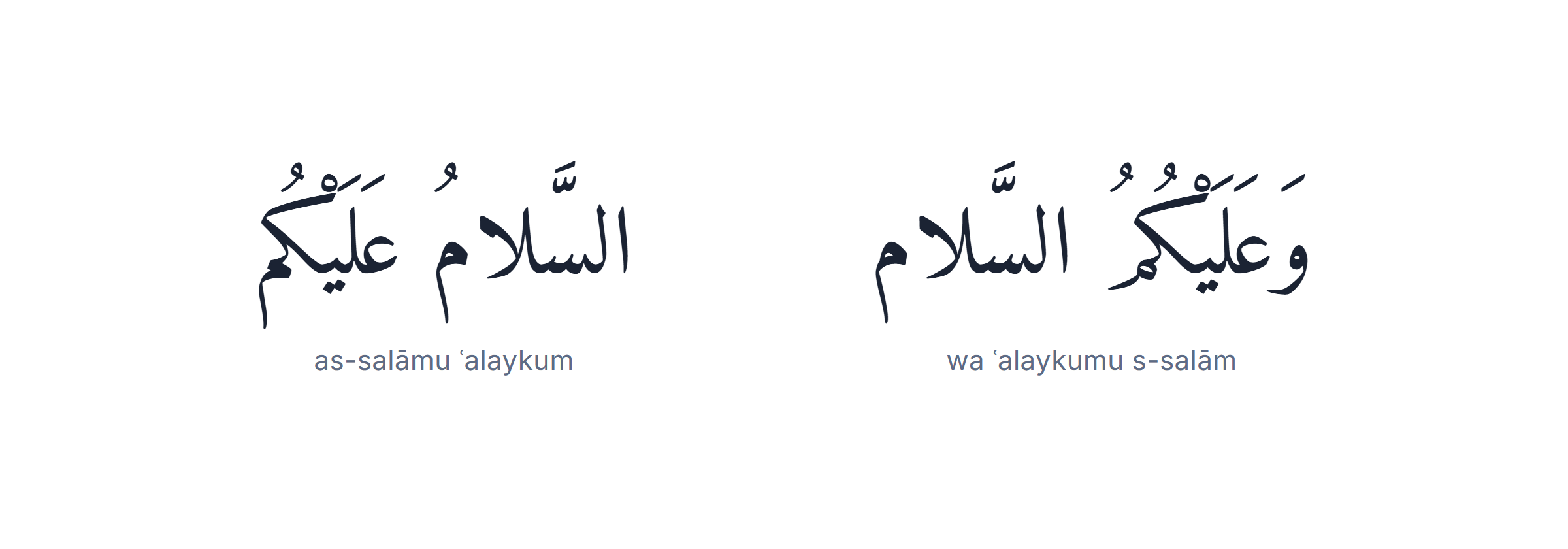
As-salāmu ʿalaykum, and its three levels
The universal Arabic greeting. Understood everywhere, appropriate at every hour, in every register, to one person or a hundred.
| Level | Greeting | Reply |
|---|---|---|
| Standard | السَّلامُ عَلَيْكُم as-salāmu ʿalaykum | وَعَلَيْكُمُ السَّلام wa ʿalaykumu s-salām |
| Warmer | السَّلامُ عَلَيْكُم وَرَحْمَةُ الله …wa raḥmatu llāh | وَعَلَيْكُمُ السَّلامُ وَرَحْمَةُ الله |
| Fullest | …وَرَحْمَةُ اللهِ وَبَرَكاتُه …wa barakātuh | وَعَلَيْكُمُ السَّلامُ وَرَحْمَةُ اللهِ وَبَرَكاتُه |
🔑 The reply reverses the order. The greeting is “peace upon you”; the answer is “and upon you peace”. That inversion is the whole convention — do not simply echo the greeting back unchanged.
Note the plural -kum even when addressing one person. It is the fixed form; do not try to make it singular.

Time-of-day greetings
These are the prettiest pairs in the language, and the reply is never a repetition.
| When | You say | They reply | Literally |
|---|---|---|---|
| Morning | صَباحُ الخَيْر ṣabāḥ al-khayr | صَباحُ النّور ṣabāḥ an-nūr | “morning of goodness” → “morning of light” |
| Evening | مَساءُ الخَيْر masāʾ al-khayr | مَساءُ النّور masāʾ an-nūr | “evening of goodness” → “evening of light” |
| Good night | تُصْبِحُ عَلى خَيْر tuṣbiḥu ʿalā khayr | وَأَنْتَ مِن أَهْلِ الخَيْر | “may you wake to goodness” |
In the dialects the morning pair gets played with affectionately — ṣabāḥ al-ward (morning of roses), ṣabāḥ al-full (morning of jasmine), ṣabāḥ al-ʿasal (morning of honey). Any of them is a charming reply to ṣabāḥ al-khayr, and using one marks you instantly as someone who has actually listened to people speak.
How are you — and the answer everyone gives
| Arabic | Transliteration | To whom |
|---|---|---|
| كَيْفَ حالُك؟ | kayfa ḥāluk? | to a man |
| كَيْفَ حالُكِ؟ | kayfa ḥāluki? | to a woman |
| كَيْفَ حالُكُم؟ | kayfa ḥālukum? | to a group, or formally |
The reply is close to automatic:
- بِخَيْر، الحَمْدُ لِله — bi-khayr, al-ḥamdu lillāh — “well, praise God”. This is the answer. Use it even on a mediocre day.
- الحَمْدُ لِله on its own also works and is extremely common.
- Then return it: وَأَنْت؟ wa anta? (to a man) / وَأَنْتِ؟ wa anti? (to a woman).
Welcoming someone
| Arabic | Transliteration | Use |
|---|---|---|
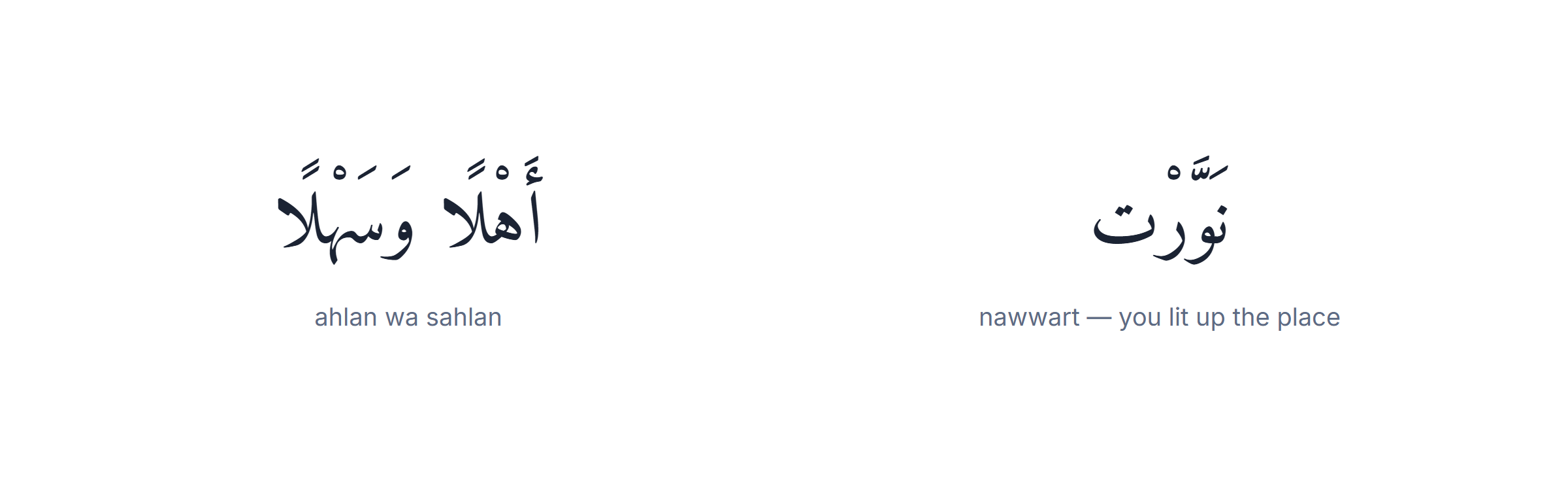
| أَهْلًا وَسَهْلًا | ahlan wa sahlan | welcome — literally “[you are among] family, and [your path is] easy” |
| أَهْلًا | ahlan | the short casual form, closer to “hi” |
| أَهْلًا بِك | ahlan bik / biki | welcome to you — a common reply to ahlan |
| تَفَضَّل | tafaḍḍal | please come in / after you / here you are |
| نَوَّرْت | nawwart | “you have lit up [the place]” — said to an arriving guest. Reply: النّورُ نورَك |
نَوَّرْت is the one to learn if you want to sound genuinely at home. It is warm, extremely common in the Levant and Egypt, and almost never taught.
Leaving
| Arabic | Transliteration | Notes |
|---|---|---|
| مَعَ السَّلامة | maʿa s-salāma | the standard goodbye — “with peace” |
| إِلى اللِّقاء | ilā l-liqāʾ | “until the meeting” — more formal, like “until we meet again” |
| في أَمانِ الله | fī amāni llāh | “in God’s safekeeping” — warm, often to someone travelling |
| تُصْبِحُ عَلى خَيْر | tuṣbiḥu ʿalā khayr | good night, on parting for the evening |
You will also hear bye and salām used casually everywhere, and in North Africa bslama, which is the same maʿa s-salāma worn down by use.

Occasions
| Occasion | Arabic | Reply |
|---|---|---|
| Eid | عيد مُبارَك / كُلُّ عامٍ وَأَنْتُم بِخَيْر | وَأَنْتُم بِخَيْر |
| Ramadan | رَمَضان مُبارَك / رَمَضان كَريم | اللهُ أَكْرَم |
| Congratulations | مَبْروك | اللهُ يُبارِك فيك |
| To someone who is ill | سَلامْتَك | اللهُ يِسَلِّمَك |
| To someone who has done you a kindness | جَزاكَ اللهُ خَيْرًا | وَإِيّاك |
🔑 مَبْروك mabrūk is the workhorse. New job, new baby, new car, exam passed, haircut — all take mabrūk, and the reply is always allāhu yubārik fīk.
Etiquette that is not in the words
- Greet first, business second. Walking into a shop and opening with your question reads as abrupt. Greet, ask how they are, then speak.
- The younger greets the older; the one arriving greets the seated. A convention rather than a rule, but a widely felt one.
- Greet the whole room. As-salāmu ʿalaykum to the group is enough; you do not need to work around individually.
- Handshakes vary. Follow the other person’s lead. Many observant Muslims do not shake hands with the opposite gender — a hand placed over the heart is the standard, warm alternative and is not a rebuff.
- Expect the exchange to be longer than in English. Two or three rounds of greeting and asking after health before the actual topic is normal, not stalling.
The same greeting in five dialects
As-salāmu ʿalaykum and marḥaban work everywhere. “How are you” does not — it is one of the most dialect-divided phrases in the language.
| Region | How are you? | Common reply |
|---|---|---|
| MSA | kayfa ḥāluk | bi-khayr, al-ḥamdu lillāh |
| Egyptian | izzayyak / izzayyik | kwayyis, al-ḥamdu lillāh |
| Levantine | kīfak / kīfik | mnīḥ, al-ḥamdu lillāh |
| Gulf | shlōnak / shlōnich | zayn, al-ḥamdu lillāh |
| Moroccan (Darija) | kīdayr / labas | labas, al-ḥamdu lillāh |
Notice what does not change: al-ḥamdu lillāh ends the answer in every single one. If you learn one thing from this table, learn that.
Typing Darija specifically? We keep a dedicated Moroccan Darija keyboard.
Speaking to a man, a woman, or a group
Arabic marks who you are talking to on the verb and the pronoun, so a greeting learned in one form is wrong in the other two. This is the most common visible mistake beginners make, and it is fixed by learning three endings rather than one phrase.
| To a man | To a woman | To a group | Meaning |
|---|---|---|---|
| كَيْفَ حالُك | كَيْفَ حالُكِ | كَيْفَ حالُكُم | How are you? |
| أهْلاً بِك | أهْلاً بِكِ | أهْلاً بِكُم | Welcome |
| شُكْراً لَك | شُكْراً لَكِ | شُكْراً لَكُم | Thank you |
The pattern is regular: -ka to a man, -ki to a woman, -kum to a group. Learn the three endings once and they apply everywhere.
Two pieces of relief. In fast speech the final vowel is often swallowed, so kayfa ḥālak and kayfa ḥālik can sound nearly identical — the mistake is far more visible in writing than in speech. And as-salāmu ʿalaykum never changes: it is already plural and works for one person or fifty, of any gender. That is a large part of why it is the safe default.
Can a non-Muslim say as-salāmu ʿalaykum?
Yes, and it is asked often enough to deserve a direct answer rather than a hedge.
As-salāmu ʿalaykum means “peace be upon you”. It is used across the Arab world by Arab Christians, Jews and the non-religious as much as by Muslims, and in Arabic-speaking countries it functions as the ordinary greeting rather than a religious declaration. A visitor using it is understood as being polite, not as claiming anything.
The reply, wa ʿalaykumu s-salām, is equally open. If someone greets you and you answer correctly, you have done the socially expected thing; saying nothing is the option that reads badly.
Where more care is warranted is the devotional layer — al-ḥamdu lillāh, mā shāʾ Allāh, bārak Allāhu fīk. These are still used broadly and warmly, but they carry explicit religious content, and delivered as a performance rather than meant they can land as parody. Recognise them, respond to them graciously, and adopt them when they feel honest rather than as a party trick.
The neutral alternatives always work: marḥaban for hello, ṣabāḥ al-khayr for good morning, shukran for thank you. Nobody has ever been thought rude for using them.
Greetings in writing: messages, email, and what changes
Written Arabic greetings are more formal than spoken ones and follow their own conventions, which no spoken phrasebook covers.
A message or a WhatsApp usually opens with the greeting alone — السَّلامُ عَلَيْكُم — on its own line, then the content below. Jumping straight to the request reads as brusque in a way it does not in English.
A formal email opens تَحِيّة طَيِّبة وَبَعْد (taḥiyya ṭayyiba wa-baʿd) — roughly “warm greetings, and to proceed”. It is the standard business opener and marks the writer as literate in the register.
Closings run مَعَ الشُّكْر (maʿa sh-shukr, with thanks) for neutral, مَعَ التَّحِيّات (maʿa t-taḥiyyāt, with regards) for formal, and تَحِيّاتي (taḥiyyātī) for friendly.
Two practical notes. Written Arabic drops harakat — the marks shown here are a teaching aid, and adding them to a real email looks like a textbook. And it is worth typing these in a proper Arabic keyboard rather than transliterating them: salam alaykom in Latin letters reads as a foreigner’s approximation, while السلام عليكم reads as Arabic.
The physical greeting, and when not to
Half of an Arabic greeting is not spoken, and the unspoken half is where visitors most often go wrong.
Between men. A handshake, usually lighter and longer than a Western one, often with the left hand on the other person’s shoulder or over the heart. Between men who know each other, cheek kisses — the count varies by country and is nothing to worry about; follow rather than lead.
Between women. Broadly the same, with cheek kisses more common and offered sooner.
Between a man and a woman, and this is the one that matters. Do not initiate physical contact. Many women, particularly in more conservative settings, will not shake hands with a man, and an offered hand puts them in the position of refusing. Wait. If a hand is extended, take it. If not, place your right hand flat over your heart and give the greeting — this is universally understood, entirely polite, and never wrong.
Two smaller rules. Use the right hand for greeting, giving and receiving; the left carries other associations. And greet the eldest person first in a group, then work round — skipping someone is more noticeable than any mistake in the words.
Arabic greetings: the rule behind all of them
Arabic greetings come in pairs, and the reply is almost never a repetition. Peace upon you is answered with and upon you peace; morning of goodness with morning of light. The convention is to give back a little more than you received — which is why learning Arabic greetings without their replies leaves you stranded two seconds into the exchange.
Sources and further reading
Everything factual on this page can be checked. These are the sources worth going to directly if you want more depth than an article can give: