Common Arabic Phrases: 50 Essential Ones You Will Actually Use
Most phrase lists give you a hundred entries and no idea which ten matter. These are grouped by situation, written in real Arabic script, and — the part usually missing — each one tells you what you will hear back.
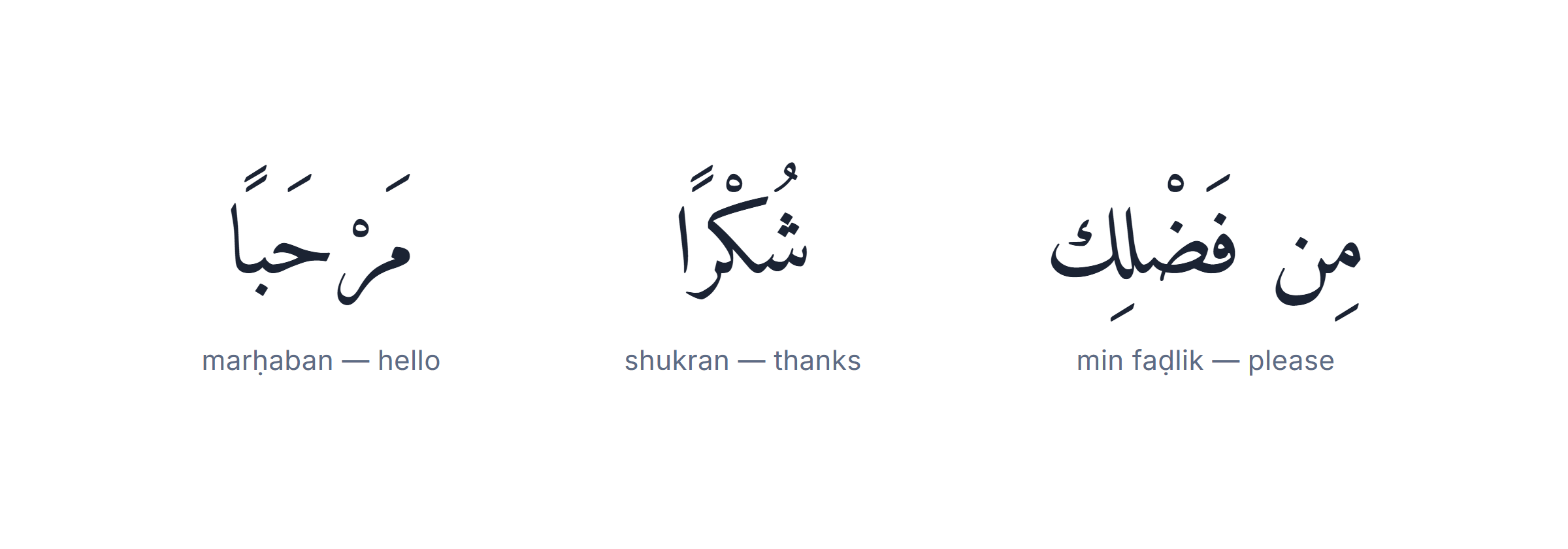
The first ten
If you learn nothing else, learn these. They cover the overwhelming majority of short exchanges with a stranger.
| Arabic | Transliteration | Meaning | What you will hear back |
|---|---|---|---|
| السَّلامُ عَلَيْكُم | as-salāmu ʿalaykum | Peace be upon you (hello) | وَعَلَيْكُمُ السَّلام |
| مَرْحَبًا | marḥaban | Hello | مَرْحَبًا / أَهْلًا |
| شُكْرًا | shukran | Thank you | عَفْوًا |
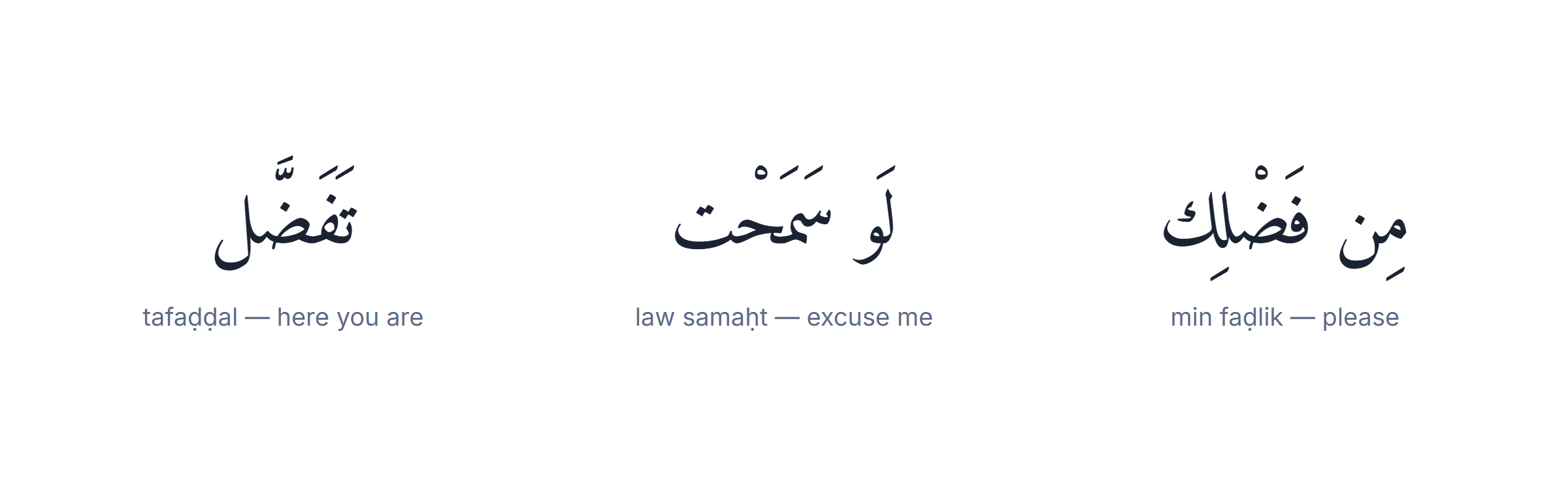
| مِن فَضْلِك | min faḍlik | Please | — |
| نَعَم | naʿam | Yes | — |
| لا | lā | No | — |
| آسِف | āsif | Sorry (m.) — آسِفة āsifa (f.) | وَلا يهِمّك |
| لا أَفْهَم | lā afham | I don’t understand | they will slow down |
| كَم الثَّمَن؟ | kam ath-thaman? | How much? | a number |
| مَعَ السَّلامة | maʿa s-salāma | Goodbye | مَعَ السَّلامة |
Politeness
Arabic politeness is warmer and more formulaic than English. Using the set phrases is not stiff — it is expected, and skipping them reads as brusque.
| Arabic | Transliteration | Use it when |
|---|---|---|
| أَهْلًا وَسَهْلًا | ahlan wa sahlan | welcoming someone — literally “family and ease” |
| تَفَضَّل | tafaḍḍal | here you are / please go ahead / after you. Enormously useful |
| عَفْوًا | ʿafwan | you’re welcome — also “excuse me” to get attention |
| لَو سَمَحْت | law samaḥt | excuse me / if you would permit — softer than min faḍlik |
| شُكْرًا جَزيلًا | shukran jazīlan | thank you very much |
| لا شُكْرَ عَلى واجِب | lā shukra ʿalā wājib | “no thanks needed for a duty” — a warm you’re-welcome |
🔑 تَفَضَّل tafaḍḍal is the single most useful word here. It covers handing something over, inviting someone to sit, letting someone pass and offering food. Learn it with its feminine تَفَضَّلي tafaḍḍalī and plural تَفَضَّلوا tafaḍḍalū.

Meeting someone
| Arabic | Transliteration | Meaning |
|---|---|---|
| ما اسْمُك؟ | mā ismuk? (m.) / mā ismuki? (f.) | What is your name? |
| اسْمي… | ismī… | My name is… |
| كَيْفَ حالُك؟ | kayfa ḥāluk? | How are you? |
| بِخَيْر، الحَمْدُ لِله | bi-khayr, al-ḥamdu lillāh | Fine, praise God — the standard reply |
| مِن أَيْنَ أَنْت؟ | min ayna anta? (m.) | Where are you from? |
| أَنا مِن… | anā min… | I am from… |
| تَشَرَّفْنا | tasharrafnā | Pleased to meet you — literally “we are honoured” |
Want your own name written properly in Arabic script? Our write your name in Arabic page uses a hand-checked database rather than automatic conversion.
When you are stuck
These are the phrases that keep a conversation alive when you have run out of Arabic. In practice they are worth more than another twenty vocabulary items.
| Arabic | Transliteration | Meaning |
|---|---|---|
| هَل تَتَكَلَّم الإنْجِليزِيّة؟ | hal tatakallam al-inglīziyya? | Do you speak English? |
| لا أَتَكَلَّم العَرَبِيّة جَيِّدًا | lā atakallam al-ʿarabiyya jayyidan | I don’t speak Arabic well |
| مَرَّة أُخْرى، مِن فَضْلِك | marra ukhrā, min faḍlik | Again, please |
| بِبُطْء، مِن فَضْلِك | bi-buṭʾ, min faḍlik | Slowly, please |
| ما مَعْنى هَذا؟ | mā maʿnā hādhā? | What does this mean? |
| كَيْفَ تَقول … بِالعَرَبِيّة؟ | kayfa taqūl … bil-ʿarabiyya? | How do you say … in Arabic? |
| أَحْتاجُ مُساعَدة | aḥtāju musāʿada | I need help |
Out and about
| Arabic | Transliteration | Meaning |
|---|---|---|
| أَيْنَ…؟ | ayna…? | Where is…? |
| أَيْنَ الحَمّام؟ | ayna al-ḥammām? | Where is the bathroom? |
| كَم السّاعة؟ | kam as-sāʿa? | What time is it? |
| هَذا غالٍ جِدًّا | hādhā ghālin jiddan | This is very expensive |
| أُريدُ هَذا | urīdu hādhā | I want this |
| الحِساب، مِن فَضْلِك | al-ḥisāb, min faḍlik | The bill, please |
| لَذيذ | ladhīdh | Delicious — say it and watch the room change |
| يَمين / يَسار / عَلى طول | yamīn / yasār / ʿalā ṭūl | right / left / straight on |
The phrases with God in them
A set of expressions referencing God are used constantly in everyday Arabic, by religious and non-religious speakers alike, and often with no religious weight at all. Not knowing them makes ordinary conversation opaque.
| Arabic | Transliteration | What it actually means in use |
|---|---|---|
| إِن شاءَ الله | in shāʾ Allāh | “God willing” — in practice: hopefully, let’s see, and sometimes a gentle probably not |
| ما شاءَ الله | mā shāʾ Allāh | said on seeing something good — a compliment that also wards off envy |
| الحَمْدُ لِله | al-ḥamdu lillāh | “praise God” — the default answer to how are you, and said after eating or sneezing |
| بِسْمِ الله | bismillāh | said when starting something — eating, driving, any beginning |
| اللهُ يُبارِك فيك | allāhu yubārik fīk | “God bless you” — a warm thank-you or a reply to a compliment |
These are also the phrases most often rendered as wall art and jewellery. If you want one set properly with its harakat, our Arabic calligraphy generator will render any of them in 22 open-licence fonts.

MSA versus what people actually say
Everything above is Modern Standard Arabic, which is understood everywhere and spoken natively nowhere. In the street you will hear the dialect. Some of the highest-frequency differences:
| Meaning | MSA | Egyptian | Levantine | Moroccan |
|---|---|---|---|---|
| How are you? | kayfa ḥāluk | izzayyak | kīfak | kīdayr / labas |
| What? | mādhā | ēh | shū | ashnu / shnu |
| Now | al-ʾān | dilwaʾti | hallaʾ | daba |
| Good / fine | jayyid | kwayyis | mnīḥ | mezyan |
| Yes | naʿam | aywa | ēh | īyeh |
🔑 Nobody will mind if you use MSA. You will sound slightly formal — a little like using “shall” and “whom” in English — and you will be understood and appreciated everywhere. Then pick up the local version of these five as you go.
How to actually memorise these
- Ten at a time, as whole sentences. Never as a word list. Your mouth learns chunks.
- Learn each one with its reply. A phrase you cannot follow up on is a dead end in a real conversation.
- Type them in Arabic script, do not read the transliteration. Transliteration is a crutch that becomes a ceiling — it cannot honestly represent ع or ح, and every hour in it is an hour of reading practice you skipped.
- Say them out loud. Silent reading of a phrase list produces recognition, not speech.
- Use one per day for real. One phrase, actually said to a person, beats twenty reviewed on a screen.
Numbers you need in the first week
Prices, addresses and times arrive on day one, and no phrasebook section pays off faster.
| Arabic | Transliteration | English |
|---|---|---|
| واحِد | wāḥid | one |
| اثْنان | ithnān | two |
| ثَلاثة | thalātha | three |
| أرْبَعة | arbaʿa | four |
| خَمْسة | khamsa | five |
| عَشَرة | ʿashara | ten |
| مِئة | miʾa | a hundred |
| كَمْ؟ | kam? | how many / how much? |
| بِكَمْ هٰذا؟ | bikam hādhā? | how much is this? |
Two warnings the tables never carry. Arabic numbers written as digits run left to right inside a right-to-left line, so a price reads in the opposite direction to the words beside it. And the grammar of counting is genuinely strange — the noun after 3–10 goes plural, after 11 and up it goes back to singular, and the gender agreement inverts. Nobody expects a beginner to get that right; say the number and point.
Buying something, start to finish
A complete exchange, in the order it actually happens:
| You say | Meaning |
|---|---|
| مِنْ فَضْلِك، بِكَمْ هٰذا؟ | Excuse me, how much is this? |
| غالي شْوَيّة | That is a bit expensive |
| في تَخْفيض؟ | Is there a discount? |
| آخِر سِعْر؟ | Best price? (literally: last price) |
| طَيِّب، خُدْ | All right, take it (I accept) |
| لا شُكْراً | No thank you — and it means no |
Ākhir siʿr is the phrase that changes the interaction. Where haggling is expected, it signals you know the game; the counter-offer that follows it is usually the real price.
Where haggling is not expected — supermarkets, chains, most of the Gulf, anywhere with a printed label — using it is mildly awkward rather than offensive. The rule of thumb: if the price is on a sticker, it is the price.
And lā shukran deserves its own line. Said with a small smile and a hand on the chest it closes a sale attempt politely and completely, and it is the single most useful phrase in a busy market.
Three phrases to use carefully
Most phrase lists are all encouragement. Three entries genuinely need a warning.
إنْ شاءَ الله — in shāʾ Allāh. Literally “if God wills”. In practice it ranges from a sincere yes to a soft no to “stop asking”, and the meaning lives entirely in tone and context. Understand it early; commit to it late.
حَبيبي — ḥabībī. Textbooks gloss it as “my love”. Between men who know each other it is closer to “mate”. From a stranger to a woman it is not friendly. The word is fine; the pairing is what carries the meaning.
Religious greetings to someone you have misread. As-salāmu ʿalaykum is used across the Arab world by Muslims and non-Muslims alike and is almost always safe. Al-ḥamdu lillāh and mā shāʾ Allāh are more specifically devotional, and from someone who clearly does not mean them they can read as mockery rather than warmth.
The general rule behind all three: learn to recognise these before you learn to say them. Comprehension has no social cost; production does.
If something goes wrong
Short, unambiguous, and worth knowing before you need them.
| Arabic | Transliteration | English |
|---|---|---|
| ساعِدْني! | sāʿidnī! | Help me! |
| أنا تُهْت | anā tuht | I am lost |
| أحْتاج طَبيب | aḥtāj ṭabīb | I need a doctor |
| اتَّصِلْ بِالشُّرْطة | ittaṣil bi-sh-shurṭa | Call the police |
| أنا مَريض | anā marīḍ | I am ill |
| وَيْن الحَمّام؟ | wayn al-ḥammām? | Where is the bathroom? |
| ما بَفْهَم | mā bafham | I do not understand |
Two notes. Wayn is the dialect form and is understood everywhere; the MSA ayna is correct and sounds like a news broadcast. And anā marīḍ takes a final -a if you are a woman — anā marīḍa.
The one to learn first is the last: mā bafham. Almost every breakdown in a real conversation is fixed by admitting it early, and people slow down immediately when you do.
Why you understand nothing at first
You will learn these phrases, produce them correctly, get a reply, and understand none of it. That is expected, and there are three specific reasons rather than a general lack of ability.
Speed and elision. Spoken Arabic runs words together and drops final vowels. Kayfa ḥāluka becomes kīfak. What you learned as three words arrives as one.
The reply is often not the one in the book. Ask kayf ḥālak and the answer may be al-ḥamdu lillāh, tamām, māshī or a shrug — rarely the textbook anā bi-khayr.
It is probably not MSA. The phrases you learned are Modern Standard; the reply is in whatever dialect the person actually speaks, which may differ substantially in vocabulary and negation.
The fix is not more phrases. It is listening to one dialect, repeatedly, for weeks — the same podcast or the same channel until the stream separates into words. That separation is the skill, and it arrives suddenly rather than gradually.
One tactic makes it measurably faster: listen to material you have already read. Take a short news item, read it until you understand every word, then listen to the audio version of the same item. Your ear is no longer guessing at content and can spend all its effort on the sounds, which is the part that actually needs training. Ten minutes of that beats an hour of unfamiliar audio, and it works from the very first week.
Common Arabic phrases: the ten that matter most
If you only memorise ten common Arabic phrases, make them the ten in the first table — greeting, thanks, please, yes, no, sorry, I don’t understand, how much, and goodbye. Learn each one with the reply you will hear back, because that is the part every other list of common Arabic phrases leaves out, and it is the part that keeps a real conversation moving.
Sources and further reading
Everything factual on this page can be checked. These are the sources worth going to directly if you want more depth than an article can give: