Arabic vs Persian: 4 Extra Letters and the Real Differences
The Arabic vs Persian confusion is understandable: Persian is written in Arabic letters and borrows heavily from Arabic vocabulary. It is also no more related to Arabic than English is to Hungarian. Here is what is genuinely shared and what only looks shared.
They are not related — at all
This is the headline, and it surprises almost everyone who has only seen the two written down.
| Arabic | Persian (Farsi) | |
|---|---|---|
| Language family | Semitic (Afro-Asiatic) | Indo-European (Iranian branch) |
| Closest relatives | Hebrew, Amharic, Aramaic | Kurdish, Pashto — and distantly English, Greek, Hindi |
| Script | Arabic, 28 letters | Perso-Arabic, 32 letters |
| Direction | right to left | right to left |
| Where | 22 countries, ~400 m speakers | Iran, Afghanistan (Dari), Tajikistan (Tajik) |
Persian is, genealogically, a cousin of English. Arabic is not. The resemblance is entirely a matter of the writing system and of borrowing — the same way Vietnamese uses Latin letters without becoming a Romance language.

The four letters Persian added
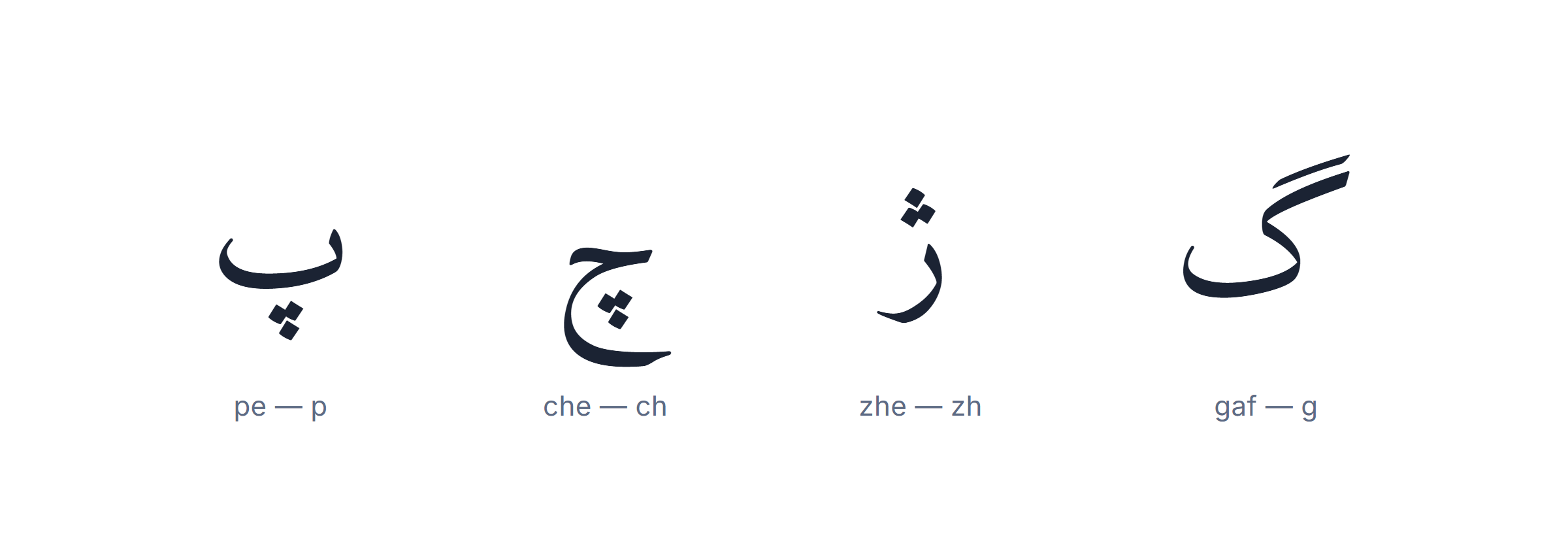
Arabic has 28 letters. Persian uses all of them and adds four, for sounds Arabic does not have:
| Letter | Sound | Example | Built from |
|---|---|---|---|
| پ | p as in pen | پدر | ب | with three dots instead of one
| چ | ch as in chair | چای | ج | with three dots instead of one
| ژ | zh, the s in measure | ژاله | ز | with three dots instead of one
| گ | g as in go | گل | ك | with a second stroke
🔑 The pattern is elegant and worth noticing: three of the four are an existing Arabic letter with its dots tripled. Arabic has no p, no ch, no g and no zh, so Persian built them out of the nearest available shapes. Urdu later borrowed all four.
This is also why Arabic speakers writing foreign names reach for ب for p — Paris becomes باريس Bārīs. Persian simply writes پاریس.
How to spot Persian at a glance
Four tells, and any one of them settles it in about two seconds:
- Look for پ چ ژ گ. If any of those four appear, it is not Arabic. This is the fastest test there is.
- Look at the letter k. Arabic writes ك with a small hook inside; Persian writes ک without it.
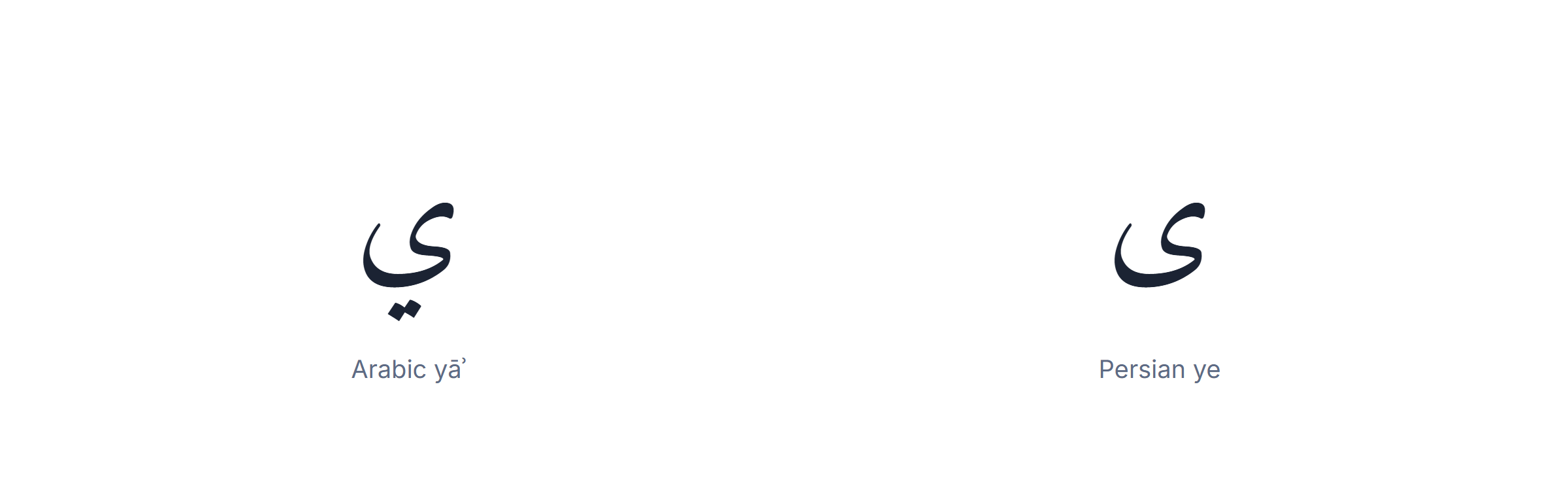
- Look at final y. Arabic ي keeps its two dots at the end of a word; Persian ی drops them.
- Look for ة. The tāʾ marbūṭa — the h with two dots that ends countless Arabic feminine nouns — is essentially absent from Persian, which has no grammatical gender to mark.
A fifth, softer tell: Persian is often set in Nastaliq, the sloping, cascading style where each word appears to hang down to the left. Arabic is almost always set in Naskh, which sits flat on the line. You can compare the two directly in our calligraphy generator, which ships both.

The same letter, a different sound
Persian took the whole Arabic alphabet including letters for sounds Persian does not have — and then pronounced them with the nearest Persian sound. The result is a set of homophones that make Persian spelling harder than Arabic spelling.
| Letters | In Arabic | In Persian |
|---|---|---|
| ث س ص | three distinct sounds: th, s, emphatic ṣ | all pronounced s |
| ذ ز ض ظ | four distinct sounds | all pronounced z |
| ت ط | t and emphatic ṭ | both t |
| ح ه | pharyngeal ḥ and plain h | both a plain h |
| ق غ | uvular q and voiced gh | merged for most speakers |
| ع | the pharyngeal ʿayn | usually reduced to a glottal stop or nothing |
The seven Arabic sounds with no English equivalent are covered letter by letter in Arabic alphabet pronunciation.
Where the grammar diverges — which is everywhere
| Feature | Arabic | Persian |
|---|---|---|
| Grammatical gender | yes — every noun is masculine or feminine | 🟢 none at all |
| Word formation | three-consonant roots poured into patterns | prefixes and suffixes, like European languages |
| Word order | verb–subject–object, or SVO | subject–object–verb |
| Plurals | many are “broken” — the word restructures internally | 🟢 regular suffixes ها / ان |
| Number | singular, dual, plural | singular and plural only |
| Case endings | yes in formal MSA | none |
| Definite article | ال | no article at all |
🔑 Read that column again: no gender, no dual, no cases, no article, regular plurals. On grammar alone, Persian is dramatically simpler for an English speaker — it is the script and the vocabulary that make it look intimidating.
The shared vocabulary — real, and one-directional
A large share of formal Persian vocabulary is of Arabic origin, the legacy of centuries of Arabic as the language of scholarship and administration after the seventh century. The commonly quoted range is around 40–50 % of the formal written lexicon, dropping considerably in everyday speech.
The borrowing runs overwhelmingly into Persian. But not entirely — some famous Arabic words came the other way:
- فيروز fayrūz, turquoise — from Persian
- بستان bustān, garden — Persian bū (scent) + stān (place)
- دفتر daftar, notebook
- كنز kanz, treasure
Which is harder to learn?
The US Foreign Service Institute places Arabic in Category IV (~2,200 hours) and Persian in Category III (~1,100 hours) for English speakers — Persian is budgeted at roughly half.
Why Persian comes out easier despite the unfamiliar script:
- No grammatical gender, no cases, no dual, regular plurals
- It is Indo-European, so the sentence logic feels more familiar
- Recognisable cognates: مادر mādar (mother), پدر pedar (father), برادر barādar (brother), نام nām (name)
- 🔑 No diglossia. Written and spoken Persian differ, but nothing like the gap between Modern Standard Arabic and the Arabic dialects — which is arguably the single hardest thing about Arabic
What Persian makes harder: the homophone spelling problem above, and Nastaliq, which is genuinely harder to read at speed than Naskh.
The numerals give it away instantly
Before you read a single word, the digits tell you which language you are looking at.
| Value | Arabic | Persian |
|---|---|---|
| 4 | ٤ | ۴ |
| 5 | ٥ | ۵ |
| 6 | ٦ | ۶ |
| 7 | ٧ | ۷ |
Zero through three and eight and nine are shared. Four, five, six and seven differ, and the Persian five ۵ against the Arabic five ٥ is the clearest single tell on any page — one is a closed loop, the other an open hook.
In both languages the digits run left to right inside a right-to-left line, so a date or a phone number is read in the opposite direction to the words around it. And in both, the Latin digits 1 2 3 are increasingly common in commercial and technical text, so a page can carry two numeral systems at once without either being an error.
Persian kept the letters and changed the poetry
Both traditions are enormous and they are built on different machinery, which is a better illustration of the gap than any grammar table.
Arabic poetry is quantitative and root-driven. Classical metre counts long and short syllables, and because Arabic words are built by pouring three-consonant roots into fixed vowel templates, related words rhyme structurally. The music comes out of the morphology before the poet does anything.
Persian borrowed the metres and had to bend them. Persian has no root system and a different syllable inventory, so classical Persian verse adapted Arabic prosody to a language it did not naturally fit — and then produced Rumi, Hafez, Saadi and the Shahnameh inside those borrowed forms. Ferdowsi wrote the Shahnameh in deliberately Persian-heavy vocabulary, consciously avoiding Arabic loans.
The point for a learner: a shared script and a shared metre did not produce a shared literature. Reading Hafez does not prepare you for al-Mutanabbi and the reverse is equally true, however similar the two pages look.
Where each is spoken, and by how many
Geography explains part of why the two get confused: the language areas touch, and they have traded vocabulary across that border for well over a thousand years.
| Arabic | Persian | |
|---|---|---|
| Family | Semitic (Afro-Asiatic) | Indo-European (Iranian) |
| Speakers | Roughly 400 million | Roughly 80–110 million |
| Countries | Official in over 20 | Iran, Afghanistan (Dari), Tajikistan (Tajik) |
| Script | Arabic, 28 letters | Arabic + 4, so 32 |
| Varieties | MSA plus deeply divergent dialects | Three main mutually intelligible varieties |
One asymmetry worth naming. Persian dialect variation is far milder than Arabic’s. A Tehrani, a Kabuli and a Dushanbe speaker can hold a conversation; Tajik is written in Cyrillic and is still the same language. A Moroccan and an Iraqi speaking their own dialects often cannot, and fall back on MSA or on Egyptian.
So the two languages are not mirror images even in how they vary. Arabic is one written standard over many spoken languages. Persian is closer to one language with accents.
Telling them apart in software
The confusion has a practical form that costs people real time: text that looks right and behaves wrong, because the two languages share code points without sharing conventions.
Two letters have separate Unicode characters that render almost identically. Arabic yāʾ ي (U+064A) carries two dots below; Persian yeh ی (U+06CC) has none in its final and isolated forms. Arabic kāf ك (U+0643) and Persian keheh ک (U+06A9) differ in the little stroke on top. In the middle of a word they look nearly the same and they are different characters — which is why a search for a Persian word typed with Arabic letters returns nothing, and why copied text sometimes fails to match itself.
The keyboard layouts are different too. A standard Arabic layout does not have پ, چ, ژ or گ at all, so Persian typed on an Arabic keyboard comes out with the wrong letters substituted.
And a font that covers Arabic may not cover Persian. Many Arabic webfonts omit the four added letters, which then fall back to a different face mid-word — the usual cause of Persian text that looks subtly broken on a page that renders Arabic perfectly.
If you are typing Arabic, use a tool built for Arabic: our online Arabic keyboard emits the Arabic code points, so what you copy is what search engines and Arabic software expect.
Arabic vs Persian: the summary
The Arabic vs Persian question has a clean answer: same script, unrelated languages. Persian is Indo-European and a distant cousin of English; Arabic is Semitic. Persian adds four letters, drops grammatical gender, cases and the dual, and borrows heavily from Arabic vocabulary. Learn to read one and you can read most of the other in a fortnight.
Sources and further reading
Everything factual on this page can be checked. These are the sources worth going to directly if you want more depth than an article can give:
- Wikipedia — Persian alphabet
- US Department of State — FSI language difficulty categories
- Wikipedia — Indo-European languages