Arabic Harakat: The Complete Guide to All 8 Vowel Marks
The Arabic harakat are the marks above and below the letters, and they are not decoration. They carry the short vowels — and adult Arabic text leaves almost all of the harakat out, which is the single hardest thing about learning to read Arabic.
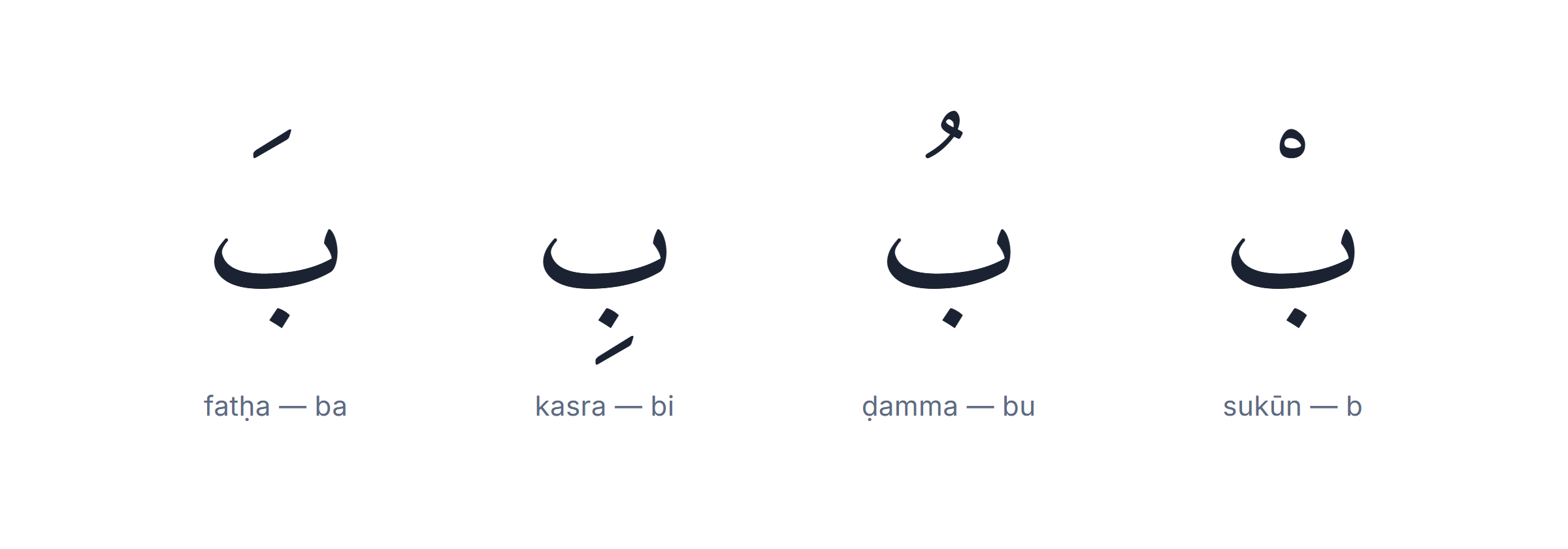
What harakat actually are
الحَرَكات al-ḥarakāt — literally “the movements” — are the small marks written above and below Arabic letters. Collectively the system is called التَّشْكيل tashkīl, “the shaping”.
They exist because of a structural fact about the Arabic writing system: the 28 letters record consonants and long vowels. The three short vowels have no letters at all. The harakat fill that gap.
The three short vowels
| Mark | Name | Sound | Position | Example |
|---|---|---|---|---|
| بَ | فَتْحة | a as in cat | a short stroke above | بَ | = ba
| بِ | كَسْرة | i as in sit | a short stroke below | بِ | = bi
| بُ | ضَمّة | u as in put | a small و above | بُ | = bu
That is the entire short-vowel inventory. Arabic has three vowel qualities, each short or long — six in total. English has roughly a dozen depending on the accent. For once Arabic is the simpler language.
🔑 The long vowels are letters, not marks: ا is long ā, و is long ū, ي is long ī. That is why they survive in unvowelled text and the short ones do not — and why doubling a vowel when you type phonetically (salaam rather than salam) produces the right spelling.

Sukun — the absence of a vowel
السُّكون as-sukūn, “the stillness”, is a small circle above a letter meaning no vowel follows. The consonant closes the syllable.
- مَكْتَب maktab (office) — the sukun on ك is what makes it mak-tab and not makatab.
- قَلْب qalb (heart) — sukun on the ل.
Sukun is the mark beginners most often skip, and skipping it is what produces the characteristic learner’s mistake of inserting vowels that are not there.
Shadda — the doubler
الشَّدّة ash-shadda is a small w-shape above a letter meaning the consonant is doubled — held roughly twice as long.
This is not cosmetic. Doubling changes meaning, often dramatically:
| Without shadda | With shadda |
|---|---|
| دَرَسَ | darasa — he studiedدَرَّسَ | darrasa — he taught
| عَلِمَ | ʿalima — he knewعَلَّمَ | ʿallama — he taught
🔑 Shadda stacks with a vowel. The shadda sits on the letter and the fatha, kasra or damma sits with it — above for fatha and damma, and by convention below the shadda (or below the letter) for kasra. So دَرَّسَ carries both marks on the same ر.
Shadda is also what makes the sun-letter rule visible: الشَّمْس ash-shams shows a shadda on the ش because the l of al- assimilated into it.

Tanwin — the -n endings
التَّنْوين at-tanwīn is the doubled form of each short vowel, and it adds an -n sound at the end of a word. It marks indefiniteness in formal Arabic — roughly the job of English a or an.
| Mark | Name | Sound | Example |
|---|---|---|---|
| ـً | tanwīn fatḥ | -an | شُكْرًا | shukran — thank you
| ـٍ | tanwīn kasr | -in | بَيْتٍ | baytin — of a house
| ـٌ | tanwīn ḍamm | -un | بَيْتٌ | baytun — a house
Madda, dagger alif and the rest
| Mark | Name | What it does |
|---|---|---|
| آ | مَدّة | madda: a wave over alif marking a long ā with a glottal onset — القُرْآن |
| ٰ | dagger alif | a vertical stroke standing in for an unwritten long ā — هَٰذا, اللّٰه |
| ء | هَمْزة | hamza: the glottal stop. Strictly a letter rather than a haraka, but it behaves like a mark and sits on ا و ي or alone |
| ٱ | وَصْلة | wasla: an alif whose glottal stop is skipped when the word is joined to the one before |
Hamza deserves its own treatment — which seat it takes depends on the surrounding vowels, and it is the single most common spelling error among learners and native writers alike. We cover the rule in how to type hamza in Arabic.

Why real Arabic text has none of this
Here is the part that catches every learner off guard around month three.
Newspapers, novels, websites, road signs, contracts and text messages are written with no harakat at all. Consonants and long vowels only. The reader is expected to supply the short vowels from vocabulary, grammar and context — instantly, unconsciously, the way an English reader handles read in “I read it yesterday”.
Two consequences worth naming plainly:
- You cannot reliably pronounce an Arabic word you have not already learned. This breaks the normal beginner strategy of reading your way into a language, and it is why progress feels like it stalls in month three.
- The plateau is the training wheels coming off, not a regression. Reading did not get worse; the support disappeared.
When harakat ARE written
- The Qur’an — fully vowelled, always, because exact recitation matters. This is the largest body of fully vowelled Arabic in existence.
- Children’s books and learning material — vowelled while readers are building vocabulary.
- Classical poetry — where metre depends on precise vowel length.
- Dictionaries — the headword is vowelled so you know how it sounds.
- Ambiguous words in ordinary text — a writer will add a single mark where a genuine misreading is likely.
- Tanwīn fatḥ — as above, this one survives almost everywhere.
How to type harakat
On a physical Arabic keyboard the marks live on the Shift layer of the number row and nearby keys, which is why most people never learn them — they are invisible until someone tells you.
| Mark | Standard Arabic (101) key |
|---|---|
| fatḥa َ | Shift + Q |
| kasra ِ | Shift + A |
| ḍamma ُ | Shift + E |
| sukūn ْ | Shift + X |
| shadda ّ | Shift + ~ |
| tanwīn fatḥ ً | Shift + W |
| tanwīn kasr ٍ | Shift + S |
| tanwīn ḍamm ٌ | Shift + R |
The mark is typed after the letter it sits on. Type ب, then the fatha, and the two combine into بَ. Order matters, and a shadda goes before its vowel.
⚠️ One practical warning: not every font positions harakat well. The Naskh faces — Amiri, Scheherazade New, Noto Naskh Arabic — were designed for careful mark placement. Many display fonts put them approximately. Check at a large size before printing anything.
Reading a vowelled word out loud, step by step
Knowing what each mark does is not the same as reading at speed. The procedure below is what fluent readers do without noticing, slowed to its steps.
Take كَتَبَ.
- Read right to left, consonant first. The letter carries the sound; the mark above or below it is the vowel that follows. Not precedes — follows. This single rule fixes most beginner misreadings.
- kāf + fatha above it → ka.
- tāʾ + fatha → ta.
- bāʾ + fatha → ba. The word is kataba, “he wrote”.
Now مُدَرِّس. Mīm + damma → mu. Dāl + fatha → da. Rāʾ carries a shadda and a kasra, so it doubles and then takes i: rri. Sīn ends the word bare. Mudarris — a teacher.
The order of stacked marks is fixed: the shadda is read first and the vowel second, always. ـِّ is never i-then-double; it is always double-then-i. And note where the kasra sits in that example — under the shadda rather than under the letter. Both positions are correct and both mean the same thing; typesetters disagree, and you will see each.
Hamza — the mark that is not a haraka
ء looks like a diacritic, sits where diacritics sit, and is not one. Hamza is a consonant — the glottal stop, the catch in the middle of English “uh-oh”. It takes harakat of its own.
The confusion matters because hamza never disappears from unvowelled text the way harakat do. A newspaper drops every fatha and kasra on the page and still prints سُؤال with its hamza, because removing it would change the word. If you have been treating hamza as optional decoration, you have been misreading a consonant.
It is written four ways depending on the surrounding vowels — on alif أ, on wāw ؤ, on yāʾ ئ, or on the line ء. Those carriers are spelling, not sound: all four are the same glottal stop. The rules for choosing between them are genuinely fiddly and are a writing problem, not a reading one — for reading, treat all four as identical.
Two more marks get mistaken for harakat and are not. Waṣla ٱ marks an alif that is skipped when the word is not first in the sentence. Alif maqṣūra ى is a full letter that sounds like a long ā. Neither is a vowel mark, and neither is optional.
Five harakat mistakes that survive for years
- Reading the mark before the letter. The vowel always follows its consonant. Readers who learned from transliteration import the Latin order and produce akta for kataba for months.
- Treating sukun as silence. ـْ means “no vowel here”, not “no sound here”. The consonant is fully pronounced; it simply closes the syllable.
- Skipping tanwīn on the ending. ـً is -an and it is audible in careful speech. Dropping it is fine in dialect and wrong when reading MSA aloud.
- Doubling too gently. A shadda is a real geminate — the consonant is held roughly twice as long. English speakers halve it and produce a different word: darasa (he studied) versus darrasa (he taught).
- Waiting for the marks. The most expensive one. Learners keep reading only vowelled text and never build the pattern recognition that unvowelled reading needs. Start reading unvowelled material at month three, badly, on purpose.
Where the marks came from
Harakat are not original to the script. The earliest Arabic writing had neither vowel marks nor the dots that distinguish ب ت ث from one another — a reader supplied both from knowledge of the language.
That worked while Arabic was written mostly by people who spoke it natively. It stopped working as the language spread and as the exact wording of the Quran needed to be fixed beyond dispute. The tradition credits Abū al-Aswad al-Duʾalī, in the seventh century, with a first system of coloured dots marking vowels, and al-Khalīl ibn Aḥmad, in the eighth, with replacing them with the small shapes still used today — most of them abbreviations of letters, the fatha from a small alif, the kasra from a yāʾ, the damma from a wāw.
Two things follow that are useful rather than merely historical. First, the marks were invented as a reading aid for non-native and uncertain readers, which is exactly the position a learner is in — using them is not a crutch, it is the intended use. Second, text without them is the older and still the default state, so unvowelled reading is not an advanced variant of normal Arabic. It is normal Arabic.
Arabic harakat: what to remember
The Arabic harakat are the short vowels, and adult Arabic text leaves them out. Three vowel marks, sukun for no vowel, shadda for a doubled consonant, three tanwin endings — that is the whole system. Learn the Arabic harakat while you are reading vowelled text, then drop them deliberately in month three, because the skill you are really building is supplying them yourself.
Sources and further reading
Everything factual on this page can be checked. These are the sources worth going to directly if you want more depth than an article can give:
- Wikipedia — Arabic diacritics
- Unicode Consortium — the Arabic code chart (PDF)
- Google Fonts — Arabic typefaces with careful mark positioning