Why Is Arabic Written Right to Left? The Honest 3,000-Year Answer
Arabic did not choose to go right to left. It inherited the direction from a chain of alphabets going back to the Bronze Age — and the most convincing explanation involves a hammer and a chisel.

The short answer
Arabic runs right to left because it inherited the direction from Nabataean Aramaic, which inherited it from Phoenician, which had been written right to left since roughly 1050 BCE. Nobody sat down and picked it. It is the oldest surviving habit in the writing system.
The interesting question is not why Arabic goes right to left. It is why the Phoenicians did — and the best answer we have is about tools.

The chisel theory
The most widely repeated explanation, and the most physically convincing, is that the earliest alphabetic writing was carved into stone rather than written on a surface.
Picture a right-handed mason. The chisel is held in the left hand, the hammer swings in the right. Under those constraints:
- The left hand naturally sits to the left of where the right hand is striking.
- Progress runs away from the striking hand, which means moving leftward across the stone.
- The carved characters stay visible, unobstructed by either hand.
Carving therefore favours right-to-left. And the earliest Semitic inscriptions we have — Proto-Sinaitic marks in the turquoise mines of Serabit el-Khadim, later Phoenician inscriptions — are exactly that: cut into rock.
The counterpart argument explains the switch: once writing moved from stone to ink on papyrus, right-to-left became a nuisance for right-handers, because the writing hand drags across what was just written and smudges it. That pressure is real, and it is part of why left-to-right eventually won in the Greek and Latin world.

The chain of inheritance
| When | Script | Direction |
|---|---|---|
| c. 1900–1500 BCE | Proto-Sinaitic | variable — vertical, boustrophedon, either way |
| c. 1050 BCE | Phoenician | fixed right to left |
| c. 900 BCE onward | Aramaic, Paleo-Hebrew | right to left |
| c. 200 BCE – 400 CE | Nabataean Aramaic | right to left |
| c. 400 CE onward | Arabic | right to left |
🔑 This is also why Arabic and Hebrew share a direction without being closely related in script. Both descend from Phoenician along different branches. They are cousins several times removed who kept the same family habit.
Early Semitic writing was not consistent about it. Some inscriptions run boustrophedon — literally “as the ox ploughs” — alternating direction line by line, left to right, then right to left, then back. Direction settled into a fixed convention only gradually, and Phoenician is where it locked.
How Europe ended up going the other way
The Greeks borrowed the Phoenician alphabet around the 8th century BCE — and borrowed the direction with it. Early Greek inscriptions are right to left, and many are boustrophedon.
Over the following two centuries Greek settled on left to right. The likely drivers:
- The shift from chiselled stone to ink, where a right-hander smudges leftward writing
- Simple standardisation — once a majority convention emerges, it becomes self-reinforcing
Latin took the alphabet from Greek, and Europe with it. So Arabic and English use writing systems descended from the same Phoenician ancestor, running in opposite directions because one branch changed its mind and the other did not.
Why Arabic numbers run left to right
This is the detail that confuses people the most, and it is genuinely odd.
In Arabic text, numbers are written left to right — the same direction as English. The year 2026 is written with the 2 on the left and the 6 on the right, inside a sentence flowing the other way.
So a line of Arabic containing a number is genuinely bidirectional: the words run right to left and the digits inside them run left to right. Every piece of software that handles Arabic has to implement this, and it is why Arabic text handling is a well-known source of software bugs.
You will also see two different sets of digit shapes: the Western forms 0 1 2 3 used across North Africa, and the Eastern Arabic forms ٠ ١ ٢ ٣ used in Egypt eastward. Both are read left to right. Our franco-arabic typing tool converts between them.
Which other languages go right to left
| Script | Languages | Related to Arabic? |
|---|---|---|
| Arabic | Arabic, Persian, Urdu, Pashto, Kurdish, Uyghur | same script, mostly unrelated languages |
| Hebrew | Hebrew, Yiddish, Ladino | shared Phoenician ancestor |
| Syriac | Syriac, Neo-Aramaic | shared Aramaic ancestor |
| Thaana | Dhivehi (Maldives) | influenced by Arabic |
| Nkoo | Manding languages, West Africa | created in 1949, deliberately right to left |
Persian and Urdu are the reminder that direction travels with the script, not with the language. Both are Indo-European — distant relatives of English — and both write right to left because they adopted the Arabic alphabet. See Arabic vs Persian and Arabic vs Urdu.
What it means in practice
- Books open the other way. What an English reader calls the back cover is the front. Page numbers ascend leftward.
- Whole interfaces mirror. Arabic websites and apps flip the layout: navigation moves right, progress bars fill leftward, the back arrow points right.
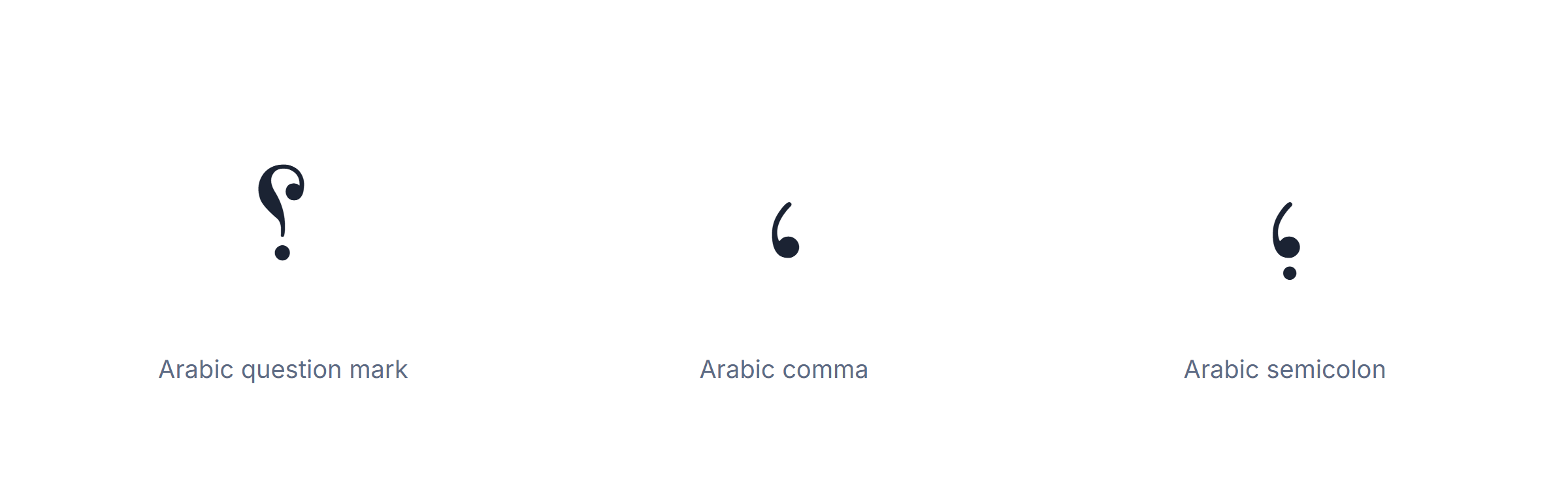
- Punctuation mirrors too. Arabic uses a reversed question mark ؟ and its own comma ،, both shaped to suit the flow.
- Handwriting is easier for left-handers. One of the few writing systems where being left-handed is an advantage.
- Mixed text is where software breaks. An Arabic sentence containing an English brand name and a phone number switches direction three times. If you have ever seen an Arabic address render in the wrong order, this is why.
How software actually handles it — the bidi algorithm
Right-to-left text is the single most common source of layout bugs in international software, and the reason is that a line of Arabic is not simply “reversed English”. It is genuinely bidirectional: the words run one way and any numbers, Latin brand names, URLs or email addresses inside them run the other.
Unicode solves this with a published specification called the Bidirectional Algorithm, usually shortened to bidi. Every character in Unicode carries a directional property — strongly right-to-left for Arabic and Hebrew letters, strongly left-to-right for Latin letters, and neutral for spaces, most punctuation and symbols. The algorithm walks the line, groups characters into runs of the same direction, and then lays those runs out in the reading order the paragraph declares.
Neutral characters are where it goes wrong. A full stop between an Arabic word and a Latin one has no direction of its own, so the algorithm has to infer where it belongs from its neighbours — and it does not always infer what a human would. This is why an Arabic postal address with a house number can render with the number in the wrong place, and why a phone number pasted into an Arabic sentence sometimes reorders itself.
Two practical consequences worth knowing:
- Always declare direction explicitly. On the web that means
dir="rtl"on the element, not a CSS text-align. Alignment is cosmetic; direction is structural, and only one of them tells the browser how to order the runs. - Isolate mixed content. HTML has
<bdi>and CSS hasunicode-bidi: isolatefor exactly this — wrapping a Latin fragment inside an Arabic sentence so it cannot disturb the text around it. Every Arabic string on this site that contains a Latin word uses it.
Get those two right and the overwhelming majority of RTL rendering problems disappear. Get them wrong and the text will look correct to you and scrambled to a reader who actually reads Arabic — which is the failure mode that survives testing.
How Arabic numerals reached Europe
The digits are worth a section of their own, because their journey explains the naming confusion completely.
The system of nine digits plus a positional zero was developed in India, and reached the Arabic-speaking world through translations of Indian mathematical works during the eighth and ninth centuries. The mathematician al-Khwārizmī — whose name gives us the word algorithm — wrote an influential treatise on calculating with them around 825 CE.
Europe then received them from the Arabic world rather than from India directly. The usual milestone is Fibonacci’s Liber Abaci of 1202, which argued for the new digits over Roman numerals on the grounds that you could actually do arithmetic with them. Adoption took centuries; Roman numerals persisted in European bookkeeping well into the Renaissance.
So English calls them Arabic numerals because that is who Europe got them from, and Arabic calls them الأرقام الهندية, al-arqām al-hindiyya — Indian numerals — because that is who the Arabic world got them from. Both names are accurate about a different link in the same chain, which is a pleasingly honest outcome for a naming dispute.
One more wrinkle: the shapes diverged. North Africa kept forms that evolved into the Western digits 0 1 2 3 4 5 6 7 8 9, while the eastern Arab world kept ٠ ١ ٢ ٣ ٤ ٥ ٦ ٧ ٨ ٩. Both are read left to right, both mean the same thing, and a Moroccan and an Egyptian will each find the other’s set slightly foreign.
Designing for right to left
If you are building anything that will be read in Arabic, the direction affects far more than the text:
- The whole layout mirrors, not just the paragraphs. Navigation moves to the right, sidebars swap sides, and the visual reading path runs from the top right.
- Icons that imply direction flip; icons that depict objects do not. A back arrow points right in Arabic. A clock, a musical note or a magnifying glass stay exactly as they are — mirroring them looks like a bug, not a translation.
- Progress runs the other way. Progress bars fill leftward, carousels advance leftward, and a timeline starts on the right.
- Numbers and units stay put. A price is still 120 followed by its currency in the reading order of the sentence, not reversed digit by digit.
- Line-height usually needs increasing. Arabic letterforms have deep descenders and stacked diacritics; European default line-heights crowd them.
CSS makes most of this automatic if you use logical properties — margin-inline-start instead of margin-left, padding-inline-end instead of padding-right. Set dir="rtl" once and a layout built on logical properties mirrors itself. A layout built on left and right has to be rewritten.
Why is Arabic written right to left: the short answer
Why is Arabic written right to left? Because Phoenician was, and Arabic inherited it. The best explanation for the original choice is a right-handed mason holding a chisel in the left hand and working leftward across stone. Greek borrowed the same alphabet and later flipped, which is the only reason English runs the other way.
Sources and further reading
Everything factual on this page can be checked. These are the sources worth going to directly if you want more depth than an article can give: