Arabic Quotes and Proverbs: 40 With Real Translations and Context
Most lists of Arabic quotes are the same forty lines copied between sites, half of them mistranslated and several invented outright. These are real, with what they literally say, what they actually mean, and when you would hear one.

Quote, proverb, or hadith — they are not the same
Why the distinction is not pedantry
- A hadith carries religious authority a proverb does not.
- A Quranic verse carries more still, and has a citable reference.
- Native readers notice the mislabel immediately and judge it harshly.
Almost every English list of Arabic quotes mixes three different things, and the mixing is why so many of them are wrong. It is worth separating them before reading any list, including this one.
A proverb — mathal — is folk wisdom with no author. It has usually been said for centuries, it often rhymes or has internal rhythm, and nobody can tell you who first said it. This is the largest category and the one below is mostly made of them.
A literary quote has a named author: a poet, a philosopher, a novelist. Its wording is fixed, and attributing it correctly matters.
A hadith is a reported saying of the Prophet Muhammad, transmitted through a documented chain and graded by scholars for reliability. It is a religious text, not a saying. Presenting a hadith as “an Arabic quote” — which happens constantly online — is a category error, and presenting a proverb as a hadith is a more serious one.
Every one of the Arabic quotes below is labelled. Where the author is unknown it says so, rather than inventing one.
Proverbs about patience and time
How to read this table
- Arabic — the exact string, so you can verify it.
- Literally — word-for-word, even where it sounds odd.
- What it means — including when someone would say it.
Why patience dominates the Arabic quotes tradition
- Agricultural and trading societies where outcomes arrived on their own schedule.
- A literary register that rewards compression, so waiting-advice compresses well.
- A religious vocabulary in which sabr is a named virtue, not just a mood.

Patience is the single most common subject in Arabic quotes and proverbs, which tells you something about the cultures that produced them.
| Arabic | Literally | What it means |
|---|---|---|
| الصبر مفتاح الفرج | Patience is the key to relief | The situation resolves if you can wait it out. Said to someone in difficulty. |
| في التأني السلامة وفي العجلة الندامة | In deliberation, safety; in haste, regret | Slow down. Used as a warning before a decision. |
| الوقت كالسيف إن لم تقطعه قطعك | Time is like a sword: if you do not cut it, it cuts you | Use the time or lose it. Common in study and work contexts. |
| لكل جواد كبوة | Every fine horse has a stumble | Even the capable fail sometimes. Said to console. |
| ما كل ما يتمنى المرء يدركه | Not everything a person wishes for is attained | From a classical verse; used the way English uses “you can’t always get what you want”. |
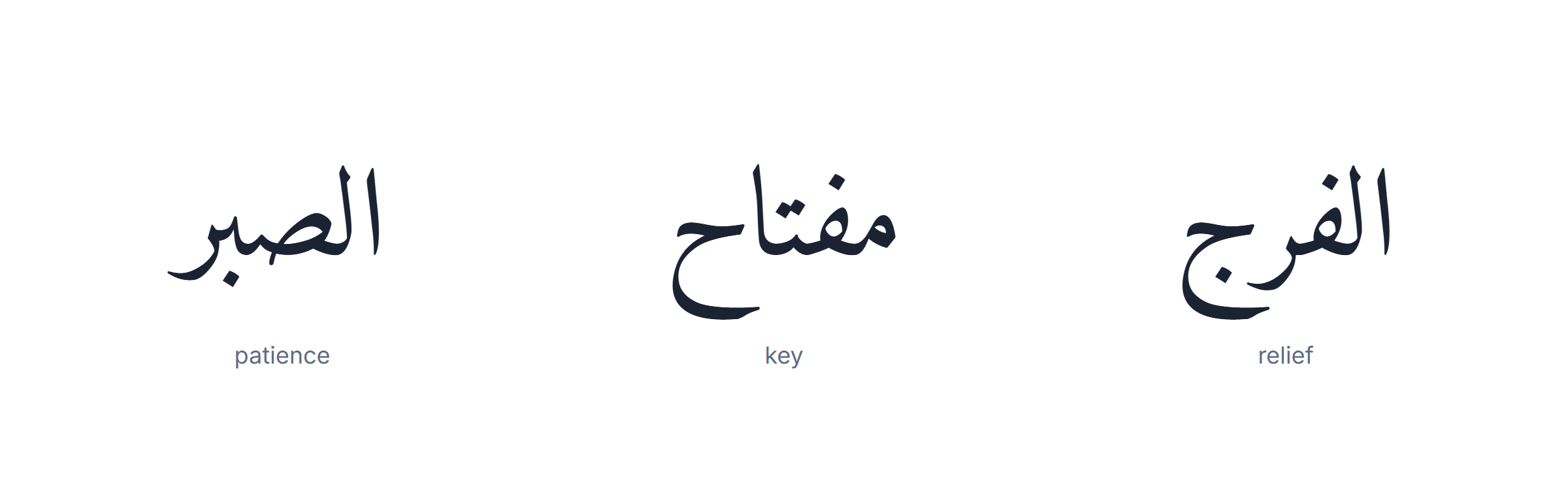
A note on the first line, because it is the most misused of all Arabic quotes in English-language content. Al-ṣabr miftāḥ al-faraj is a proverb. It is regularly captioned online as a hadith or a Quranic verse. It is neither, and saying so is not pedantry — attributing folk wisdom to scripture is exactly the kind of error a native reader notices immediately.
Proverbs about people and character
How these Arabic quotes are actually used
- Deployed at a moment, as a comment on what someone just did.
- Rarely quoted standalone the way English quotes wisdom.
- Often affectionate where the literal translation sounds harsh.

| Arabic | Literally | What it means |
|---|---|---|
| الطيور على أشكالها تقع | Birds land with their own kind | Birds of a feather. Used about company you keep, usually critically. |
| اليد الواحدة لا تصفق | One hand does not clap | Nothing gets done alone. Often used to push for cooperation. |
| الجار قبل الدار | The neighbour before the house | Check who lives next door before you buy. Advice, still given literally. |
| اسأل مجرب ولا تسأل طبيب | Ask someone experienced, not a doctor | Lived experience beats theory. Said with a certain amount of humour. |
| القرد في عين أمه غزال | The monkey is a gazelle in his mother’s eye | A parent cannot judge their own child. Affectionate, not cruel. |
| إن كان لك عند الكلب حاجة قل له يا سيدي | If you need something from the dog, call him “sir” | On swallowing pride when you need a favour. Cynical and very common. |
Notice how many of these Arabic quotes are situational rather than abstract. Arabic proverbs are typically deployed at a moment — as a comment on what someone just did — rather than quoted as standalone wisdom. That is the difference between using one correctly and using one like a poster.
Proverbs about speech and silence
The one to be careful with
- كلمة طيبة صدقة is a hadith, not a proverb.
- It appears in most English lists of Arabic quotes mislabelled.
- Attributing a hadith to folk wisdom is the error native readers judge hardest.

| Arabic | Literally | What it means |
|---|---|---|
| إذا كان الكلام من فضة فالسكوت من ذهب | If speech is silver, silence is gold | The direct ancestor of the English saying. |
| اللسان عدو الإنسان | The tongue is a person’s enemy | You will be undone by what you said. Rhymes in Arabic, which is why it stuck. |
| كلمة طيبة صدقة | A good word is charity | ⚠️ This one IS a hadith, not a proverb. Attribute it properly. |
| الكلام لك يا جارة واسمعي يا كنة | The talk is for you, neighbour — but listen, daughter-in-law | Criticising one person so another hears it. Untranslatable and extremely common. |
The fourth of these Arabic quotes is worth reading twice. It describes a specific social manoeuvre — saying something pointedly to the wrong person so the right person overhears — and English has no single expression for it. Proverbs like this are the reason translated lists feel flat: the sentence survives translation and the situation does not.
Proverbs about work, money and luck
What to notice
- Two of the five rhyme internally, which is why they survived.
- None mentions luck as a cause of anything.
The pattern in these Arabic quotes
- Effort is framed as the cause, never luck.
- Saving is framed in colour — the white penny, the black day.
- The animals are local: falcons in the Gulf, donkeys in Egypt.
| Arabic | Literally | What it means |
|---|---|---|
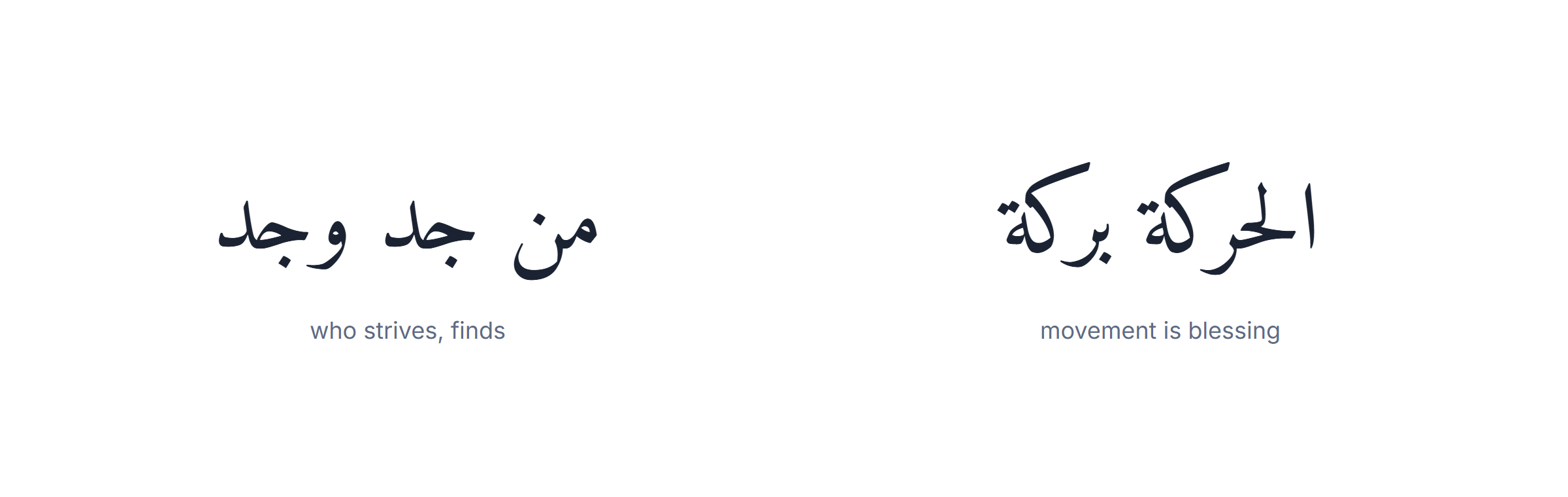
| من جد وجد ومن زرع حصد | Who strives, finds; who sows, reaps | The standard encouragement to a student. Rhymes, which is why every child knows it. |
| الحركة بركة | Movement is blessing | Doing something beats doing nothing. Said to someone hesitating. |
| القرش الأبيض ينفع في اليوم الأسود | The white penny helps on the black day | Save for hard times. The colour pairing is the whole charm of it. |
| يد واحدة ما تشيل شيلتين | One hand cannot carry two loads | On overcommitting. Dialectal, heard across the Levant and Egypt. |
| اللي ما يعرف الصقر يشويه | He who does not know the falcon grills it | The ignorant destroy what is valuable. A favourite in the Gulf, where the falcon is not a random bird. |
The last one is a good example of why Arabic quotes resist translation. The sentence is clear in English and the force of it is not: in a falconry culture, grilling a hunting falcon is not merely wasteful, it is an act of stupidity so complete it becomes funny.
Lines about love and longing
Before quoting a love line
- Check whether it was originally devotional — several were.
- Name the poet if one is known.
- Do not vowel it fully unless you are teaching from it.
What separates these from the proverbs
- Most have a named poet, so attribution matters.
- They are literary register, not everyday speech.
- Several were devotional before they were romantic.
| Arabic | Literally | Source |
|---|---|---|
| القلب يعشق كل جميل | The heart loves everything beautiful | Proverbial; used half-jokingly to excuse admiration |
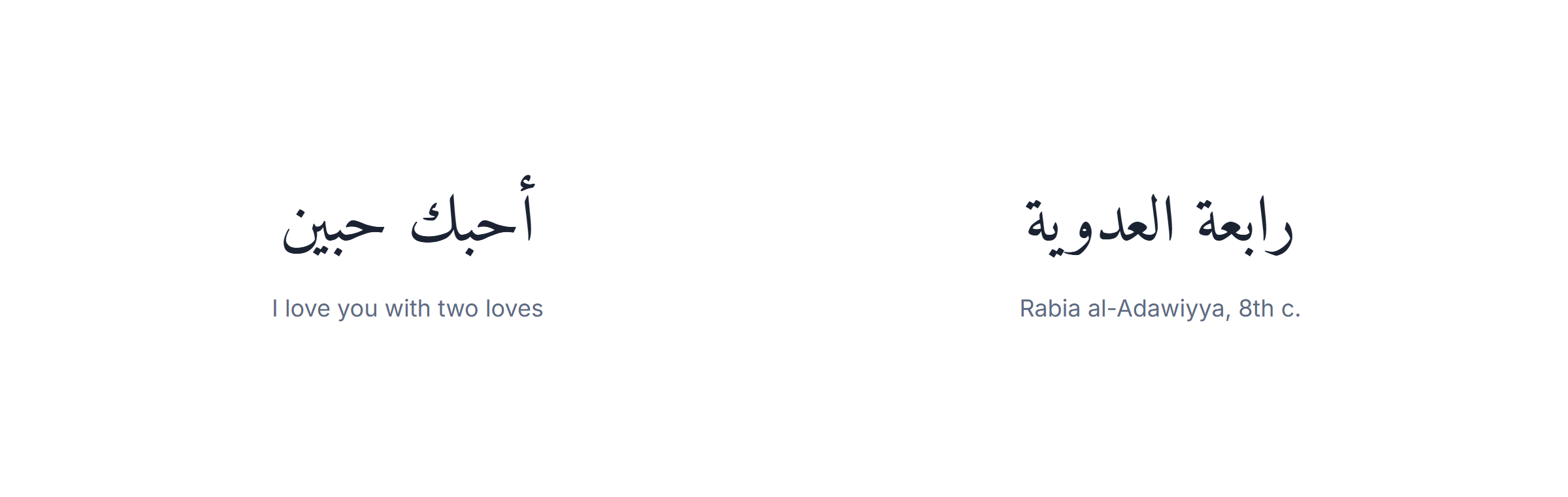
| أحبك حبين حب الهوى وحب لأنك أهل لذاكا | I love you with two loves: a love of longing, and a love because you are worthy of it | Rābiʿa al-ʿAdawiyya, 8th century — originally devotional, now widely quoted romantically |
| وعين الرضا عن كل عيب كليلة | The eye of contentment is blind to every fault | ʿAbdullāh ibn Muʿāwiya; the Arabic ancestor of “love is blind” |
| إن الطيور إذا اجتمعن على البلابل غلبنها | When the birds gather against the nightingales, they overcome them | Classical; on the many defeating the gifted few |
The second of these Arabic quotes deserves its context. Rābiʿa al-ʿAdawiyya was an eighth-century mystic and the “you” in her verse is God, not a person. It is now one of the most-quoted romantic lines in Arabic, which is a fair thing for a language to do with its own poetry — but if you use it, knowing where it came from is the difference between quoting and copying.
The expressions people actually say all day
The two that are easiest to get wrong
- In shāʾ Allāh — often a polite no, not a yes.
- Mā shāʾ Allāh — close to obligatory when praising a child.
Why these matter more than the famous Arabic quotes
- You will hear all seven within an hour of arriving anywhere Arabic is spoken.
- Each expects a specific reply, so getting one wrong is noticeable.
- None appears in a quote list, because none looks good on a poster.
If you want the phrases you will genuinely hear rather than the Arabic quotes that look good on a poster, these are them. They are formulaic — closer to “bless you” than to a proverb — and they carry the conversation.
| Arabic | Said | When, and what it really signals |
|---|---|---|
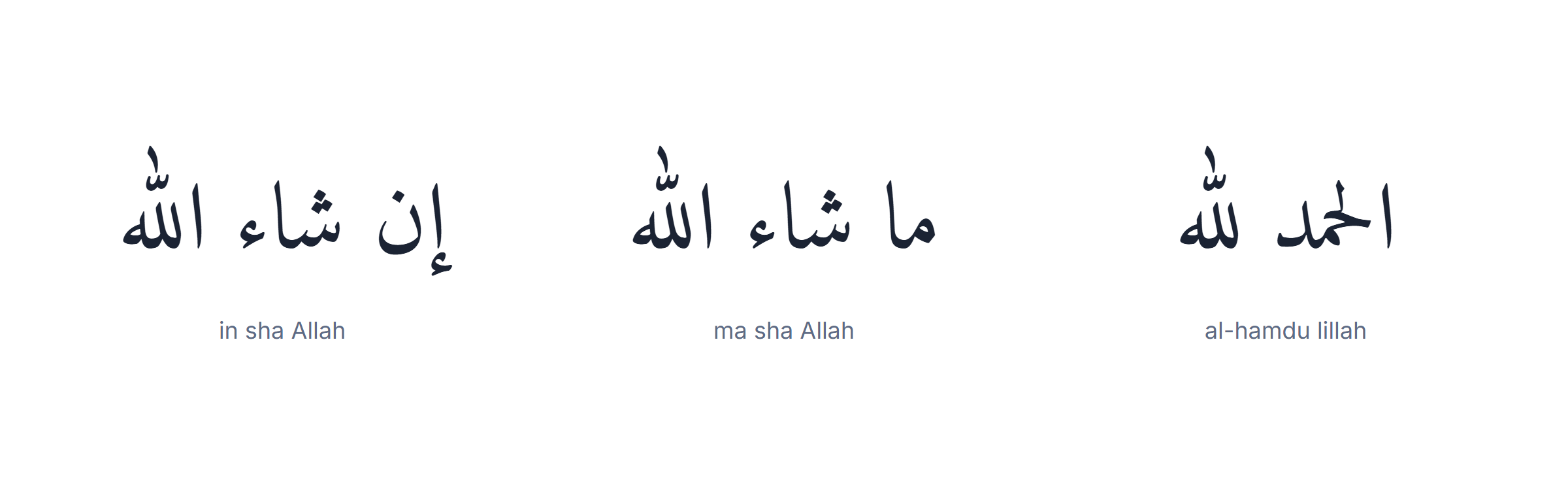
| إن شاء الله | in shāʾ Allāh | “If God wills.” Used for any future plan — and, very often, as a polite way of saying no. |
| ما شاء الله | mā shāʾ Allāh | Said when praising something, especially a child or a possession, to avert envy. Omitting it when complimenting can genuinely unsettle people. |
| الحمد لله | al-ḥamdu li-llāh | “Praise be to God.” The default answer to “how are you”, regardless of how you are. |
| يعني | yaʿnī | “I mean” / “sort of”. The most-used filler word in the language. |
| يا سلام | yā salām | “Wow.” Genuine admiration, or heavy sarcasm, depending entirely on tone. |
| الله يعطيك العافية | Allāh yaʿṭīk al-ʿāfya | “May God give you health.” Said to anyone working — a shopkeeper, a driver, a colleague. |
| تسلم إيدك | tislam īdak | “May your hand be safe.” Said to whoever cooked, made or fixed something. |
Two of these Arabic quotes are worth understanding properly because misreading them causes real misunderstanding. In shāʾ Allāh is often a soft refusal — a plan agreed with it and no follow-up was usually a decline, and pressing for a firmer answer reads as rude. And mā shāʾ Allāh is close to obligatory when praising a child; a compliment without it can be heard as inviting the evil eye rather than as kindness.
None of these belongs in a list of beautiful Arabic quotes, which is exactly why they are worth more than the list. If you want the vocabulary rather than the formulas, our common Arabic phrases and Arabic greetings guides cover the paired responses each one expects.
Dialect proverbs, by region
How to use a regional one safely
- Use it with people from that region, or explain it.
- Do not mix it into formal Standard Arabic writing.
- Check the wording locally — regional Arabic quotes vary town to town.
Why regional Arabic quotes do not travel
- The vocabulary is dialect, not Standard Arabic.
- The imagery is local — camels, bees, monkeys by geography.
- A proverb is fixed, so it cannot be paraphrased around a gap.
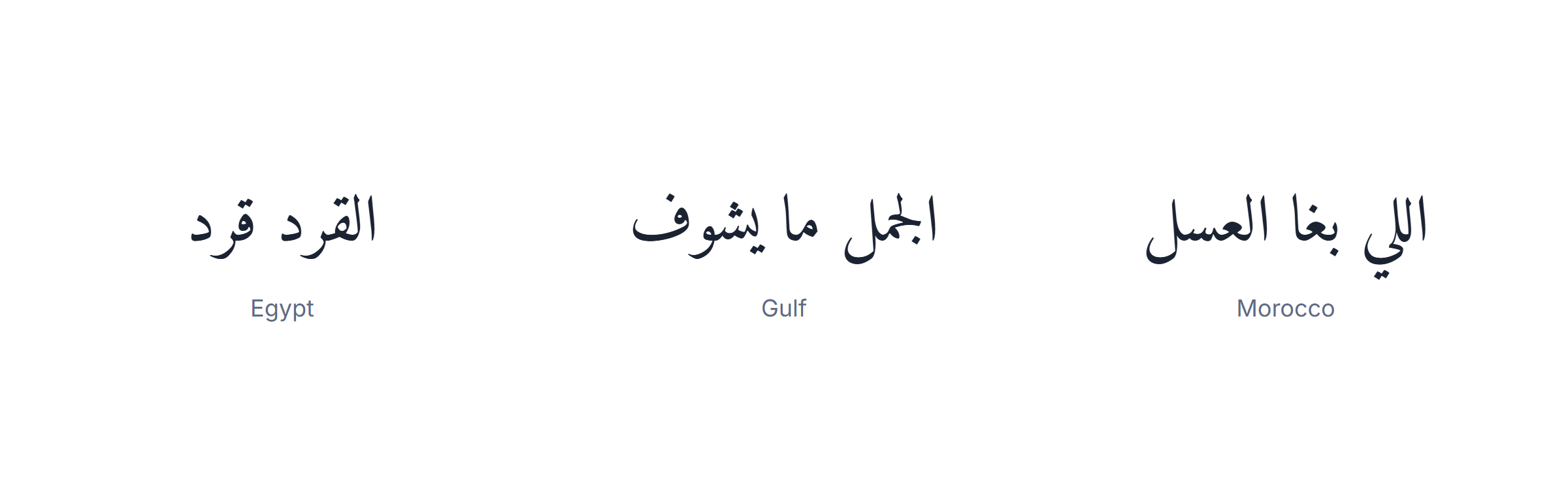
The Arabic quotes above are classical and travel everywhere. These do not — each is strongly associated with one region, and using one outside it will get you a blank look.
| Region | Arabic | Meaning |
|---|---|---|
| Egypt | اللي يشوف بلوة غيره تهون عليه بلوته | Whoever sees another’s trouble finds his own lighter. |
| Egypt | القرد قرد ولو طوقوه بالذهب | A monkey is a monkey even if you ring it with gold. On appearances. |
| Levant | ما بتصير كل الأيام سوا | Not every day is the same. Said to someone having a bad stretch. |
| Levant | تا تجي وتا تروح بتكون خلصت | By the time it comes and goes, it is finished. On worrying about the inevitable. |
| Gulf | الجمل ما يشوف عوجة رقبته | The camel does not see the crookedness of its own neck. |
| Morocco | اللي بغا العسل يصبر لقريص النحل | Who wants honey must endure the bees’ sting. |
| Morocco | الصبر مفتاح الفرج والعجلة من الشيطان | Patience is the key to relief; haste is from the devil. The local extension of the classical line. |
A pattern worth noticing across these Arabic quotes: the animals change with the geography. Camels and falcons carry the Gulf proverbs, bees and honey carry the Moroccan ones, and Egyptian proverbs lean on monkeys and donkeys. A proverb is a compressed piece of a particular landscape, which is another reason they stop working a border away.
The Moroccan examples show the vocabulary problem plainly: bgha for “wanted” and yṣbar for “be patient” are Maghrebi forms that an Egyptian reader can decode from the root but would not produce. This is the same gap described in our guide to Arabic dialects, and proverbs are where it shows most clearly, because a proverb is fixed and cannot be paraphrased around.
Quotes with a named author
What a good attribution contains
- The Arabic, exactly as written.
- A literal reading.
- The poet or “unknown”, never a guess.
- A century, if one is known.
How to attribute Arabic quotes honestly
- Name the poet, and the century if you have it.
- Write “attributed” when the source cannot be traced.
- Never invent a work title to make a citation look complete.

| Arabic | Translation | Author |
|---|---|---|
| إذا الشعب يوما أراد الحياة فلا بد أن يستجيب القدر | If a people one day wills to live, fate must respond | Abu al-Qasim al-Shabbi (Tunisia, 1909–1934) |
| على هذه الأرض ما يستحق الحياة | On this earth there is what makes life worth living | Mahmoud Darwish (Palestine, 1941–2008) |
| أنا لا أكتب لأعيش، أنا أعيش لأكتب | I do not write to live; I live to write | Attributed to Naguib Mahfouz — widely repeated, poorly sourced |
The first two are among the most quoted Arabic quotes of the modern era and both are securely attributed. The third is included as an example of the problem: it circulates everywhere with Mahfouz’s name attached and no reliable source. When a quote cannot be traced, the honest thing is to say “attributed”, which is what a native-language source would do.
The Arabic quotes that are not real
How the invented ones spread
- An English aphorism is translated into Arabic for a graphic.
- The graphic is reshared without the English original.
- Someone captions it “ancient Arabic proverb” and it is now a source.
The test that catches almost all of them
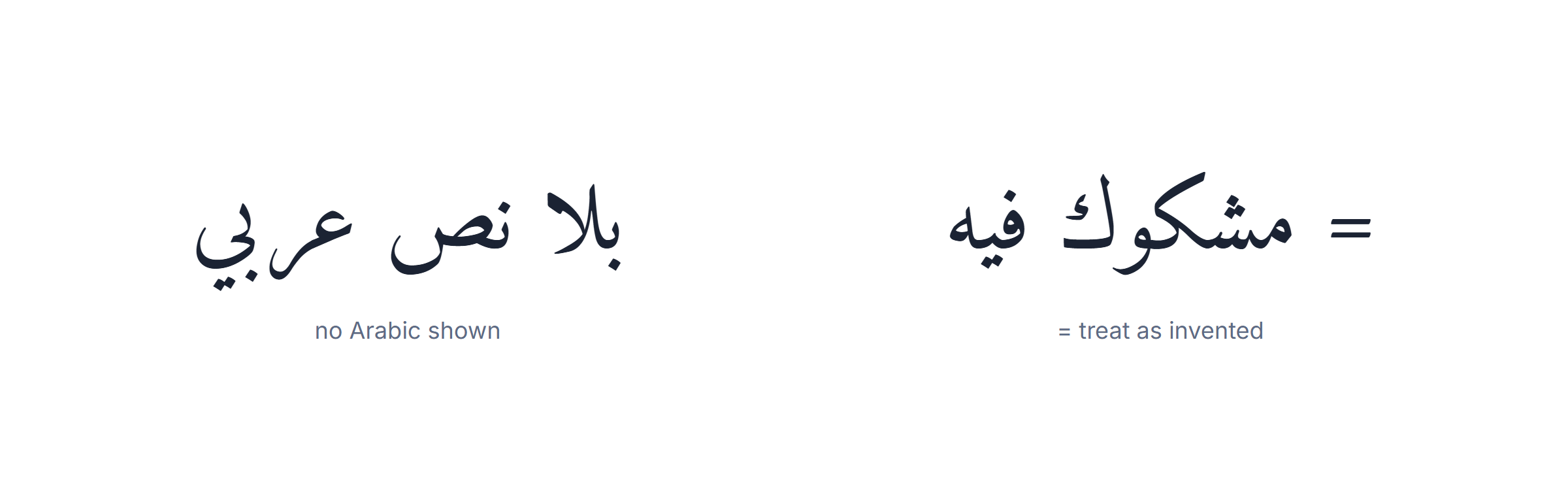
- Ask for the Arabic. A real proverb always has one, and it is short.
- Read it aloud — a translation from English rarely scans in Arabic.
- Search the Arabic string. Real Arabic quotes return Arabic-language results.
The ones to stop repeating
A short and useful list, because these appear in almost every English collection of Arabic quotes.
- Anything captioned “ancient Arabic proverb” with no Arabic text shown.
- English aphorisms translated into Arabic and presented as though they came from it.
- Hadith presented as folk sayings, and folk sayings presented as scripture.
- Quotes attributed to famous authors with no work, year or edition named.
“Trust in God but tie your camel.” This one is real — it is a hadith, not a proverb, and it is usually presented as the latter.
Most “ancient Arabic quotes” in aesthetic fonts on social media. A large share are English aphorisms translated into Arabic and then presented as though they came from it. The tell is the grammar: they read as translations, because they are.
Arabic quotes attributed to “an old Arabic saying” with no Arabic text shown. If the Arabic is not there, there is usually no Arabic. Ask for the original string — a real proverb always has one, and it is short.
Why the translations never quite work
What a good translation still gives you
- The meaning, which is most of the value.
- The use — when someone would actually say it.
- A pointer back to the Arabic, so a reader can check.
The three losses, ranked
- The situation — the largest loss, and invisible in a list.
- Rhyme and rhythm — what made it memorable in the first place.
- Root play — two words sharing a three-consonant root; no English equivalent.
Three properties of Arabic quotes survive translation badly, and knowing which one is failing tells you whether a rendering is bad or merely unavoidable.
Rhyme and rhythm. A large share of proverbs are memorable because they rhyme internally — al-lisān ʿaduww al-insān pairs two words that sound alike. English can keep the meaning or the music, never both, and every published translation quietly chooses the meaning.
Root density. Arabic builds words from three-consonant roots, so a single line can play two words off each other that share a root and therefore a family of meanings. That layer has no English equivalent at all; it simply disappears.
The situation. The largest loss is not linguistic. Most proverbs are deployed at a specific moment as a comment on what somebody just did, and the moment is half the meaning. A list strips exactly that away, which is why collections of translated proverbs read as flat even when every individual translation is accurate.
The practical consequence for anyone using Arabic quotes: give the Arabic, the literal reading and the use, which is the format used throughout this page. Two out of three is where most lists stop, and it is why they are so often wrong in ways their readers cannot detect.
How to use one without embarrassing yourself
Where each register belongs
- Classical proverbs — formal writing, speeches, printed material.
- Dialect proverbs — conversation and messaging, within their region.
- Daily formulas — everywhere, constantly.
Before you quote: the checklist
- Do you have the original Arabic, not only a translation?
- Do you know which of the four categories it is?
- If it has an author, can you name a work or a century?
- Is the register right for where you are putting it?
The four rules
Four rules for using Arabic quotes, in order of how often they are broken.
1. Know which category it is. Calling a hadith a proverb, or a proverb a Quranic verse, is the error native readers notice first and judge hardest.
2. Give the Arabic, not only the translation. Arabic quotes without their original text A quote without its original text cannot be verified by anyone, which is precisely how the invented ones spread.
3. Match the register. Classical proverbs are formal. Dialect proverbs are not, and dropping a Moroccan saying into a formal Arabic paragraph reads exactly as oddly as it would in English.
4. Do not fully vowel it unless it is being taught. Adding harakat to every letter of a proverb marks it as a textbook exercise. Normal written Arabic leaves them off.
Writing them correctly
Three things that break published Arabic quotes
- A font that cannot join — letters arrive detached. Change the font, not the text.
- Latin punctuation — a full stop or question mark lands on the wrong side of the line.
- Screenshotting — a picture of Arabic cannot be searched, selected or read aloud.

The most common technical failure when publishing Arabic quotes has nothing to do with the Arabic. It is that the letters arrive detached — ا ل ص ب ر instead of الصبر — because the destination font cannot draw a connected script. Change the font, not the text.
The second problem with published Arabic quotes is direction. A quotation mark or a full stop typed from a Latin keyboard lands on the wrong side of an Arabic line. Arabic has its own comma ، and question mark ؟, and using them is what makes a quotation look typeset rather than pasted.
Fonts that will not break it
- Amiri or Noto Naskh Arabic for body text.
- Tahoma or Arial when the file goes to someone else.
- Anything, if you export the quote as an image with the font embedded.
Punctuation that belongs to the Arabic
- ، comma · ؛ semicolon · ؟ question mark.
- Latin marks land on the wrong side of the line.
- All three sit on the same layer as the letters on our keyboard.
The final check
A last check worth doing on any Arabic quotes you publish: paste the Arabic back into a plain text box and confirm it still reads correctly. Copying from a design tool frequently reorders or strips characters silently, and a proverb that looks perfect in the artwork can be broken in the file.
If you are producing the Arabic yourself rather than copying it, the Arabic keyboard gives you the punctuation on the same layer as the letters, and the calligraphy generator exports a quote as an image with the font embedded, which is the only reliable way to put one into a design without it breaking on someone else’s machine.