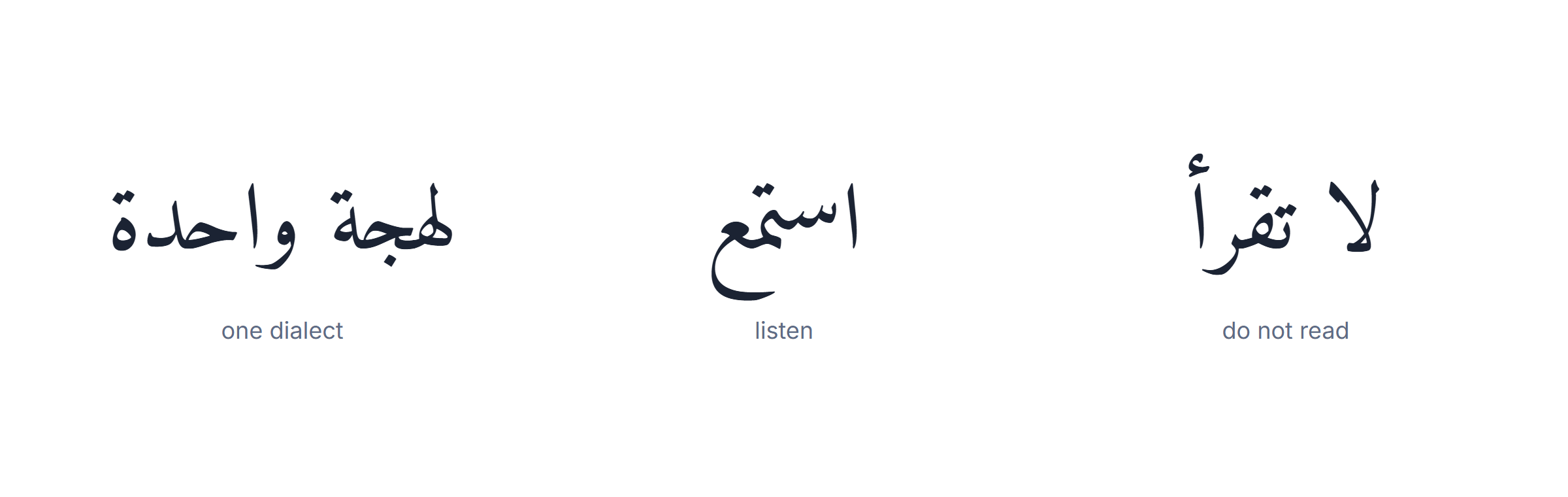
Arabic Slang: 50 Real Words, by Dialect
There is no such thing as Arabic slang in the singular. There are four large slang vocabularies that barely overlap, sitting on top of a written standard that has no slang at all.
What Arabic slang actually is
Slang here is not one thing. It is the informal vocabulary of five large dialect groups that already differ from each other, layered on top of a written standard that has no slang at all. A word that means “cool” in Cairo can mean nothing in Casablanca, and neither will appear in a dictionary of Modern Standard Arabic.
Three layers, and only one of them is slang
- Fusha — the written standard. Formal, taught, and completely slang-free.
- The dialect — the ordinary spoken language of a region. Not slang; it is simply how people speak.
- Arabic slang — the informal register inside a dialect: youth vocabulary, street terms, internet words, expressions a grandmother would frown at.
Most guides confuse the second and third layers. Shnu in Moroccan Darija is not slang, it is the ordinary word for “what”. Zwin for “nice” is closer to slang. The distinction matters because dialect vocabulary is safe everywhere and Arabic slang is not.
Why it changes so fast
It turns over faster than the standard language because it is spoken, young and online. A term that dominated Egyptian social media in 2018 can read as dated now. Any list of Arabic slang, including this one, is a snapshot rather than a reference.
Egyptian Arabic slang
Egyptian is the most widely understood dialect in the Arab world, so Egyptian Arabic slang travels further than any other. Film, television and music carried it everywhere.
| Slang | Arabic | Means | Register |
|---|---|---|---|
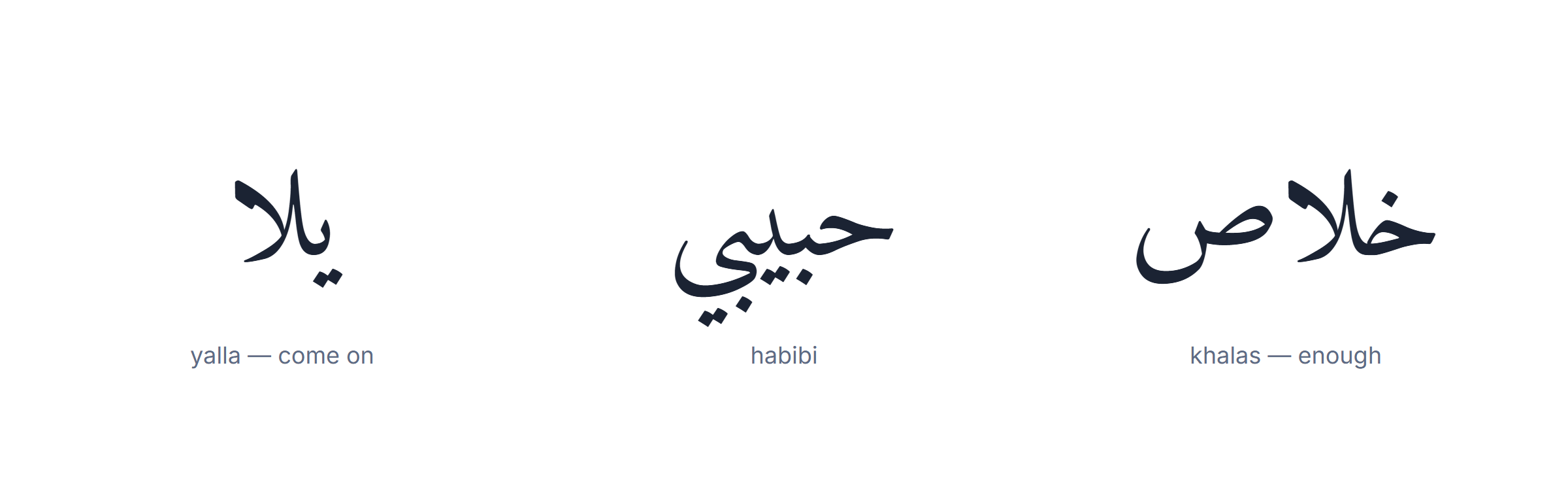
| gamed | جامد | Great, solid, impressive | Everyday |
| tamam | تمام | OK, fine, agreed | Universal |
| yasta | ياسطى | Mate, boss — addressing a man | Street |
| khalas | خلاص | Enough, done, stop | Universal |
| ya3ni | يعني | I mean, sort of — a filler | Universal |
| meshy | ماشي | Fine, works for me | Everyday |
| 3ala fekra | على فكرة | By the way | Everyday |
| bta3 | بتاع | Thing, whatsit, belonging to | Casual |
Where Egyptian Arabic slang comes from
Cairo produced the Arab world’s film industry, and from the 1930s onward Egyptian speech travelled with it. A Moroccan child who has never met an Egyptian still understands Egyptian Arabic slang, because they grew up with it on screen. The reverse is not true, and that asymmetry runs through everything in this article: slang travels in the direction the media travelled.
The second source is Cairo itself. It is one of the largest cities on earth, and dense cities generate informal vocabulary faster than anywhere else — the terms that spread nationally were almost always street terms first.
The two you will hear in the first hour
ya3ni and khalas are so frequent that they cross into other dialects and even into Arabic-accented English. If you learn two pieces of Egyptian Arabic slang, learn those.
Levantine Arabic slang
Syria, Lebanon, Jordan and Palestine share a dialect group, and their Arabic slang is the second most widely understood after Egyptian — carried by drama series rather than cinema.
| Slang | Arabic | Means | Where |
|---|---|---|---|
| shu | شو | What | All Levant |
| ktir | كتير | Very, a lot | All Levant |
| ya zalameh | يا زلمة | Man! — surprise or protest | Jordan, Palestine |
| 3anjad | عنجد | Seriously, for real | All Levant |
| tayeb | طيب | OK then, fine | All Levant |
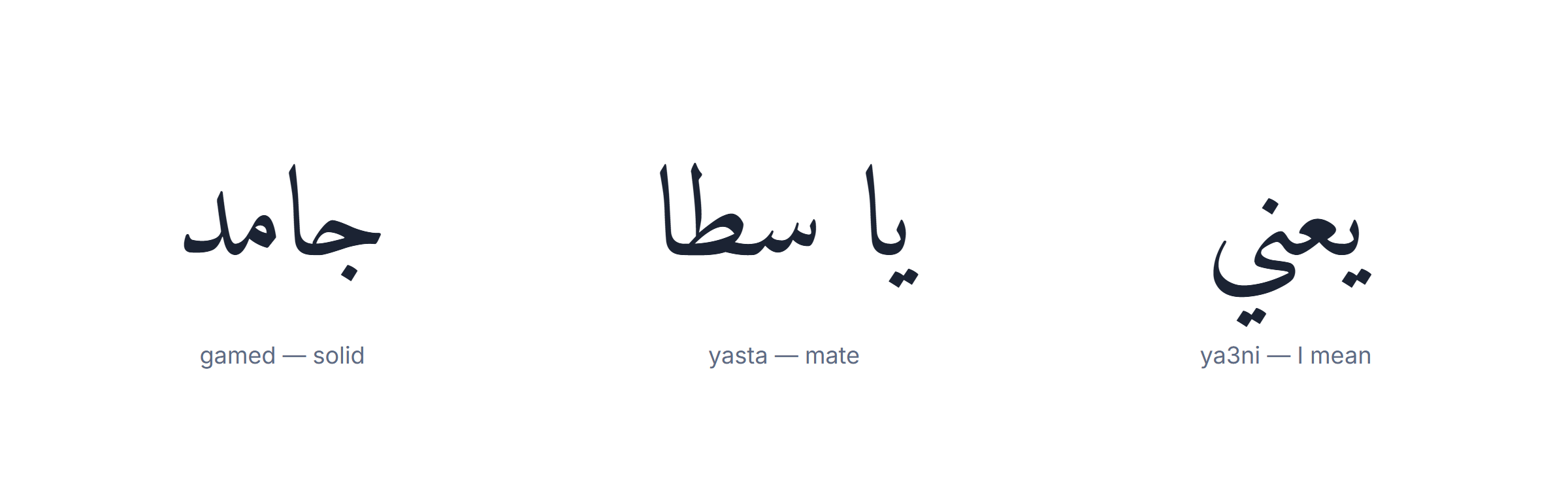
| habibi | حبيبي | Dear — friendly, not romantic | Everywhere |
| bala | بلا | Without, forget it | All Levant |
What makes Levantine slang recognisable
Two sounds mark it instantly. The qaf collapses to a glottal stop in city speech, so qalb becomes albe. And the vowel at the end of many words lengthens in a way Egyptian does not. Both are grammar rather than slang, but they are what makes Levantine Arabic slang sound Levantine even when the words themselves are shared.
Lebanese speech adds a third marker: heavy French and English code-switching. Merci ktir — thank you very much, one French word and one Arabic — is completely ordinary in Beirut and would sound affected in Damascus.
The habibi problem
habibi is the single most misunderstood word in Arabic slang. It literally means “my beloved”, and learners avoid it for that reason. In practice it is used between men, to strangers, to taxi drivers and in arguments. Treating it as romantic is a bigger error than using it freely.

Gulf Arabic slang
Gulf slang is the most conservative of the four and the least exported, but it is the one you meet at work: Saudi Arabia, the UAE, Kuwait, Qatar, Bahrain and Oman.
| Slang | Arabic | Means |
|---|---|---|
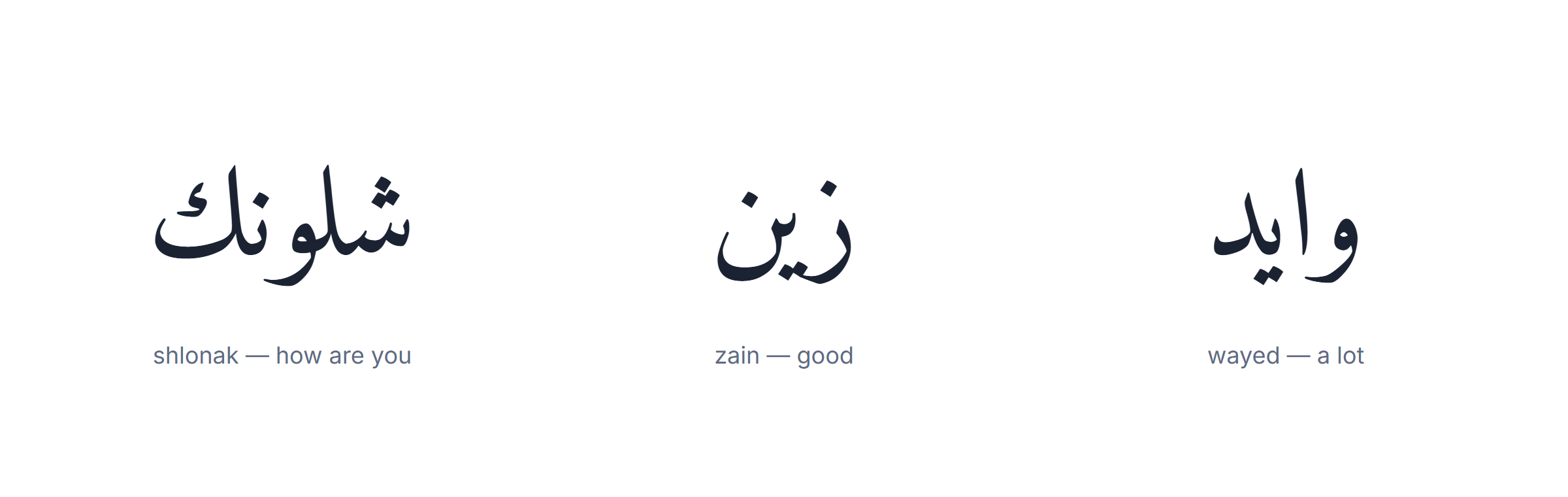
| shlonak | شلونك | How are you — literally “what colour are you” |
| zain | زين | Good, fine, nice |
| wayed | وايد | Very, a lot |
| yalla | يلا | Come on, let’s go |
| 3ad | عاد | A softener, roughly “then” or “well” |
| tara | ترى | Actually, you know |
Why Gulf slang exported the least
There is no Gulf equivalent of Egyptian cinema or Levantine drama, so Gulf Arabic slang stayed local far longer. That is changing: Saudi and Emirati production has grown quickly since about 2018, and terms that were once purely local are starting to appear in pan-Arab social media.
The Gulf is also the most conservative of the four groups phonetically. It keeps the th sounds that Egyptian flattens and preserves the qaf that the Levant drops, so Gulf speech often sounds closer to the written standard even when the vocabulary is thoroughly informal.
Why shlonak is worth knowing
It is the clearest single marker of Gulf speech. “What colour are you” as a greeting has no parallel in Egyptian or Levantine Arabic slang, and hearing it places a speaker instantly.
Moroccan and Maghrebi Arabic slang
Maghrebi is the outlier. Moroccan, Algerian and Tunisian slang carries French and Amazigh vocabulary that no eastern speaker will recognise, which is why Moroccans understand Egyptians far better than the reverse.
| Slang | Arabic | Means | Origin |
|---|---|---|---|
| zwin | زوين | Nice, pretty, good | Maghrebi |
| bezzaf | بزاف | A lot, too much | Maghrebi |
| wakha | وخا | OK, alright | Moroccan |
| daba | دبا | Now | Moroccan |
| safi | صافي | Enough, done | Moroccan |
| bsahtek | بصحتك | Well done, enjoy | Maghrebi |
| ghi | غي | Just, only | Moroccan |
The French layer
Maghrebi Arabic slang borrows from French so heavily that a French speaker can often catch the subject of a Moroccan conversation without knowing any Arabic. Tomobil for car, tilifun, servita for towel, forsheta for fork. These are not code-switching in the Lebanese sense — they are fully naturalised Arabic words that happen to have French roots, and they take Arabic plurals.
The Amazigh layer
Underneath the French sits Amazigh (Berber), which contributed vocabulary, some sounds and part of the reason Maghrebi drops short vowels so aggressively. Kteb for “he wrote” against Standard kataba is not laziness; it is a different phonological system.
Between the two layers, Maghrebi Arabic slang is genuinely opaque to eastern speakers — not merely accented, but built from words they have never heard.
Our Darija keyboard handles the extra letters Moroccan writing uses, and the Arabic dialects guide explains why the Maghreb sits so far from the rest.

The Arabic slang that works everywhere
A small set of words crosses every dialect border. If you are learning Arabic slang and do not know which dialect you will need, learn these first — they are understood from Casablanca to Muscat.
- yalla — come on, let’s go. Probably the single most useful word in this article.
- khalas — enough, done, stop.
- habibi / habibti — friendly address, not romantic.
- inshallah — God willing. Also, frequently, a polite no.
- mashallah — said on seeing something good, partly to avert envy.
- wallah — I swear. Used for emphasis far more than for oaths.
- ya3ni — I mean, sort of.
- shukran — thank you, and the one word here that is not slang at all.
The religious formulas are not optional politeness
Three of the eight — inshallah, mashallah, wallah — are religious in origin and are used by speakers of every faith and none. They function as grammar rather than piety: mashallah after a compliment is closer to touching wood than to a prayer. Omitting them where they are expected reads as cold, which is a stronger effect than most learners expect from what a textbook calls optional.
The inshallah trap
Learners take it literally. In practice inshallah ranges from genuine hope to a soft refusal, and the difference is tone. “Will it be ready tomorrow?” answered with a flat inshallah usually means no.

Internet and texting slang
Online Arabic slang is written in Latin letters with numbers standing in for sounds the Latin alphabet lacks. This is arabizi, and the numbers are not random — each was chosen because it looks like the Arabic letter.
| Number | Arabic letter | Sound |
|---|---|---|
| 2 | ء | hamza, a glottal stop |
| 3 | ع | ayn |
| 5 | خ | kh |
| 6 | ط | emphatic t |
| 7 | ح | hard h |
| 8 | غ | gh |
| 9 | ص | emphatic s |
Why arabizi persists even though Arabic keyboards exist
It started as a workaround: early phones had no Arabic support. It survived because it is faster on a Latin keyboard, because it is dialect-friendly in a way the standard script is not, and because it signals informality. Writing a message in full Arabic script to a close friend can read as oddly formal — the script choice is itself part of the register.
It has real costs. Arabizi is not searchable, not consistent between writers, and invisible to every Arabic-language tool. Two people can spell the same word four ways in one conversation.
Common written forms
- 3ala — on. 7abibi — habibi. 5alas — khalas.
- ma3lesh — never mind, sorry.
- tslm — thanks, clipped from tislam.
- lol and ahaha — borrowed straight from English.
To convert between the two, our transliteration tool takes Latin letters and numbers and returns Arabic script.

Iraqi and Sudanese slang, briefly
Two more groups fall outside the big four and are worth recognising even if you never learn them.
Iraqi
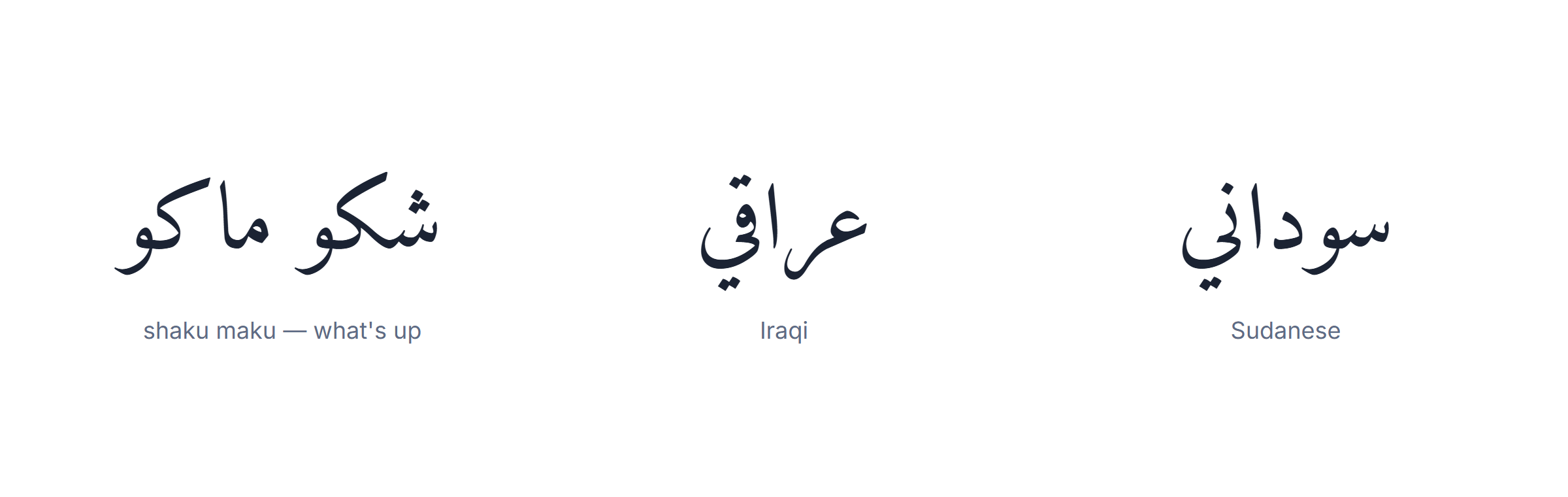
- shaku maku — what’s up, literally “what is there, what is not”. The single most recognisable Iraqi phrase.
- zain — good, shared with the Gulf.
- aku / maku — there is / there is not.
- hwaya — a lot.
Sudanese
- tamam — fine, shared with Egyptian.
- kwayis — good.
- yatak — an address form with no eastern equivalent.
Sudanese Arabic is grammatically close to Egyptian and phonetically distinct enough that Egyptians sometimes struggle with it. Iraqi sits between Gulf and Levantine and borrows visibly from Persian and Turkish — another case of Arabic slang recording who a region traded with.
Slang ages, and it ages fast
The turnover in Arabic slang is faster than in the standard language and faster than most learners expect. Terms that were everywhere five years ago now mark the speaker as older.
| Layer | Lifespan | Example type |
|---|---|---|
| Religious formulas | Centuries | inshallah, mashallah |
| Core dialect words | Generations | shu, bezzaf, wayed |
| General slang | 10-20 years | gamed, zwin |
| Youth slang | 2-5 years | whatever is current |
| Meme vocabulary | Months | platform-specific |
The practical rule
Learn the top three rows and let the bottom two come from actually talking to people. Any list of Arabic slang, this one included, is reliable for the durable layers and out of date on the volatile ones the day it is written.
How to tell which layer a word is in
- If your teacher uses it, it is durable.
- If a news anchor would never say it but a taxi driver would, it is general slang.
- If you only ever saw it written online, treat it as youth slang and do not use it in speech.

Register: when slang is warm and when it is rude
Arabic marks social distance more explicitly than English does, and using Arabic slang across the wrong distance is the fastest way to give offence without saying anything offensive.
| Speaking to | Slang | Why |
|---|---|---|
| A friend your age | Expected | Formal speech reads as cold |
| A shopkeeper, a driver | Fine, warm | habibi and yalla are normal here |
| Someone older | Light only | Use the polite address forms |
| A manager, a client | Avoid | Dialect yes, slang no |
| An official, in writing | Never | Standard Arabic only |
The safest posture for a learner
Understand a lot of Arabic slang and produce a little. Comprehension carries no social risk whatsoever; production carries all of it. Learners who invert this — producing slang they have only read — are the ones who end up apologising.
One thing that is always safe
The universal eight in the section above. Yalla, khalas and habibi are used across every register and every dialect, and no one has ever been offended by shukran.

How to test whether a slang word is safe to use
The fastest check costs nothing and avoids nearly every embarrassing mistake. Run a new word through all four questions before you say it to anyone.
- Who did you hear it from? A word learned from a friend your age in a private message is not automatically fine in a shop, an office or a family home.
- Which country was it from? A word that is affectionate in one dialect can be an insult two borders away, and the speaker will not always tell you.
- Does anyone older use it? If nobody over thirty says it, it is generational, and it will date the way every generational word does.
- Is there a neutral word that does the same job? If yes, use that one until you have heard the slang used naturally several times.
- Written and spoken registers differ more here than in English — plenty of words are normal in speech and jarring in a message.
- Song lyrics and film dialogue are deliberately stylised, so they are a poor guide to what is ordinary.
- When in doubt, the standard word is never wrong. It may sound formal; formal is a much smaller problem than rude.
Quick reference: what travels and what does not
- Travels everywhere: yalla, habibi, khalas, mabrouk, inshallah. Understood from Casablanca to Muscat without adjustment.
- Travels with a shift in tone: words for friend and brother — always understood, not always equally casual.
- Does not travel: most food, money and transport words, which are local almost everywhere.
- Travels but dates you: internet-era coinages, which move faster than any other category.
- If you only ever learn ten of these, learn the ones in the first group — they buy the most comprehension per word.
- Learn the local ten wherever you actually are; they are the ones you will hear hourly.
- Everything else can wait until you have heard it used twice.
Quick reference: one word per dialect, if you learn nothing else
- Egyptian: the all-purpose filler that stands in for any noun you have forgotten. You will hear it within the hour.
- Levantine: the softening particle that turns an order into a request.
- Gulf: the greeting that has no eastern equivalent and places a speaker instantly.
- Moroccan: the French-derived word that a French speaker will recognise before an Egyptian does.
- Each of these is neutral in tone, so none of them can embarrass you.
- Each is high frequency, so you get feedback on your pronunciation quickly.
Quick reference: where to actually hear it
- Egyptian — film and television, which is why it travels.
- Levantine — drama series, same mechanism, one generation later.
- Gulf — social platforms rather than broadcast.
- Maghrebi — music, and conversation with people who will switch to French the moment they hear you struggle.
- Subtitles help with comprehension and hurt with listening. Use them on the second pass.
- Ten minutes daily beats an hour weekly by a wide margin for a spoken register.
Quick reference: four things slang is not
- Dialect vocabulary — ordinary words of a region, safe with anyone.
- Accent — the same word pronounced differently is still the same word.
- Loanwords — French and English borrowings are often perfectly neutral.
- Religious formulae — used constantly, and not informal at all.
- Mistaking any of these for slang makes learners avoid words that were never risky.
- The test is register, not familiarity: if a newsreader would say it, it is not slang.
Quick reference: a five-minute daily routine
- Two minutes listening to something unscripted.
- Two minutes repeating one phrase until it sounds ordinary.
- One minute writing it down in Latin letters the way you would text it.
- Do it in one dialect only for the first month.
- Add a second dialect for comprehension, never for production.
- Five minutes every day beats thirty minutes on Sunday, because a spoken register is maintained by contact rather than by study.
Quick reference: register, from safest to riskiest
- Standard word — never wrong, occasionally stiff.
- Widely shared slang — safe with peers, fine in most shops and taxis.
- Regional slang — safe where it belongs, unpredictable outside it.
- Youth and internet slang — safe among people your age, odd elsewhere.
- Anything you learned from a film — assume it is stronger than it sounded.
- Moving one step down this list is almost always the right call when you are unsure.
- Nobody has ever been thought rude for using the standard word.
Arabic slang mistakes worth avoiding
- Using slang from the wrong dialect. Moroccan slang in Dubai is not charming, it is unintelligible.
- Using slang in writing. Written Arabic is Modern Standard Arabic. Slang in a formal email reads the way “gonna” reads in a legal letter.
- Learning insults first. Every list of Arabic slang online leads with them. They are the fastest way to cause offence in a language whose register you cannot yet hear.
- Taking habibi romantically. Covered above, and worth repeating.
- Assuming slang is simpler than the standard. It is not. Dialect grammar is different grammar, not lazy grammar.
The register test
Before using any piece of Arabic slang, ask where you heard it. From a friend your age, in a casual setting — safe. From a song lyric or a comedy sketch — probably not safe. From an online list with no dialect labelled — do not use it at all.
Words that look like Arabic slang and are not
Four categories get filed as slang by learners and are something else entirely. Knowing the difference stops you using a word in a setting where it does not belong.
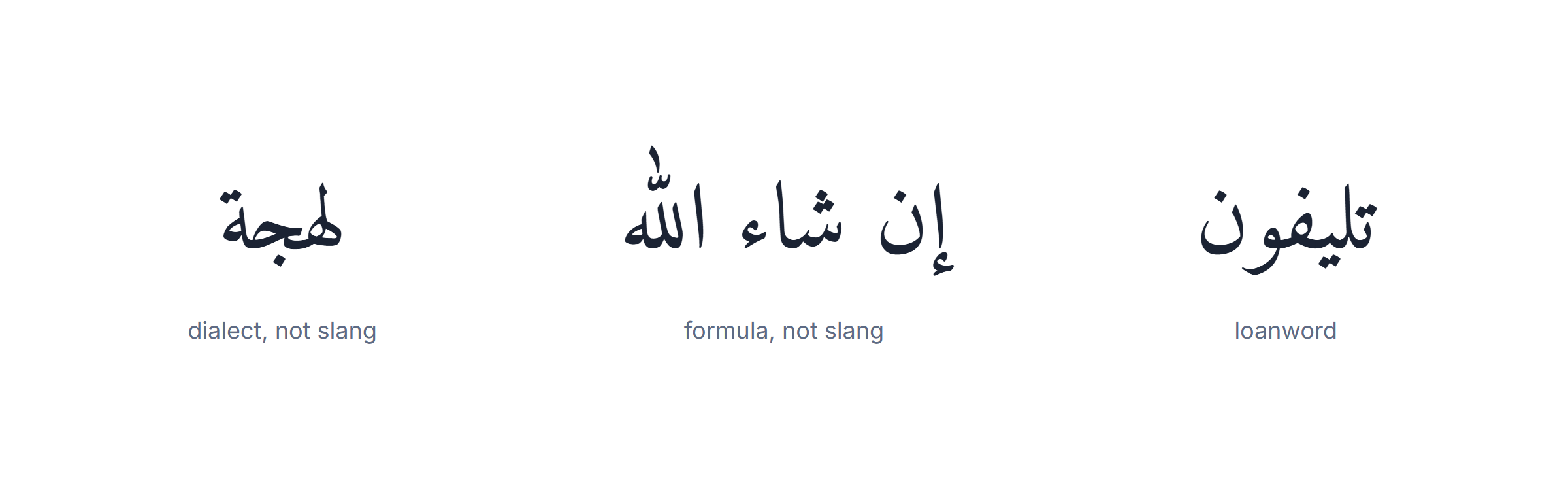
- Loanwords. Kumbyutar, bank, tilifizyun are ordinary vocabulary. They sound informal to an English ear because they are recognisable, but they are neutral in Arabic.
- Dialect grammar words. Bi- on an Egyptian present tense, ka- on a Moroccan one, 3am in Levantine — these are conjugation, not slang.
- Religious formulas. Bismillah, alhamdulillah. Universal and formal, used in speeches and contracts.
- Regional standard. Every country has vocabulary that is standard locally and unknown elsewhere. A Moroccan khizzu for carrot is not slang; it is simply the Moroccan word.
The one test that separates them
Ask whether a news anchor could say it on air. If yes, it is not slang, however unfamiliar it sounds. Arabic slang is defined by register, not by whether you happen to recognise the word.
How to actually learn Arabic slang
- Pick one dialect. Egyptian if you want reach, Levantine if you want media, Gulf if you want work, Maghrebi if you have family there.
- Learn the dialect first, the slang second. Slang without the dialect underneath sounds like a phrasebook.
- Listen, do not read. Arabic slang is a spoken register; written lists give you no sense of when it is appropriate.
- Copy people your own age. Register is social, and imitating the wrong speaker is how learners end up sounding either childish or aggressive.
- Write it down in Arabic script. Arabizi is fine for texting and terrible for memory — the script is what makes the word stick.
Our online Arabic keyboard lets you write the script without installing a layout, and common Arabic phrases covers the neutral register that slang sits on top of.