Arabic Letters: All 28, and How They Join
Twenty-eight letters, every one a consonant, each drawn up to four different ways depending on where it sits. The four shapes are the part that surprises everyone and the part that is easiest once you see the trick.

How many Arabic letters are there
The Arabic letters number twenty-eight. Every one of them is a consonant — the Arabic letters do not include short vowels, which are marked separately or, in ordinary writing, left out entirely.
Three things that make the count of Arabic letters confusing
- Hamza is a sound and a mark rather than a letter with a fixed place, so some counts say 29.
- Alif maqsura and ta marbuta are variants of existing Arabic letters, not new ones.
- Persian, Urdu and Kurdish add letters to the same script — pe, che, zhe, gaf and more. Those are not Arabic letters; they are extensions.
What the 28 do and do not cover
They cover every consonant in Modern Standard Arabic and three long vowels. They do not cover the short vowels, the sounds p, v and hard g, or anything else the language never needed. That is why loanwords get approximated: Paris becomes Baris, because there is no p among the Arabic letters.
All 28 Arabic letters, with names and sounds
| # | Letter | Name | Sound | Joins forward? |
|---|---|---|---|---|
| 1 | ا | alif | long a | No |
| 2 | ب | ba | b | Yes |
| 3 | ت | ta | t | Yes |
| 4 | ث | tha | th as in think | Yes |
| 5 | ج | jim | j — hard g in Egypt | Yes |
| 6 | ح | ha | hard h, from the throat | Yes |
| 7 | خ | kha | ch as in loch | Yes |
| 8 | د | dal | d | No |
| 9 | ذ | dhal | th as in this | No |
| 10 | ر | ra | rolled r | No |
| 11 | ز | zay | z | No |
| 12 | س | sin | s | Yes |
| 13 | ش | shin | sh | Yes |
| 14 | ص | sad | emphatic s | Yes |
| 15 | ض | dad | emphatic d | Yes |
| 16 | ط | ta | emphatic t | Yes |
| 17 | ظ | za | emphatic z | Yes |
| 18 | ع | ayn | a constricted throat sound | Yes |
| 19 | غ | ghayn | like a French r | Yes |
| 20 | ف | fa | f | Yes |
| 21 | ق | qaf | k from the back of the throat | Yes |
| 22 | ك | kaf | k | Yes |
| 23 | ل | lam | l | Yes |
| 24 | م | mim | m | Yes |
| 25 | ن | nun | n | Yes |
| 26 | ه | ha | h | Yes |
| 27 | و | waw | w, long u | No |
| 28 | ي | ya | y, long i | Yes |
For how each of these actually sounds, including the six that have no English equivalent, see Arabic alphabet pronunciation. This page is about the letters as shapes.
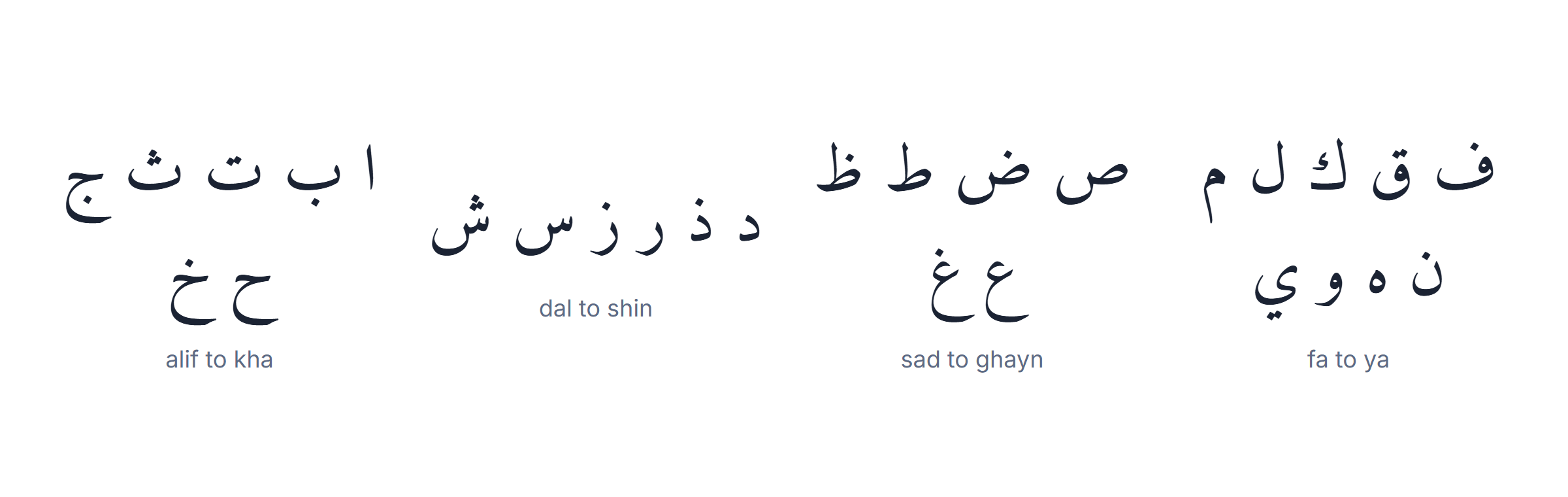
Every letter has up to four shapes
This is the single most important fact about Arabic letters and the one that surprises every beginner. A letter is drawn differently depending on where it sits in the word.
| Position | Example: ayn | When it is used |
|---|---|---|
| Isolated | ع | Standing alone, or after a non-joiner |
| Initial | عـ | Start of a word or joined group |
| Medial | ـعـ | Joined on both sides |
| Final | ـع | End of a word or joined group |
Why four shapes per letter is not as hard as it looks
The four shapes are not four different letters to memorise. In almost every case the core of the letter stays the same and only the connecting stroke changes. Once you can see the core, the four forms collapse into one shape with three tails.
The six that never join forward
alif, dal, dhal, ra, zay, waw. After one of these, the next letter must start fresh, which is why Arabic words sometimes have a visible gap in the middle. That gap is correct writing, not a broken font — and telling the two apart is covered below.

The dots do most of the work
Look at the table of Arabic letters again and a pattern appears: many Arabic letters share an identical body and differ only in dots. This is the most efficient thing about the script and the most dangerous.
| Body | No dots | 1 dot | 2 dots | 3 dots |
|---|---|---|---|---|
| The tooth | — | ب ba (below) | ت ta (above) | ث tha |
| The hook | ح ha | ج jim (below) خ kha (above) | — | — |
| The half-circle | د dal | ذ dhal | — | — |
| The curve | ر ra | ز zay | — | — |
| The teeth | س sin | — | — | ش shin |
| The loop | ص sad | ض dad | — | — |
| The eye | ع ayn | غ ghayn | — | — |
What the dot system means for learning the Arabic letters
You are not memorising 28 unrelated shapes. You are memorising roughly 17 bodies and a dot rule, which is a much smaller job. Group the Arabic letters by body when you learn them and the alphabet gets noticeably shorter.
Why the dots were invented
Early Arabic was written without them. As the language spread to non-native speakers in the seventh century, ambiguity between identical bodies became a real problem — particularly for Quranic recitation — and the dots were added to resolve it. The same reform added the short-vowel marks.
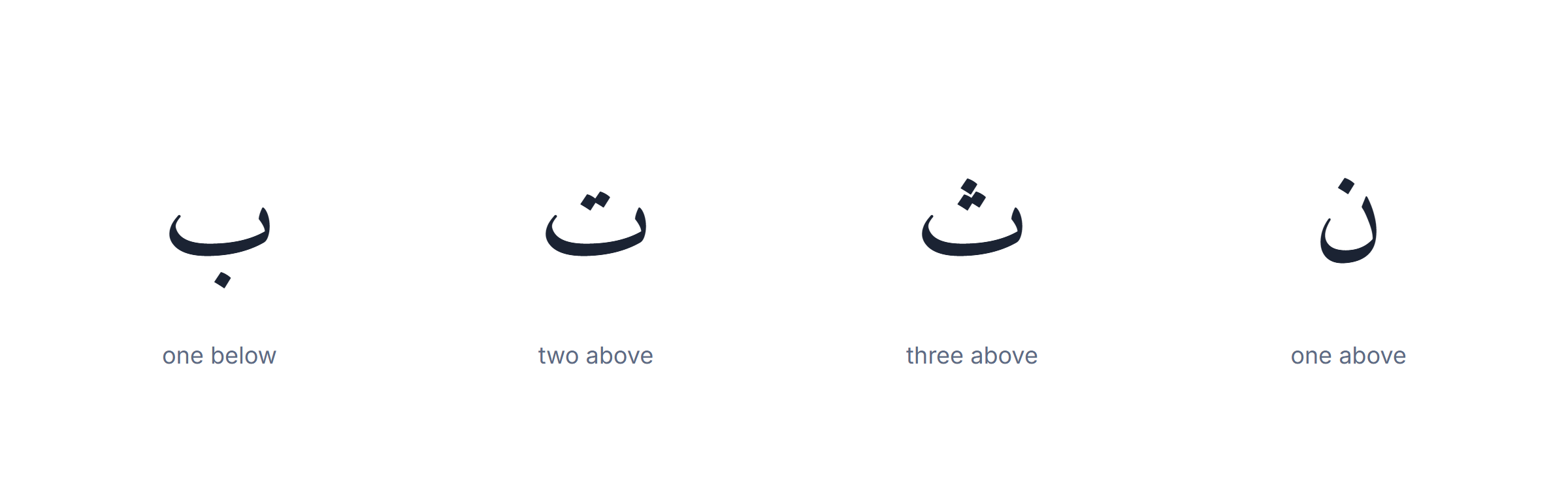
Quick reference: the six that never join forward
- ا alif — long a, and the carrier hamza most often sits on.
- د dal and ذ dhal — one dot apart, and both leave a gap after them.
- ر ra and ز zay — the same pair relationship, below the line.
- و waw — long u, and the reason so many words seem to break in the middle.
Quick reference: dot counts
- One dot above: ن nun, خ kha, ذ dhal, ز zay, غ ghayn, ظ za, ف fa.
- One dot below: ب ba, ج jim.
- Two dots above: ت ta, ق qaf.
- Two dots below: ي ya.
- Three dots above: ث tha, ش shin.
- No dots at all: the majority — and that is why the dotted ones are worth learning as a set.
Where the vowels went
All 28 Arabic letters are consonants, so the vowels have to come from somewhere. They come from two places.
Long vowels are letters
- alif carries long a.
- waw carries long u.
- ya carries long i.
Short vowels are marks, and usually absent
Fatha, kasra and damma sit above or below the letter and are omitted in almost all ordinary writing. A newspaper, a novel and a text message contain no short vowels at all. Readers supply them from context, exactly as an English reader supplies the missing vowels in txt.
Full marking survives in three places: the Quran, children’s books, and teaching material. Our harakat guide covers each mark and our Arabic keyboard has them on their own row.
The practical consequence
The Arabic letters k-t-b written bare can be kataba (he wrote), kutiba (it was written), kutub (books) or kutub as a command. Grammar and context decide, which is why reading Arabic is a different skill from decoding it.

Two alphabetical orders, and when each is used
Arabic has two orderings of its letters, and both are still in use. Neither changes the Arabic letters themselves — only the sequence they are listed in.
| Order | Starts | Based on | Used for |
|---|---|---|---|
| Hija’i | alif, ba, ta, tha | Similar shapes grouped together | Dictionaries, indexes, teaching |
| Abjadi | alif, ba, jim, dal | The older Semitic order | Numerals, outlines, poetry |
Abjad numerals
In the older order each of the Arabic letters carries a numeric value — alif is 1, ba is 2, jim is 3, and so on up to 1000. This is still used for numbering sections the way English uses (i), (ii), (iii), and it is the reason some Arabic documents label points with letters rather than digits.
Which ordering of the Arabic letters to learn
Hija’i, without hesitation. It is the order of every dictionary and every keyboard reference. Abjadi is worth recognising, not memorising.
Typing the Arabic letters
The Arabic letters are laid out on a keyboard by frequency and hand balance, not by alphabetical order — the same principle as QWERTY, and just as unintuitive at first.
| Latin key | Arabic letter | Latin key | Arabic letter |
|---|---|---|---|
| Q | ض dad | H | ا alif |
| W | ص sad | J | ت ta |
| E | ث tha | K | ن nun |
| R | ق qaf | L | م mim |
| T | ف fa | Z | ئ hamza on ya |
| Y | غ ghayn | X | ء hamza |
| U | ع ayn | C | ؤ hamza on waw |
| I | ه ha | V | ر ra |
| O | خ kha | B | لا lam-alif |
| P | ح ha | N | ى alif maqsura |
| A | ش shin | M | ة ta marbuta |
| S | س sin | G | ل lam |
| D | ي ya | F | ب ba |
You do not have to memorise this
Our online Arabic keyboard shows every letter on screen, so you can click rather than recall, and copy the result anywhere. If you would rather type in Latin letters and have them converted, the transliteration tool does that instead.

When the Arabic letters look wrong
When the Arabic letters render badly, three failures look similar and have completely different causes. Diagnosing them in this order saves a lot of time.
| What you see | Cause | Fix |
|---|---|---|
| EVERY letter standing alone | The application is not shaping Arabic | Change application, or enable the World-Ready composer |
| A gap after one specific letter | Correct writing — one of the six non-joiners | Nothing. It is right. |
| Empty boxes | The font has no Arabic glyphs | Noto Naskh Arabic, Amiri or Arial |
| Text reading backwards | Direction not set | dir="rtl" |
| Marks colliding | Font mark-positioning, or line height too tight | Better font, or line-height 1.8 |
The distinction that matters most when Arabic letters look broken
A gap after alif, dal, dhal, ra, zay or waw is correct. A gap after every letter is a shaping failure. Learners report the first as a bug constantly, and the six non-joiners are the whole explanation. More on choosing a font that renders the Arabic letters properly in our Arabic fonts guide.
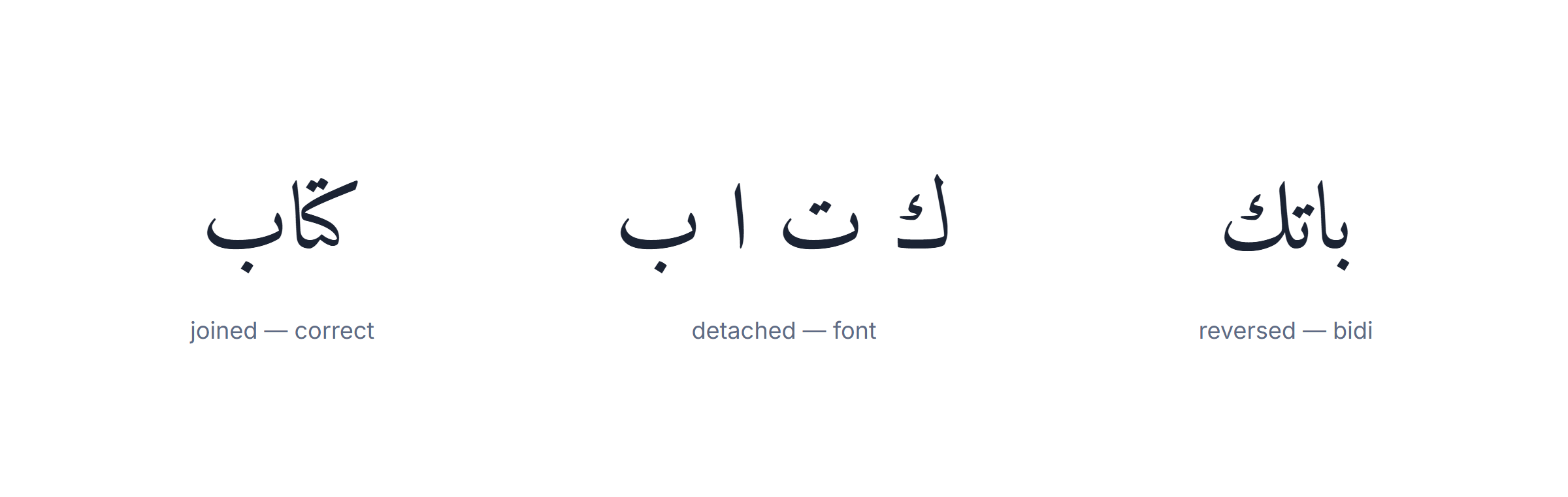
If a letter will not render
- Check the font first — a missing glyph is a font problem, not an encoding one.
- Check the direction second — text that reads backwards is a direction problem.
- Check the copy-paste source last — some tools strip the joining information.
If the letters are joined wrongly
- Isolated forms strung together usually mean the text was pasted from an image tool.
- Reversed order usually means the app is not bidi-aware.
If you cannot type one at all
- Use an on-screen keyboard rather than hunting for a key mapping.
- Learn the four or five keys you use most; the rest can stay on screen indefinitely.
Three habits of people who read fluently
- They read the skeleton first and the dots second.
- They guess from context and correct, rather than decoding letter by letter.
- They read out loud far more than beginners do.
The order to learn them in
Alphabetical order is the worst possible order in which to learn the Arabic letters, because it front -loads four letters that look almost identical.
- Start with the distinctive shapes. mim, waw, lam, alif, kaf — no two look alike.
- Then take the bodies in groups. ba/ta/tha together, jim/ha/kha together, dal/dhal, ra/zay, sin/shin, sad/dad. Learn the body once and the dots second.
- Then the six non-joiners as a set, because they behave as a set.
- Then the throat letters — ayn, ghayn, ha, kha, qaf. These are the hard sounds and they are easier once the shapes are already automatic.
- Write, do not just read. The four positional forms only stick if your hand makes them.
Roughly how long it takes
Most learners can recognise all 28 Arabic letters in isolation within a week and read simple joined words within a month. The shapes are not the slow part — the throat consonants and the missing short vowels are. Our typing test is a straightforward way to check whether recognition has become automatic.
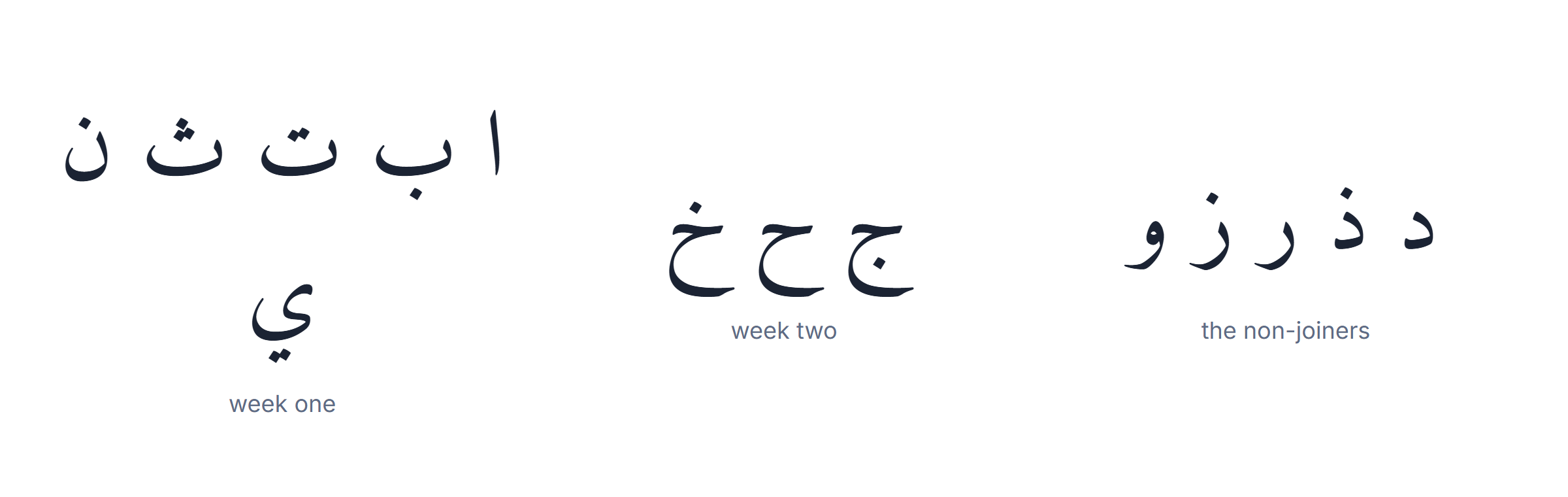
Getting started: your first week
Most people who give up do it in the first ten days, and almost always for the same reason: they try to memorise all twenty-eight at once, in alphabetical order, out of context. That is the hardest possible order. A week is enough to read short words if you spend it on the right things.
A seven-day plan that works
| Day | What you learn | Why this order |
|---|---|---|
| 1 | ا ب ت ث ن ي | One shape, four dot positions. You learn the dot system on day one instead of memorising six unrelated forms. |
| 2 | ج ح خ | Same skeleton again, and it introduces the two throat sounds English does not have. |
| 3 | د ذ ر ز و | The non-joiners. Learning them together explains every gap you will see inside words. |
| 4 | س ش ص ض | Two more skeletons, two more dot pairs, and your first emphatic consonants. |
| 5 | ط ظ ع غ | The set that sounds foreign longest. Spread over one day rather than mixed into others. |
| 6 | ف ق ك ل م ه | High-frequency consonants that appear in almost every sentence. |
| 7 | Nothing new | Read back. Recognition, not recall, is what you are building. |
What to do each day, in order
- Say the sound out loud before you write it. The shape is a label for a sound, and a label with nothing behind it is much harder to keep.
- Write each new letter joined to a familiar one, never in isolation. Isolated practice teaches a form you will rarely meet in real text.
- Read five real words that use only what you have covered so far. Five is enough; the point is contact with real spelling, not volume.
What to skip in week one
- Short vowel marks. They are learning aids, not part of ordinary text, and they double what you are looking at for no early gain.
- Handwriting speed. Legible and slow beats fast and wrong every time.
- The abjad order. It matters for numerals and old texts, and for nothing you will read this month.
- Grammar of any kind. Cases, roots and verb forms all assume you can already read. They are not week-one material.
How to tell the week worked
- You can point at a word and say where one letter ends and the next begins.
- You recognise a letter you have learned when it appears in the middle of a word, not just alone.
- You can spot the six non-joiners on sight, because they leave a visible gap after them.
- You stop reading right to left consciously and simply do it.
None of that requires you to recite the alphabet. Recitation is a party trick; reading is the skill, and reading is built out of recognition in context.
The emphatic letters, and why they are a separate set
Four of the Arabic letters — sad, dad, ta, za — are called emphatic, and they are the feature that gives Arabic its characteristic sound more than any single consonant does.
| Plain | Emphatic | Difference | Minimal pair |
|---|---|---|---|
| س sin | ص sad | Tongue root pulled back | sayf sword / sayf summer |
| د dal | ض dad | Same, heavier | dall / dall |
| ت ta | ط ta | Same, heavier | tin figs / tin clay |
| ذ dhal | ظ za | Same, heavier | — |
Why they matter beyond pronunciation
Emphatic letters colour the vowels around them. An a next to sad is a darker, further back sound than an a next to sin, without anything being written to say so. This is why Arabic can sound so different from its transliteration: the vowels shift according to which of the Arabic letters they sit beside.
The language is named after one of them
Arabic is called lughat al-dad, the language of dad, because the letter dad was believed to exist in no other language. That is not quite true, but it is a fair measure of how distinctive the emphatic set is.
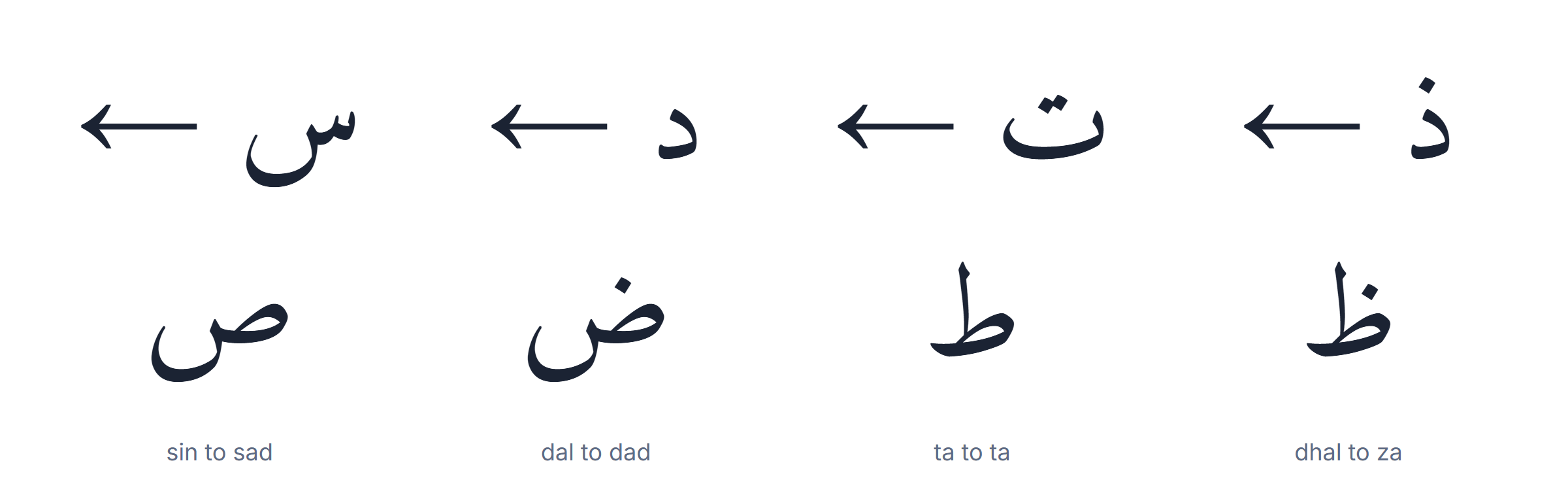
Quick reference: the five confusable pairs
- د dal and ذ dhal — identical but for one dot above.
- ر ra and ز zay — identical but for one dot above.
- ص sad and ض dad — identical but for one dot above.
- ط ta and ظ za — identical but for one dot above.
- ع ayn and غ ghayn — identical but for one dot above.
Five pairs, one rule: the dotted member of each pair is the heavier or emphatic sound. Learn the pairs together and you have learned ten letters for the price of five shapes.
The letters that are not quite letters
Five characters sit alongside the 28 Arabic letters and cause most of the counting confusion.
- Hamza ء — a glottal stop. It has no fixed alphabetical position and rides on alif, waw or ya depending on the vowels around it, which is why it has six written forms.
- Alif madda آ — alif with a long a, written as one character.
- Ta marbuta ة — the feminine ending. Looks like ha with two dots and is pronounced t or h depending on position.
- Alif maqsura ى — a ya without dots that sounds like alif. Appears at the end of words only.
- Lam-alif لا — a required ligature of two letters that gets its own key on the keyboard.
Which of these near-letters you need early
Ta marbuta, immediately — it marks the feminine on thousands of words. Hamza, soon after, because it is genuinely common. The other three can wait until you meet them.
Why hamza is the hardest
Its written form depends on the vowel before it and the vowel after it, which means the rule involves grammar rather than just spelling. It is the single most common spelling error made by native writers, not only learners.

Writing the Arabic letters by hand
Handwriting differs from print in ways that catch out learners who only ever read screens.
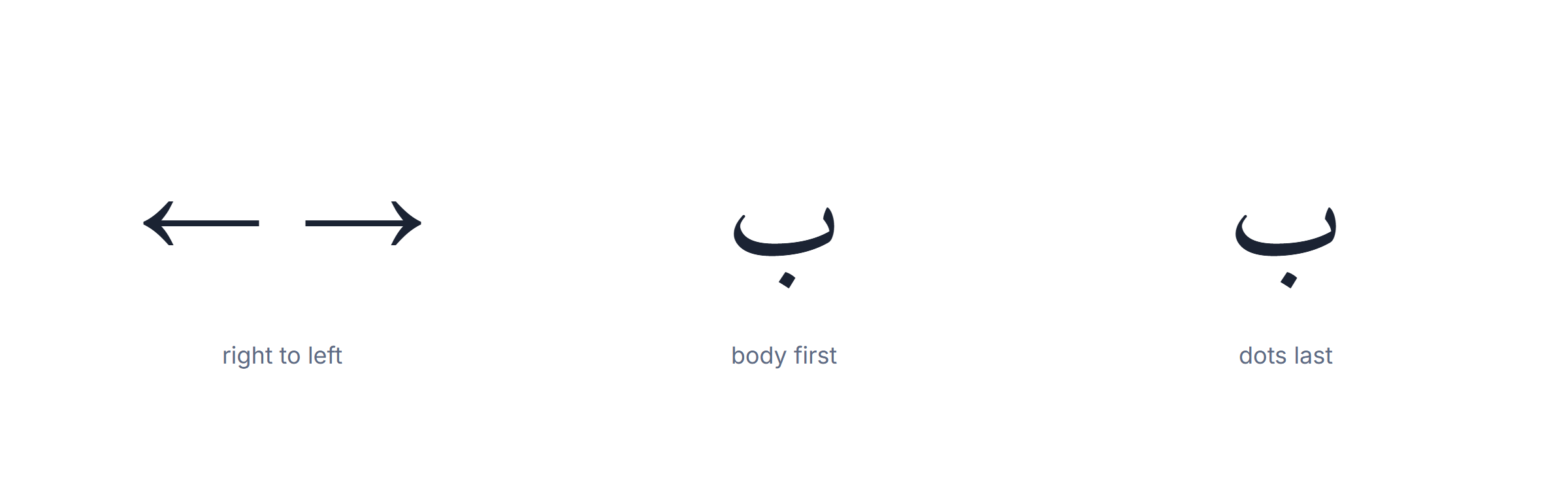
- Right to left, and top to bottom within a letter. The direction of the line is part of the letter’s identity, and a letter drawn in the wrong direction looks wrong even when the shape is right.
- The dots come last. Write the whole word, then go back and add every dot. This is how native writers do it and it is faster.
- Everyday handwriting is Ruqah, which simplifies several shapes and merges some dots into strokes. The letters you learn from a printed Naskh font are not quite the ones you will see on a handwritten note.
- The baseline is a spine. Arabic letters hang from a connecting line rather than sitting on one, and keeping that line straight is most of what makes handwriting legible.
The single most useful habit
Write words, never isolated letters. The four positional forms only become automatic in context, and drilling isolated Arabic letters teaches the one form you will use least.
The same letters, other languages
The Arabic script is the second most widely used writing system on earth, and most of the languages that use it added letters.
| Language | Letters added | For |
|---|---|---|
| Persian | پ چ ژ گ | p, ch, zh, hard g |
| Urdu | Persian set + retroflex ٹ ڈ ڑ | t, d, r said with the tongue curled |
| Kurdish | Vowel letters | Writing short vowels explicitly |
| Pashto | ښ ڑ and more | Retroflex and additional fricatives |
| Ottoman Turkish | Persian set | Abandoned for Latin in 1928 |
What this means in practice
A font that renders all 28 Arabic letters perfectly may still fail on Persian or Urdu, and a keyboard layout for one will not produce the other. If text shows boxes where a Persian p should be, the font is Arabic-only rather than broken — our fonts guide covers which families carry the extensions.
The comparison worth reading
How far Persian and Urdu really diverge from Arabic, beyond the extra letters, is covered in Arabic vs Persian and Arabic vs Urdu.

A five-minute self-test
- Write the six non-joiners from memory. If you cannot, that is the first gap.
- Write ba, ta, tha, nun and ya side by side. They share a body; the dots are the whole difference.
- Write one word containing an initial, a medial and a final form of the same letter.
- Write the four emphatic letters and their plain partners as pairs.
Anyone who can do those four things has the Arabic letters. Everything after that is vocabulary and grammar rather than script.
Next to the Latin alphabet
Almost every difficulty a beginner meets comes from an assumption carried over from the Latin alphabet. Setting the two systems side by side removes most of them in a couple of minutes.
| Question | Latin alphabet | Arabic script |
|---|---|---|
| Direction | Left to right | Right to left — but numbers still run left to right |
| Letter count | 26 | 28, all consonants |
| Vowels | Five written letters | Three long ones are letters; short ones are optional marks |
| Case | Upper and lower | None at all |
| Shape per letter | Two, and they look unrelated | Up to four, and they look related |
| Joining | Print separates, cursive joins | Always joined, print included |
| What the dots do | Decorate i and j | Distinguish whole letters |
Which differences actually cost you time
- Joining. This is the real one. English readers expect a word to be a row of separate shapes; here a word is one connected line, and finding the boundaries is a learned skill.
- Missing short vowels. You will read consonant skeletons and supply the vowels from vocabulary. That feels impossible for about two weeks and then stops being noticeable.
- Sounds with no English equivalent. Roughly six of them. They are a pronunciation problem, not a reading problem — you can read a word correctly long before you can say it well.
Which differences cost nothing
- No capitals. One less system to learn, and sentence starts and proper nouns simply are not marked.
- No silent letters in the English sense — spelling maps onto sound far more predictably than English does.
- Right-to-left stops being conscious within days. Your software already handles it; you are not fighting the machine.
The comparison that misleads people
Transliteration tables that pair each letter with an English one are useful for about a week and then start doing harm. Several sounds have no honest English partner, and once you have attached a wrong sound to a shape it is much harder to remove than to learn correctly the first time.
- Learn the sound from audio, not from the Latin letter next to it in a table.
- Treat any transliteration as a hint about where a word came from, never as a pronunciation guide.
- Drop transliteration entirely as soon as you can read the script slowly — slowly is enough.
Important notes before you memorise anything
A few facts remove most of the confusion people carry for months. None of them are difficult; they are just rarely said early enough.
Counting and naming
- The count you see quoted will be 28, 29 or 30 depending on whether hamza and the variant forms are counted. All three counts describe the same script.
- Letter names are words in their own right, and a name is not the sound. Knowing a name without the sound is memorising an index.
- Some names differ by region and by teaching tradition. This is not a sign that one source is wrong.
What changes and what never changes
- The skeleton never changes. Whatever position a letter is in, the core stroke is recognisably the same — this is why four forms is not four times the work.
- The dots never move. Their number and whether they sit above or below is fixed for the life of the letter.
- Joining is a property of the letter, not of the word or the font. Six letters never join forward, everywhere, always.
Things that are true of the script, not of the language
- The same script is used for Persian, Urdu, Pashto and Kurdish, with extra letters added. Seeing an unfamiliar shape does not mean you missed one.
- Fonts vary far more than in Latin type. A shape you cannot place is often a stylistic ligature.
- Handwriting drops and merges strokes the way Latin cursive does, so printed text and handwritten text are two separate reading skills.
Two habits that pay off immediately
- Always read a letter inside a word. Isolated drilling produces someone who recognises flashcards.
- Type what you read. Typing forces you to identify a letter precisely rather than approximately, and it takes seconds per word.
Five mistakes with the Arabic letters
- Learning them in alphabetical order. It groups the four hardest-to-tell-apart letters at the very start.
- Treating the four shapes as four letters. They are one letter with three different tails.
- Reporting a non-joiner gap as a bug. Six of the Arabic letters never join forward, and the gap is correct.
- Ignoring the dots when writing by hand. Without them, ba, ta, tha, nun and ya are the same shape.
- Expecting short vowels to be written. They are not, outside the Quran and teaching material.